CFA-Level-2 Chartered Financial Analyst Level 2

Loading demo links...

Showing 1–3 of 20 questions

Question 1 (Financial Reporting and Analysis)

SIMULATION

Ota L'Abbe, a supervisor at an investment research firm, has asked one of the junior analysts, Andreas Hally, to draft a research report dealing with various accounting issues.

Excerpts from the request are as follows:

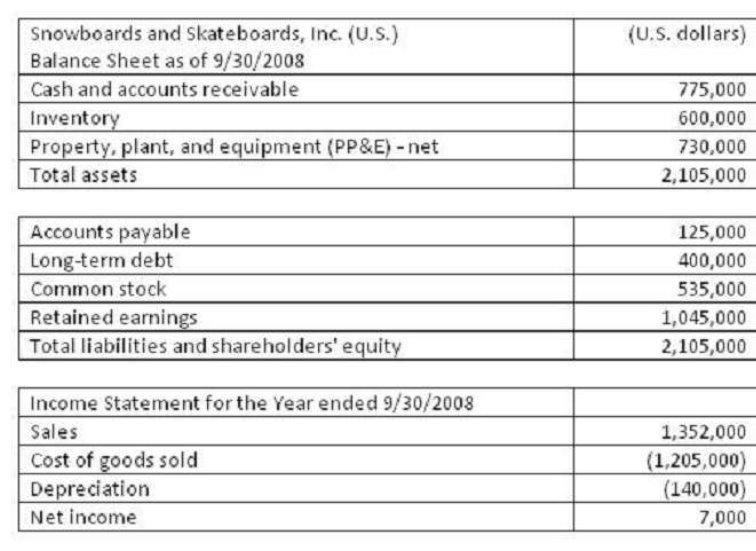
• “There's an exciting company that we're starting to follow these days. It's called Snowboards andSkateboards, Inc. They are a multinational company with operations and a head office based in the resort town of Whistler in western Canada. However, they also have a significant subsidiary located in the United States."

• "Look at the subsidiary and deal with some foreign currency issues including the specificdifferences between the temporal and all-current methods of translation, as well as the effect on financial ratios."

• "The attached file contains the September 30, 2008, financial statements of the U.S. subsidiary.Translate the financial statements into Canadian dollars in a manner consistent with U.S. GAAP." The following are statements from the research report subsequently written by Hally:

Statement 1: Subsidiaries whose operations are well integrated with the parent will use the allcurrent method of translation.

Statement 2: Self-contained, independent subsidiaries whose operating, investing, and financing activities are primarily located in the local market will use the temporal method of translation.

Other information to be considered

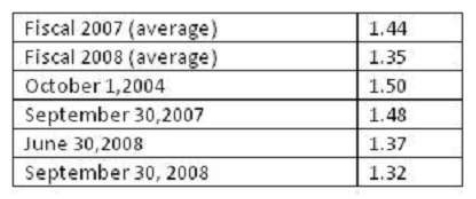
Exchange rates (CAD/USD)

• Beginning inventory for fiscal 2008 had been purchased evenly throughout fiscal 2007. Thecompany uses the FIFO inventory value method.

• Dividends of USD 25,000 were paid to the shareholders on June 30, 2008.

• All of the remaining inventory at the end of fiscal 2008 was purchased evenly throughout fiscal2008.

• All of the PP&E was purchased, and all of the common equity was issued at the inception of thecompany on October 1, 2004. No new PP&E has been acquired, and no additional common stock has been issued since then. However, they plan to purchase new PP&E starting in fiscal 2009.

• The beginning retained earnings balance for fiscal 2008 was CAD 1,550,000.

• The accounts payable on the fiscal 2008 balance sheet were all incurred on June 30, 2008.

• The U.S. subsidiary's operations are highly integrated with the main operations in Canada.

• The remeasured inventory for 2008 using the temporal method is CAD 810,000.

• All monetary asset and liability balances are the same as they were at the end of the 2007 fiscalyear, except that long-term debt was USD 467,700.

• Costs of goods sold under the temporal method in 2008 is CAD 1,667,250.

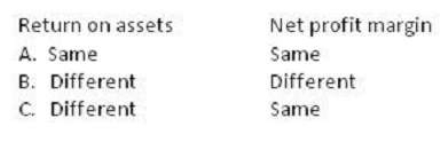
Suppose the parent uses the all-current method to translate the subsidiary for fiscal 2008. Will return on assets and net profit margin in U.S. dollars before translation be the same as, or different than, the translated Canadian dollar ratios?
Answer is in the explanation below.
Question 2 (Financial Reporting and Analysis)

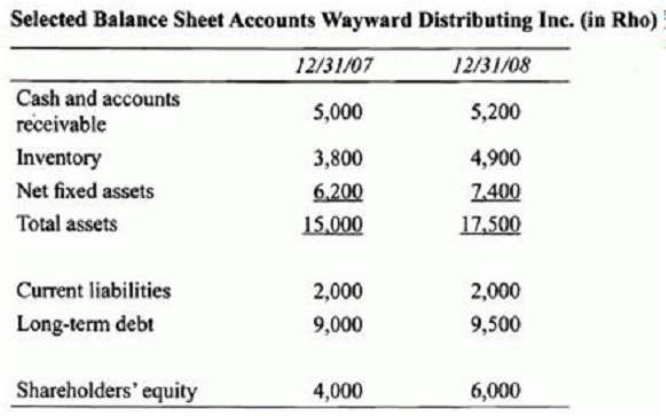
Jenna Stuart is a financial analyst for Deuce Hardware Company, a U.S. company that reports its results in U.S. dollars. Wayward Distributing, Inc., is a foreign subsidiary of Deuce Hardware, which began operations on January 1,2007. Wayward is located in a foreign country and reports its results in the local currency called the Rho. Selected balance sheet information for Wayward is shown in the following table.

Stuart has been asked to analyze how the reported financial results of Wayward will be affected by the choice of the all-current or temporal methods of accounting for foreign operations. She has gathered the following exchange rate information on the $/Rho exchange rate:

• Spot rate on 1/01/08: $0.35 per Rho

• Spot rate on 12/31/08: $0.45 per Rho

• Average spot rate during 2008: $0.42 per Rho

Will the temporal method report a translation gain or loss for 2008, and will that gain or loss be reported on Deuce's income statement or the balance sheet?

Select an option, then click Submit answer.

  • Gain on the balance sheet.

  • Loss on the income statement.

  • Gain on the balance sheet and a loss on the income statement.

Question 3 (Portfolio Management)

Sara Robinson and Marvin Gardner are considering an opportunity to start their own money management firm. Their conversation leads them to a discussion on establishing a portfolio management process and investment policy statements. Robinson makes the following statements:

Statement 1;

Our only real objective as portfolio managers is to maximize the returns to our clients.

Statement 2:

If we are managing only a fraction of a client's total wealth, it is the client's responsibility, not ours, to determine how their investments are allocated among asset classes.

Statement 3: When developing a client's strategic asset allocation, portfolio managers have to consider capital market expectations. In response, Gardner makes the following statements:

Statement 4: While return maximization is important for a given level of risk, we also need to consider the client's tolerance for risk.

Statement 5: We'll let our clients worry about the tax implications of their investments; our time is better spent on finding undervalued assets.

Statement 6: Since we expect our investor's objectives to be constantly changing, we will need to evaluate their investment policy statements on an annual basis at a minimum.

Robinson wants to focus on younger clientele with the expectation that the new firm will be able to retain the clients for a long time and create long-term profitable relationships. While Gardner felt it was important to develop long-term relationships, he wants to go after older, high-net-worth clients.

Which one of the following factors is the least likely to affect the individual investor's ability to accept risk?

Select an option, then click Submit answer.

  • Required spending needs.

  • Financial strength.

  • Behavioral factors.