Compounds containing a hydroxyl group attached to a benzene ring are called phenols. Derivatives of phenols, such as naphthols and phenanthrols, have chemical properties similar to those of phenols, as do most of the many naturally-occurring substituted phenols. Like other alcohols, phenols have higher boiling points than hydrocarbons of similar molecular weight. Like carboxylic acids, phenols are more acidic than their alcohol counterparts. Phenols undergo a number of different reactions; both their hydroxyl groups and their benzene rings are highly reactive. A number of chemical tests can be used to distinguish phenols from alcohols and carboxylic acids.
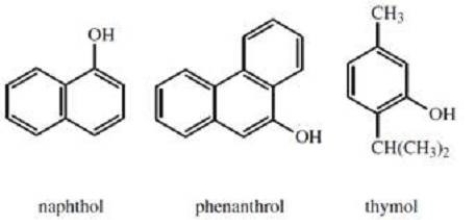
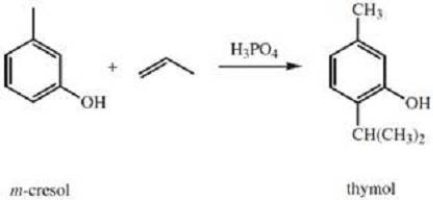
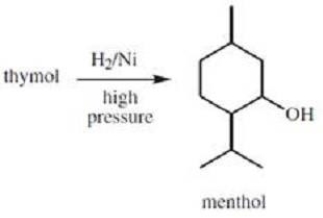
Thymol, a naturally occurring phenol, is an effective disinfectant that is obtained from thyme oil. Thymol can also be synthesized from m-cresol, as shown in Reaction A below. Thymol can then be converted to menthol, another naturally-occurring organic compound; this conversion is shown in Reaction B.
Reaction A
Reaction B
Which of the following shows the order of decreasing acidity among the four compounds below?
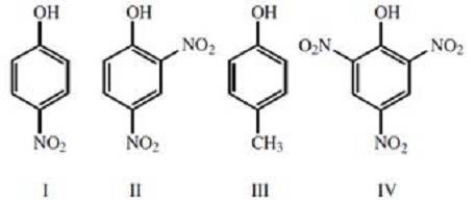
Select an option, then click Submit answer.
-
○
I, III, IV, II
-
○
IV, I, II, III
-
○
IV, III, II, I
-
○
IV, II, I, III