The polymerase chain reaction (PCR) is a powerful biological tool that allows the rapid amplification of any fragment of DNA without purification. In PCR, DNA primers are made to flank the specific DNA sequence to be amplified. These primers are then extended to the end of the DNA molecule with the use of a heat-resistant DNA polymerase. The newly synthesized DNA strand is then used as the template to undergo another round of replication.
 The 1st step in PCR is the melting of the target DNA into 2 single strands by heating the reaction mixture to approximately 94 oC, and then rapidly cooling the mixture to allow annealing of the DNA primers to their specific locations. Once the primer has annealed, the temperature is elevated to 72 oC to allow optimal activity of the DNA polymerase. The polymerase will continue to add nucleotides until the entire complimentary strand of the template is completed at which point the cycle is repeated (Figure 1)
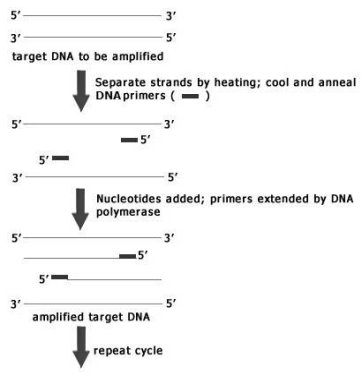
Figure 1
One of the uses of PCR is sex determination, which requires amplification of intron 1 of the amelogenin gene. This gene found on the X-Y homologous chromosomes has a 184 base pair deletion on the Y homologue. Therefore, by amplifying intron 1 females can be distinguished from males by the fact that males will have 2 different sizes of the amplified DNA while females will only have 1 unique fragment size.
Which of the following statements could be used to correctly describe the overall polymerase chain reaction?
Select an option, then click Submit answer.
Reference / correct answer:
It is an anabolic reaction that synthesizes new DNA strands.
This question requires knowledge of the definition of anabolism and catabolism. A catabolic reaction involves the breakdown of macromolecules, whereas an anabolic reaction involves the synthesis of macromolecules from individual building blocks. PCR entails the synthesis (amplification) of a new DNA strand using a DNA template and free nucleotides, therefore, it is an anabolic reaction that synthesizes new DNA strands.
