In 1972, Georges Ungar reported the discovery of a peptide that appeared to transfer learning. Ungar’s claim was based on experiments in which rats placed in a chamber with specially designed dark and light regions were trained to avoid the dark regions of the chamber. Following their training, the rats were killed and brain extracts were prepared. These brain extracts were injected into naive rats which were then observed to acquire the fear of darkness without training. Two hypotheses were proposed to explain these remarkable results:
Hypothesis 1
Ungar concluded that the extracts contained some chemical that transmitted the learned fear of darkness to the naive rats. A fifteen amino-acid polypeptide was isolated from the brain extracts and sequenced. Ungar claimed that this peptide, called scotophobin, was a chemical transmitter of learning. The peptide had the primary structure shown below: C-ser-asp-asn-arg-gln-gln-gly-lys-ser-ala-arg-gln-glygly-tyr-N Scotophobin
Hypothesis 2
Other researchers, who tested scotophobin but could not reproduce Ungar’s results, argued that scotophobin did not transfer the learned fear of darkness. Instead, they suggested that scotophobin, which is structurally similar to ACTH and vasopressin, acted to increase stress in the rats. Since stress increases sympathetic nervous activity, rats injected with scotophobin would become hyperactive and tend to spend less time in the dark regions of the experimental chamber. They argued that such stress responses in the rats could be misinterpreted as a fear of darkness. Ungar’s claim was further weakened by chemical analysis in which both the scotophobin extracts which Ungar had injected into the naive rats and a sample of synthesized scotophobin peptide were subjected to SDS polyacrylamide gel electrophoresis, as shown in Figure 1.
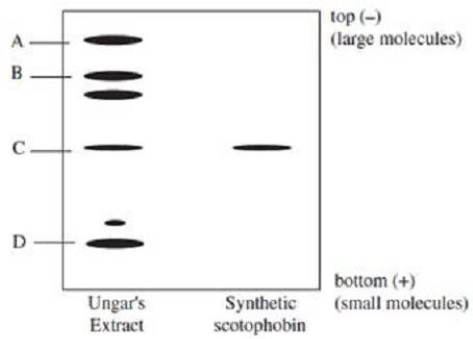
Figure 1
Researchers were interested in purifying a second protein (protein X) from Ungar’s extract. The gene segment encoding protein X was believed to consist of thirty nucleotides. According to Figure 1, which band could represent protein X?
Select an option, then click Submit answer.
-
○
Band A
-
○
Band B
-
○
Band C
-
○
Band D

