CFA-Level-3 Chartered Financial Analyst Level 3

Loading demo links...

Showing 13–15 of 15 questions

Question 13 (Alternative Assets)

International Opportunity Investors (IOI) manages substantial euro-priced equity portfolios for two

U.S.-based investors, Mark Taylor and Cindy Amsler. Taylor and Amsler have invested in European stocks because of recent media reports suggesting that, due to continued interest rate increases in the United States, European stocks will outperform U.S. stocks over the next few years. Their portfolios are well diversified and similar to the local index portfolio in capitalization weightings.

Ted Tavinsky, lOI's portfolio manager asks his assistant, Tim Treblehorn, to review the relationship between international asset returns and the level of currency risk assumed when investing in foreign securities. The findings, Tavinsky believes, will prove useful in marketing the fund to North American investors. Treblehorn relays two fundamental conclusions to Taylor. First, correlations between international markets have been increasing, and the result has been reduced diversification benefits for international investors. Second, currency risk is typically less than half that of foreign stock risk, but the actual risk assumed is much lower because currency returns and stock returns are not perfectly positively correlated.

Taylor however is very concerned that the U.S. downturn may spread to the global economy. He states that he would like to explore the possibility of investing in the RRIC countries (Brazil, Russia, India, and China). Tavinsky replies that the prospects for the BRIC countries are quite good. Relative to the current G6 countries (U.S., Japan, U.K., Germany, France, and Italy), the stronger economic growth for emerging markets should result in higher stock returns.

Furthermore, the increased growth in these markets will increase the demand for capital, which should strengthen their currency values.

Amsler is a novice investor and has hesitantly invested in the overseas markets. In order to calm her fears, Tavinsky and Treblehorn investigate the possibility of hedging using futures contracts on an equity index as well as a euro forward contract. They have chosen futures contracts written on the Eurostoxx equity index for her portfolio because the price changes of the contract have a high correlation with the returns on Amsler's equity portfolio. Amsler's equity portfolio has a market value of €15,000,000 and a beta of 1.15 relative to the local underlying index.

Tavinsky and Treblehorn collect data for spot exchange rates, futures contract prices and betas, as well as U.S. and European interest rates. Tavinsky and Treblehorn are bearish on the European stock market over the next year as noted by their forecasted return for it.
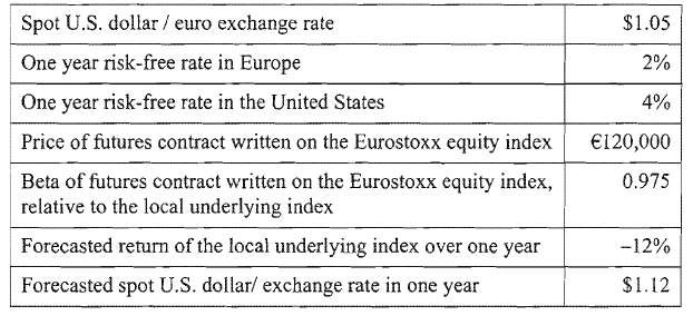
Tavinsky has told Amsler that he and Treblehom will calculate the value of her portfolio in hedged and unhedged scenarios. Tavinsky states that if, at the beginning of the year, he were to fully hedge the systematic risk of Amsler's equity portfolio using the index futures, the appropriate futures position to accomplish this would be 125 contracts. Treblehorn states that if they decide to hedge the currency risk of the portfolio as well, the principal for the forward contract that will hedge the currency risk of the hedged equity position will be €15,000,000, using a ''hedging the principal" strategy.

Lastly, Tavinsky and Treblehorn calculate the forecasted return on the portfolio assuming that currency risk is hedged. Assuming that both equity and currency risk are hedged, Tavinsky calculates that the dollar return would be 8.8%. Treblehorn states that the forecasted spot U.S. dollar / euro exchange rate in one year of $1.12 should be used for the forward contract rate.

Assuming a futures position based on the expected exchange rate in one year turns out to be a perfect hedge and the currency risk is not hedged, the dollar return on the Amsler equity portfolio is closest to:

Select an option, then click Submit answer.

  • a 9% gain.

  • an 11% gain.

  • a 7% loss.

Question 14 (Ethics)

Stephanie Mackley is a portfolio manager for Durango Wealth Management (DWM), a regional money manager catering to wealthy investors in the southwestern portion of the United States. Mackley's clients vary widely in terms of their age, net worth, and investment objectives, but all must have at least $1 million in net assets before she will accept them as clients.

Many of Mackley’s clients are referred to her by Kern & Associates, an accounting and consulting firm. DWM does not provide any direct compensation to Kern & Associates for the referrals, but Mackley’s who is the president of her local CFA Society, invites Kern & Associates to give an annual presentation to the society on the subject of tax planning and minimization strategies that Kern & Associates provides for its clients. Kern & Associates' competitors have never received an invitation to present their services to the society. When Mackley receives a referral, she informs the prospect of the arrangement between DWM and Kern & Associates.

DWM maintains a full research staff that analyzes and recommends equity and debt investments. All of the in-house research is provided to the firm's portfolio managers and their clients. In addition, DWM provides a subscription service to outside investors and portfolio managers. Aaron Welch, CFA, a private contractor, researches and reports on high-tech firms in the U.S. and other developed countries for several portfolio management clients. One of his latest reports rated InnerTech Inc., a small startup that develops microscopic surgical devices, as a strong buy. After reviewing the report carefully, Mackley decides to purchase shares of InnerTech for clients with account values over $6 million. She feels that accounts with less than this amount cannot accept the risk level associated with InnerTech stock.

Two days after purchasing InnerTech for her clients, the stock nearly doubles in value, and the clients are ecstatic about the returns on their portfolios. Several of them give her small bouquets of flowers and boxes of chocolates, which she discloses to her supervisor at DWM. One client even offers her the use of a condo in Vail, Colorado for two weeks during ski season, if she can reproduce the results next quarter. Mackley graciously thanks her clients and asks that they refer any of their friends and relatives who are in need of asset management services. She provides brochures to a few clients who mention that they have friends who would be interested. The brochure contains a description of Mackley's services and her qualifications. At the end of the brochure, Mackley includes her full name followed by "a Chartered Financial Analyst" in bold font of the same size as her name Following is An excerpt from the brochure:

"DWM can provide many of the investment services you are likely to need. For those services that we do not provide directly, such as estate planning, we have standing relationships with companies that do provide such services. 1 have a long history with DWM, serving as an investment analyst for six years and then in my current capacity as a portfolio manager for twelve years. My clients have been very satisfied with my past performance and will likely be very satisfied with my future performance, which I attribute to my significant investment experience as well as my participation in the CFA Program. I earned the right to use the CFA designation thirteen years ago. All CFA charter-holders must pass a series of three rigorous examinations that cover investment management and research analysis."

Two weeks later, some of Mackley's clients request that she provide supporting documentation for the research report on InnerTech, so they can familiarize themselves with how DWM analyzes investment opportunities. Mackley asks Welch for the documents, but Welch is unable to provide copies of his supporting research since he disposed of them, according to the company's policy, one week after issuing and distributing the report. Mackley informs Welch that obtaining the supporting documents is of the utmost importance, since one of the clients requesting the materials, Craig Adams, is about to inherit S20 million and as a result will be one of the firm's most important clients. Welch agrees to recreate the research documents in order to support the firm's relationship with Adams.

Does Mackley's signature at the end of her brochure violate any CFA Institute Standards of Professional Conduct?

Select an option, then click Submit answer.

  • No.

  • Yes, because "a Chartered Financial Analyst" should not be written in bold.

  • Yes, because "a Chartered Financial Analyst" should not be written in bold and should not include "a."

Question 15 (Alternative Assets)

Cynthia Farmington, CFA, manages the Lewis family's $600 million securities portfolio. Farmington and the Lewis family have agreed that they should hire a manager of alternative investments to manage a portion of the portfolio containing those assets. As part of the hiring process, they attempted to do the necessary due diligence. They assessed each manager's organization, the relative efficiency of the markets each manager has invested in, the character of each manager, and the service providers, such as lawyers, that each manager has used. In particular, they hoped to find a manager who has run an operation with low employee turnover, has invested in efficient and transparent markets, has sound character, and has utilized reputable providers of external services.

Eventually, Farmington hires the firm owned and managed by Bruce Carnegie, CFA, to diversify the Lewis portfolio into alternative investments. Carnegie will manage the portion of the portfolio containing these assets, and Farmington will continue to manage the remainder of the portfolio in a mix of approximately 50/50 high-grade stocks and bonds. Over the past ten years, the stock portion of the portfolio has closely tracked the S&P 500 and the bond portfolio has closely tracked a broad bond index.

Carnegie and Farmington meet to discuss how Carnegie should proceed. Farmington mentions that she and the Lewis family have agreed that the main goal of the alternative investments that Carnegie will manage should be to enhance the return of the overall portfolio. Diversification is only a secondary goal. In particular, Farmington says the Lewis family has expressed an interest in having the portfolio take positions in private equity. Farmington says that she envisions that Carnegie should take five positions of about 55 million each in distinct private equity investments, and each position should have about a 5-year horizon.

Farmington states that she has grown very dependent on benchmarks for her investing activities, and has concerns with respect to how she and Carnegie will monitor the success of the portfolio allocation in private equity. She has read that there can be a problem with the valuation of private equity indices in that they depend on price-revealing events like IPOs, mergers, and new financing. Thus, the repricing of the index occurs infrequently. Carnegie concludes that the solution is to follow the commonly accepted practice of creating their own private equity benchmark.

Farmington asks Carnegie to explain the choices that exist in the private equity market. Carnegie explains that there are two basic categories: venture capital funds and buyout funds. Farmington asks that Carnegie explain the pros and cons of one over the other. Carnegie states that buyout funds would probably have higher return potential, fewer losses, earlier cash flows, and less error in the measurement of the returns.

Carnegie comments that before he proceeds he will need to communicate with the clients. Farmington says this communication is not necessary because the Lewis family has largely followed her advice with very few questions. Even when the market has fallen and the portfolio has not done well, the Lewis family has not asked for any changes.

Given that Farmington states that high return is more important than diversification, the choice to focus on private equity is:

Select an option, then click Submit answer.

  • not appropriate because private equity offers good diversification, but the returns are comparatively low.

  • appropriate because private equity offers a high return but relatively low diversification.

  • appropriate because private equity offers both a high return and good diversification.