CFA-Level-3 Chartered Financial Analyst Level 3

Loading demo links...

Showing 7–9 of 15 questions

Question 7 (Alternative Assets)

Smiler Industries is a U.S. manufacturer of machine tools and other capital goods. Dat Ng, the CFO of Smiler, feels strongly that Smiler has a competitive advantage in its risk management practices. With this in mind, Ng hedges many of the risks associated with Smiler's financial transactions, which include those of a financial subsidiary. Ng's knowledge of derivatives is extensive, and he often uses them for hedging and in managing Srniler's considerable investment portfolio.

Smiler has recently completed a sale to Frexa in Italy, and the receivable is denominated in euros. The receivable is €10 million to be received in 90 days. Srniler's bank provides the following information:

Smiler borrows short-term funds to meet expenses on a temporary basis and typically makes semiannual interest payments based on 180-day LIBOR plus a spread of 150 bp. Smiler will need to borrow S25 million in 90 days to invest in new equipment. To hedge the interest rate risk on the loan, Ng is considering the purchase of a call option on 180-day LIBOR with a term to expiration of 90 days, an exercise rate of 4.8%, and a premium of 0.000943443 of the loan amount. Current 90day LIBOR is 4.8%.

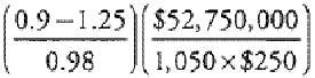
Smiler also has a diversified portfolio of large cap stocks with a current value of $52,750,000, and Ng wants to lower the beta of the portfolio from its current level of 1.25 to 0.9 using S&P 500 futures which have a multiplier of 250. The S&P 500 is currently 1,050, and the futures contract exhibits a beta of 0.98 to the underlying.

Because Ng intends to replace the short-term LIBOR-based loan with long-term financing, he wants to hedge the risk of a 50 bp change in the market rate of the 20-year bond Smiler will issue in 270 days. The current spread to Treasuries for Smiler's corporate debt is 2.4%. He will use a 270-day, 20-year Treasury bond futures contract ($100,000 face value) currently priced at 108.5 for the hedge. The CTD bond for the contract has a conversion factor of 1.259 and a dollar duration of $6,932.53. The corporate bond, if issued today, would have an effective duration of 9.94 and has an expected effective duration at issuance of 9.90 based on a constant spread assumption. A regression of the YTM of 20-year corporate bonds with a rating the same as Smiler's on the YTM of the CTD bond yields a beta of 1.05.

What position should Smiler take to alter the beta of the equity portfolio?

Select an option, then click Submit answer.

  • Long 72 futures contracts.

  • Short 72 futures contracts.

  • Long 70 futures contracts.

Question 8 (Quantitative Methods)

Joan Nicholson, CFA, and Kim Fluellen, CFA, sit on the risk management committee for Thomasville Asset Management. Although Thomasville manages the majority of its investable assets, it also utilizes outside firms for special situations such as market neutral and convertible arbitrage strategies. Thomasville has hired a hedge fund, Boston Advisors, for both of these strategies. The managers for the Boston Advisors funds are Frank Amato, CFA, and Joseph Garvin, CFA. Amato uses a market neutral strategy and has generated a return of S20 million this year on the $100 million Thomasville has invested with him. Garvin uses a convertible arbitrage strategy and has lost $15 million this year on the $200 million Thomasville has invested with him, with most of the loss coming in the last quarter of the year. Thomasville pays each outside manager an incentive fee of 20% on profits. During the risk management committee meeting Nicholson evaluates the characteristics of the arrangement with Boston Advisors. Nicholson states that the asymmetric nature of Thomasville's contract with Boston Advisors creates adverse consequences for Thomasville's net profits and that the compensation contract resembles a put option owned by Boston Advisors.

Upon request, Fluellen provides a risk assessment for the firm's large cap growth portfolio using a monthly dollar VAR. To do so, Fluellen obtains the following statistics from the fund manager. The value of the fund is $80 million and has an annual expected return of 14.4%. The annual standard deviation of returns is 21.50%. Assuming a standard normal distribution, 5% of the potential portfolio values are 1.65 standard deviations below the expected return.

Thomasville periodically engages in options trading for hedging purposes or when they believe that options are mispriced. One of their positions is a long position in a call option for Moffett Corporation. The option is a European option with a 3-month maturity. The underlying stock price is $27 and the strike price of the option is $25. The option sells for S2.86. Thomasville has also sold a put on the stock of the McNeill Corporation. The option is an American option with a 2month maturity. The underlying stock price is $52 and the strike price of the option is $55. The option sells for $3.82. Fluellen assesses the credit risk of these options to Thomasville and states that the current credit risk of the Moffett option is $2.86 and the current credit risk of the McNeill option is $3.82.

Thomasville also uses options quite heavily in their Special Strategies Portfolio. This portfolio seeks to exploit mispriced assets using the leverage provided by options contracts. Although this fund has achieved some spectacular returns, it has also produced some rather large losses on days of high market volatility. Nicholson has calculated a 5% VAR for the fund at $13.9 million. In most years, the fund has produced losses exceeding $13.9 million in 13 of the 250 trading days in a year, on average. Nicholson is concerned about the accuracy of the estimated VAR because when the losses exceed $13.9 million, they are typically much greater than $13.9 million. In addition to using options, Thomasville also uses swap contracts for hedging interest rate risk and currency exposures. Fluellen has been assigned the task of evaluating the credit risk of these contracts. The characteristics of the swap contracts Thomasville uses are shown in Figure 1.

Fluellen later is asked to describe credit risk in general to the risk management committee. She states that cross-default provisions generally protect a creditor because they prevent a debtor from declaring immediate default on the obligation owed to the creditor when the debtor defaults on other obligations. Fluellen also states that credit risk and credit VAR can be quickly calculated because bond rating firms provide extensive data on the defaults for investment grade and junk grade corporate debt at reasonable prices.

Regarding Fluellen's comments on the credit risk of the Moffett and McNeill options:

Select an option, then click Submit answer.

  • Fluellen is only correct regarding the Moffett option.

  • Fluellen is only correct regarding the McNeill option.

  • Fluellen is incorrect regarding both the Moffett and McNeill options.

Question 9 (Asset Classes)

Milson Investment Advisors (MIA) specializes in managing fixed income portfolios for institutional clients. Many of MIA's clients are able to take on substantial portfolio risk and therefore the firm's funds invest in all credit qualities and in international markets. Among its investments, MIA currently holds positions in the debt of Worth inc., Enertech Company, and SBK Company. Worth Inc. is a heavy equipment manufacturer in Germany. The company finances a significant amount of its fixed assets using bonds. Worth's current debt outstanding is in the form of noncallable bonds issued two years ago at a coupon rate of 7.2% and a maturity of 15 years. Worth expects German interest rates to decline by as much as 200 basis points (bps) over the next year and would like to take advantage of the decline. The company has decided to enter into a 2-year interest rate swap with semiannual payments, a swap rate of 5.8%, and a floating rate based on 6month EURIBOR. The duration of the fixed side of the swap is 1.2. Analysts at MIA have made the following comments regarding Worth's swap plan:

• "The duration of the swap from the perspective of Worth is 0.95."

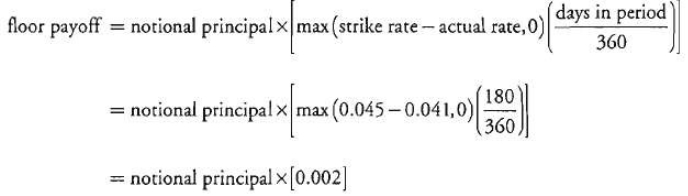
• "By entering into the swap, the duration of Worth's long-term liabilities will become smaller,causing the value of the firm's equity to become more sensitive to changes in interest rates." Enertech Company is a U.S.-based provider of electricity and natural gas. The company uses a large proportion of floating rate notes to finance its operations. The current interest rate on Enertech's floating rate notes, based on 6-month LIBOR plus 150bp, is 5.5%. To hedge its interest rate risk, Enertech has decided to enter into a long interest rate collar. The cap and the floor of the collar have maturities of two years, with settlement dates (in arrears) every six months. The strike rate for the cap is 5.5% and for the floor is 4.5%, based on 6-month LIBOR, which is forecast to be 5.2%, 6.1%, 4.1%, and 3.8%, in 6,12, 18, and 24 months, respectively. Each settlement period consists of 180 days. Analysts at MIA are interested in assessing the attributes of the collar. SBK Company builds oil tankers and other large ships in Norway. The firm has several long-term bond issues outstanding with fixed interest rates ranging from 5.0% to 7.5% and maturities ranging from 5 to 12 years. Several years ago, SBK took the pay floating side of a semi-annual settlement swap with a rate of 6.0%, a floating rate based on LIBOR, and a tenor of eight years. The firm now believes interest rates may increase in 6 months, but is not 100% confident in this assumption. To hedge the risk of an interest rate increase, given its interest rate uncertainty, the firm has sold a payer interest rate swaption with a maturity of 6 months, an underlying swap rate of 6.0%, and a floating rate based on LIBOR.

MIA is considering investing in the debt of Rio Corp, a Brazilian energy company. The investment would be in Rio's floating rate notes, currently paying a coupon of 8.0%. MIA's economists are forecasting an interest rate decline in Brazil over the short term.

Which of the following is closest to the payoff on Enertech's collar 24 months from now? Enertech will:

Select an option, then click Submit answer.

  • make a payment of $0.0020 per dollar of notional principal.

  • make a payment of $0.0035 per dollar of notional principal.

  • will receive a payment of $0.0035 per dollar of notional principal.