CFA-Level-3 Chartered Financial Analyst Level 3

Loading demo links...

Showing 10–12 of 15 questions

Question 10 (Ethics)

Shirley Riley, CFA, has just been promoted, from vice president of trading to chief investment officer (CIO) at Crane & Associates, LLC (CA), a large investment management firm. Riley has been with CA for eight years, but she has much to learn as she assumes her new duties as CIO. Riley has decided to hire Denny Simpson, CFA, as the new compliance officer for CA, Riley and Simpson have been reviewing procedures and policies throughout the firm and have discovered several potential issues. Communications with Clients

Portfolio managers are encouraged to communicate with clients on a regular basis. At a minimum, managers are expected to contact clients on a quarterly basis to review portfolio performance. Each client must have an investment policy statement (IPS) created when their account is opened, specifying the objectives and constraints for their portfolio. IPSs are reviewed at client request at any time. Any time market conditions dictate a change in the investment style or strategy of a client portfolio, the client is notified immediately by phone or email.

Employee Incentive Program

CA offers several incentive programs to employees. One of the most popular of these programs is the CA IPO program. Whenever CA is involved in an initial public offering (IPO), portfolio managers are allowed to participate. The structure is simple—for every 100 shares purchased on behalf of a client, the manager is awarded five shares for his own account. The manager is thus rewarded for getting an IPO sold and at the same time is able to share in the results of the IPO. Any¬time shares are remaining 72 hours before the IPO goes public, other employees are allowed to participate on a first-come, first-serve basis. Employees seem to appreciate this opportunity, but CA does not have exact numbers on employee participation in the program.

Private Equity Fund

CA has a private equity fund that is internally managed. This fund is made available only to clients with more than $5 million in assets managed by CA, a policy that is fully disclosed in CA's marketing materials. Roughly one-third of the fund's assets are invested in companies that are either very small capitalization or thinly traded (or both). The pricing of these securities for monthly account statements is often difficult. CA support staff get information from different sources— sometimes using third party services, sometimes using CA valuation models. In some instances, a manager of the private equity fund will enter an order during the last trading hour of the month to purchase 100 shares of one of these small securities at a modest premium to the last trade price. If the trade gets executed, that price can then be used on the account statements. The small size of these trades does not significantly affect the fund's overall position in any particular company holding, which is typically several thousand shares.

Soft Dollar Usage

Several different managers at CA use independent research in developing investment ideas. One of the more popular research services among CA managers is "Beneath the Numbers (BTN)," which focuses on potential accounting abuses at prominent companies. This service often provides early warnings of problems with a stock, allowing CA managers the opportunity to sell their clients' positions before a negative surprise lowers the price. Stocks covered by BTN are typically widely held in CA client accounts. Managers at CA have been so happy with BTN that they have also subscribed to a new research product provided by the same authors—"Beneath the Radar (BTR)." BTR recommends small capitalization securities that are not large enough to attract much attention from large institutional investors. The results of BTR's recommendations are mixed thus far, but CA managers are willing to be patient.

As they discuss these issues, Riley informs Simpson that she is determined to bring CA into full compliance with the CFA Institute's "Asset Manager Code of Professional Conduct." The following questions should be answered with the Asset Manager Code as a guide.

Trading stocks during the last trading hour of a month to establish a fair market price:

Select an option, then click Submit answer.

  • does not violate the Asset Manager Code of Professional Conduct.
  • is acceptable so long as the trade is not material relative to the overall CA position in the security.

  • is not consistent with the Asset Manager Code of Professional Conduct.
Question 11 (Portfolio Management and Wealth Planning)

Lucy Sakata, CFA and Gary Lowenstein, CFA are portfolio managers for the Murray Funds, a provider of investment funds to institutional and wealthy individual investors. Murray frequently indexes in developed markets, but uses full blown active management in less efficient markets and when they think their analysts have a particular expertise. The vast majority of Murray's clients attempt to minimize tracking error.

One of the Murray's funds invests in a Hong Kong index and is marketed as a way for investors to participate in the growth of the Asian economies. The index represents the best known Hong Kong stocks and Murray uses a full replication strategy for the fund. The index is a market cap-weighted index and ten firms represent over 70% of the index's total market cap._Sakata would like to market the Hong Kong fund to institutions with a required minimum investment of $50 million. Many potential clients are institutions who outsource their foreign equity management and are subject to maximum holdings on individual stocks.

Murray also has a Canada fund that invests in an index which represents the 25 largest cap stocks in Canada. It is marketed as a way for investors to exploit the growth in demand for commodities. The index adjusts for stock splits and repurchases as necessary. Most of the index's return has come from capital gains, rather than dividends, due to the tremendous increase in global demand for commodities. To encourage long-term holding, Murray places a back-end load of 3% on fund redemptions that are made within two years of initial investment.

Sakata and Lowenstein discuss the fundamental law of active management and how it applies to three hypothetical managers who invest against the broad large-cap U.S. market, as represented by the S&P 500 index.

• Manager A under-weights and over-weights the 500 individual stocks of the S&P 500 index asshe sees appropriate, keeping industry exposures similar to those of the index. She has an information coefficient of 0.05 and is restricted to long-only positions.

• Manager B holds cash and long S&P 500 futures. He tries to generate excess returns by alteringthe duration of the cash position and has an information coefficient of 0.05.

• Manager C has an information coefficient of 0.07, and she uses a long-short strategy for the 500stocks in the S&P 500 index.

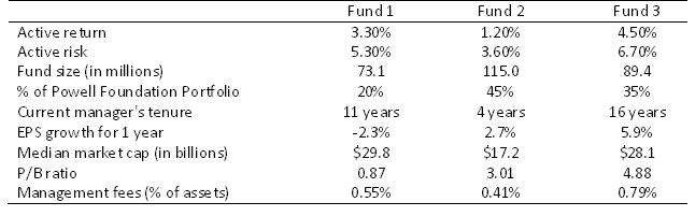
Sakata is consulting with the trustees of the Powell Foundation. The foundation has a position in the three Murray funds described in Exhibit 1 below.

Exhibit 1: Powell Foundation Holdings

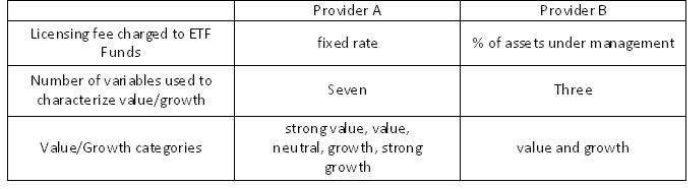
Murray has a value fund that invests in stocks in the U.S. Lowenstein is considering several equity style index providers as a benchmark for the fund. The characteristics of the index providers and the methodologies they use to construct equity style indices are described in Exhibit 2 below.

Exhibit 2: Comparison of Index Providers

In regard to the index providers, Lowenstein makes the following statements:

Statement 1: "I would like to use the indices from either provider in a returns-based style analysis.

Based on the information in the table, I believe that if I regress a value manager's returns against

Provider B's indices, the manager's selection return will appear artificially large."

Statement 2: "If an index provider uses buffering rules, a fund tracking that index will experience lower transactions costs."

Determine which of the following is the most likely reason that the Hong Kong fund will be inappropriate for the institutional investors.

Select an option, then click Submit answer.

  • Illiquid stocks comprising the index.

  • The weighting scheme of the index.

  • The lack of potential excess returns.

Question 12 (Ethics)

Cindy Hatcher, CFA, has spent the last ten years as a portfolio manager with Bernhardt Capital. While working for Bernhardt, Hatcher was responsible for maintaining and improving the company's code of ethics and guidelines for ethical money management. As a result of Hatcher's efforts, Bernhardt saw a dramatic decline in the number of complaints received from their individual and institutional customers.

One of Bernhardt's direct competitors, Smith Investments, is keenly aware of Hatcher's reputation for ethical business practices and has offered her a job as their compliance officer. Hatcher has been apprised of several potential ethical problems at Smith that she will be directly responsible for fixing through implementation of policies and procedures that will prevent ethical dilemmas. The management at Smith is willing to grant Hatcher the authority to construct and implement policies to eliminate the ethical problems at the company.

Hatcher agrees to accept the position with Smith and resigns from employment with Bernhardt. As her first initiative with the company, Hatcher distributes to all employees at Smith a survey intended to acquaint her with the company's common business practices. Her goal is to identify those factors that are most likely to interfere with Smith's compliance with the CFA Institute's Code of Ethics and Standards of Practice. After collecting and analyzing the anonymous responses to the survey, Hatcher has identified the following four issues as the most frequently cited questionable business practices:

1. Many Smith employees have relatives who are clients of the firm. For relatives* accounts wherethe Smith employee does not have beneficial ownership, trades are generally executed in conjunction with trades for other discretionary accounts held at the firm. Only in accounts where the Smith employee has beneficial ownership are trades delayed until all discretionary account trading is completed.

2. Many of Smith's employees either personally own or maintain, through a family member,beneficial ownership of stocks that are also held in accounts for many of the firm's clients. While the company maintains a strict disclosure policy to the firm of such beneficial ownership and an "at will" disclosure policy to its clients, employees are not barred from trading these securities for their personal benefit even if their clients also own or have a direct or indirect financial interest in the same securities.

3. Account managers meet weekly to discuss the issues and concerns of the client portfoliosmanaged at the firm. During the meetings it is not unusual for individual clients to be identified and discussed. Information regarding the client's holdings and investment strategy is discussed as well as persona! needs related to the client's portfolio. The meetings are held in order to provide guidance and continuing education to all of the firm's account managers.

4. At the suggestion of fixed-income analysts at the firm, most of the portfolio managers workingfor Smith have been adding B-rated corporate fixed-income securities to their portfolios. Analysts originally made (and continue to make) the suggestion due to the attractive yield potential offered by this class of investments. Smith's portfolio managers were thrilled with the idea since the returns on many of the portfolios' equity positions have been stifled by high profile accounting scandals.

Management at Smith Investments has been pleased with Hatcher's efforts so far but is concerned about the firm's ability to maintain compliance with the CFA Institute's Global

Investment Performance Standards (GIPS®). The managing director of the firm, Erich Prince, has made the following comments to Hatcher:

"I am concerned that we will not be able to claim compliance with GIPS at the end of the year since our new information system has inhibited our ability to include terminated portfolios in the historical record up to the last full measurement period before they were terminated. Also, we are unable to regroup portfolios that utilize hedging into separate composites from those that do not utilize hedging. These portfolios are currently grouped according to traditional value and growth strategies based on the capitalization of portfolio holdings (i.e., large vs. small)."

Hatcher eases Prince's mind by telling him she will "ensure full compliance with GIPS by the end of the quarter."

Smith's portfolio managers have been adding B-rated corporate fixed-income securities to their portfolios at the recommendation of the firm's fixed-income analysts. With regard to this situation,

Smith's employees have violated the CFA Institute's Code and Standards for which of the

following reasons?

Select an option, then click Submit answer.

  • Fixed-income analysts are recommending debt securities that are below an investment grade credit rating.

  • Portfolio managers have failed to consider the investment policy statement of each portfolio before adding the fixed-income securities to the portfolios.

  • Fixed-income analysts have failed to provide a detailed description of the investment characteristics of the corporate fixed-income securities to the portfolio managers.