300-510 Implementing Cisco Service Provider Advanced Routing Solutions (SPRI)

Loading demo links...

Showing 7–9 of 15 questions

Question 7 (Multicast Routing)
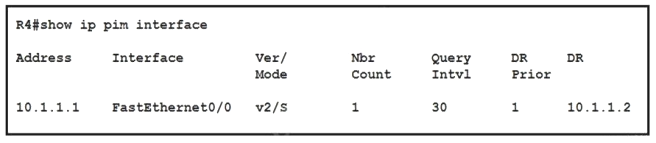
Refer to the exhibit. Which two commands must the engineer configure for the company’s PIM-SM network to enable Auto-RP mappings to be sent over the FastEthernet0/0 interface, without affecting normal operation? (Choose two.)

Select all that apply, then click Submit answer.

  • enable auto-rp listener

  • enable sparse-mode

  • enable Auto-RP announcements

  • enable sparse-dense mode

  • enable dense mode

Question 8 (Multicast Routing)

Which two conditions must be met before separate ISPs can provide interdomain multicast routing? (Choose two.)

Select all that apply, then click Submit answer.

  • Each ISP must configure MSDP to connect its individual multicast administrative domain to the domains at other ISPs.

  • Each ISP must dedicate a single router to handle multicast traffic between providers.

  • Each ISP must replace its RP assignment with a global RP.

  • Each ISP must configure its network to use PIM-DM.

  • Each ISP must support intradomain multicast routing.

Question 9 (Multicast Routing)

In a PIM-SM environment, which mechanism determines the traffic that a receiver receives?

Select an option, then click Submit answer.

  • The receiver explicitly requests its desired traffic from the RP on the shared tree.

  • The receiver explicitly requests traffic from a single source, which responds by forwarding all traffic.

  • The RP on the shared tree floods traffic out of all PIM configured interfaces.

  • The receiver explicitly requests traffic from each desired source, which responds by sending all traffic.