ASCP-MLT MEDICAL LABORATORY TECHNICIAN - MLT(ASCP)

Loading demo links...

Showing 4–6 of 20 questions

Question 4

Match each of the descriptions with the appropriate magnification:

1. Color, Rouleau, Overall Slide Quality, Cell Distribution

2. Platelet estimates RBC-platelet-WBC morphology WBC differential RBC inclusions

3. Select area to examine, WBC estimate

Select all that apply, then click Submit answer.

  • 40X (Dry)

  • 10X

  • 100X (Oil)

Question 5

Match each of the following:

1. Ratio of cellular area to total area in the bone marrow section.

2. Number of myeloid cells compared to nucleated erythroid cells.

3. Use low power to estimate their quantity and appearance.

4. Use Perls' Prussian blue stain.

Select all that apply, then click Submit answer.

  • Myeloid-erythroid ratio

  • Stored iron

  • Overall cellularity

  • Megakaryocytes

Question 6

The intended response is Vitamin B12 and folate deficiencies. Each of these conditions lead to a megaloblastic production of the red blood cells in the bone marrow. Since vitamin B12 and folate are needed in order to produce a synchronous development of the nucleus with the cytoplasm in hematologic cells, oval-macrocytosis often occurs if these nutrients are not in adequate supply within the body. This can also affect neutrophils, allowing for the characteristic hypersegmented nucleus.

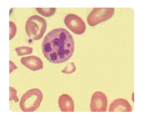
The photographic field contains several oval-macrocytes and a hypersegmented neutrophil with greater than 5 nuclear segments. Oval macrocytes are most commonly associated with pernicious anemia and malabsorption syndromes leading to vitamin B12 and folic acid deficiencies.

Clinical information relating to chronic infection, aplastic anemia, and other hematologic maligancies provide the context for the presence of the oval macrocyte.

Macrocytic erythrocytes and hypersegmented neutrophils are not present in thalassemias or in Pelger-Huet anomaly (hyposegmented neutrophils).

Conditions suggested by the macrocytes and the neutrophil in the photograph to the right include which of the following?

Select all that apply, then click Submit answer.

  • Thalassemia

  • Vitamin B12 deficiency

  • Pelger-Huet anomaly

  • Folate deficiency