MCAT-Section-3-Physical-Sciences Section Three : Physical Sciences

Loading demo links...

Showing 13–15 of 15 questions

Question 13

Every atomic orbital contains plus and minus regions, defined by the value of the quantum mechanical function for electron density. When orbitals from different atoms overlap to form bonds, an equal number of new molecular orbitals results. These are of two types: σ or π bonding orbitals, formed by overlap between orbital regions with the same sign, and antibonding σ* or π* orbitals, formed by overlap between regions with opposite signs. Bonding orbitals have lower energy than their component atomic orbitals, and antibonding orbitals have higher energy. The electron pairs reside in the lower-energy bonding orbitals; the higher-energy, less stable orbitals remain empty when the molecule is in its ground state.

A benzene ring has six unhybridized pz orbitals (one from each carbon atom), which together from six molecular π orbitals, each one delocalized over the entire ring. Of the possible π orbital structures for benzene, the one with the lowest energy has the plus region of all six p orbital functions on one side of the ring. The six electrons occupying the orbitals fill the three most stable molecular orbitals, leaving the other three empty.

Molecular orbitals are filled from the lowest to the highest energy level. The number of bonds between atoms is determined by the number of filled bonding orbitals minus the number of filled antibonding orbitals; each antibonding orbital cancels out a filled bonding orbital. For a diatomic molecule, orbitals in the n = 2 energy level are filled as follows:

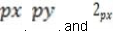
(equal in energy), π and π* (equal in energy), σ*2 . (The designation of the three p orbitals as are interchangeable.)
Absorption of a photon can raise an electron to a higher-energy molecular orbital. The excited electron does not immediately change its spin, which is opposite to that of the electron with which it was previously paired. This singlet state is relatively unstable: the molecule may interact with another molecule, or fluoresce and return to its ground state. Alternatively, there may be a change in spin direction somewhere in the system; the molecule then enters the so-called triplet state, which generally has lower energy. The molecule now cannot return quickly to its ground state, since the excited electron no longer has a partner of opposite spin with which to pair. It also cannot return to the singlet state, because the singlet has greater energy.

Consequently, the triplet state, which has two unpaired electrons in separate orbitals, is long-lived by atomic standards, with a lifetime that may be ten seconds or more. During this period, the molecule is highly reactive.

The quantum number that distinguishes the px orbital from the py orbital is called the:

Select an option, then click Submit answer.

  • azimuthal quantum number.

  • magnetic quantum number.

  • principal quantum number.

  • spin quantum number.

Question 14

Glycogen storage disease type V, also known as GSD-V or McArdle disease, is an autosomal recessive disease that results in the deficiency of myophosphorylase, an isoform of glycogen phosphorylase found in muscle cells. Patients with GSD-V experience severe muscle cramps after strenuous exercise and exercise intolerance.

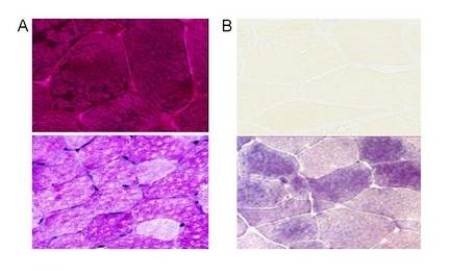
Physicians may order two histology stains of the patient's muscle tissue in order to aid in the diagnosis (see Figure 1):

(A) A Periodic acid-Schiff (PAS) stain uses periodic acid to detect carbohydrates in tissues. The reaction of the acid with sugar cleaves vicinal diols creating ketone and/or aldehyde fragments, the latter of which then reacts with the Schiff reagent togive a purple color;

(B) A phosphorylase stain identifies the presence of the enzyme using a dark blue color indicator.

Figure 1A. Comparative histochemistry of GSD-V and healthy individual.

PAS stain of muscle tissue shows an accumulation of glycogen in the GSD-V individual (top) compared to the control (bottom). B) Phosphorylase stain of muscle tissue reveals an absence of phosphorylase in the GSD-V individual (top). Despite initial pain during exercise, many patients with GSD-V have been able to increase their exercise tolerance by engaging in moderate periods of aerobic exercise. Muscle pain and fatigue subsides after a few minutes, a response that researchers call the "second wind" phenomenon.

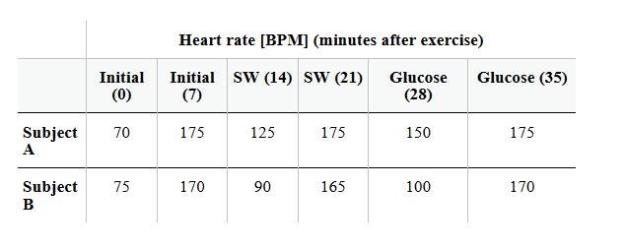
Patients who experienced "second wind" typically experienced lowered heart rate and a reported decrease in exercise effort after 7-10 minutes. A similar effect was seen in the same patients after an intravenous infusion of glucose.

Figure 2. Measured heart rates in two GSD-V patients during sustained exercise.

Two subjects were asked to ride stationary bicycles at a steady rate over the course of 40 minutes. The subjects' heart rates were measured continuously, with high and low values coinciding with 7-minute intervals. Glucose was injected intravenously after 21 minutes. SW = Second Wind.

Adapted from Bhavaraju-Sanka R, Howard J. Jr, Chahin N (2014). SOJ Neurol 1(1), 1-3. and Haller RG, Vissing J. Arch Neurol. 2002;59(9):1395-1402.

Muscle biopsies offer valuable data that can aid physicians in the diagnosis. However, they can be painful and invasive. A less invasive test uses a blood pressure cuff placed on the upper arm, which blocks blood flow to the arm. The patient affected by GSD-V is then asked to perform a strenuous arm exercise, such as squeezing a rubber ball. After some time, blood is drawn, and its chemical contents are compared to pre-exercise blood samples. One would expect to see:

Select an option, then click Submit answer.

  • a decrease in calcium.

  • an increase in lactate.

  • an increase in glucose.

  • no increase in lactate.

Question 15

Many nutrients required by plants exist in soil as basic cations:

A soil’s cation-exchange capacity is a measure of its ability to adsorb these basic cations as well as exchangeable hydrogen and aluminum ions. The cation-exchange capacity of soil is derived from two sources: small clay particles called micelles consisting of alternating layers of alumina and silica crystals, and organic colloids.

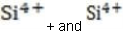
Replacement of + by other cations of lower valence creates a net negative charge within the inner layers of the micelles. This is called the soil’s permanent charge. For example, replacement of an atom of aluminum by calcium within a section where the net charge was previously zero, as shown below, produces a net charge of –1, to which other cations can become adsorbed.

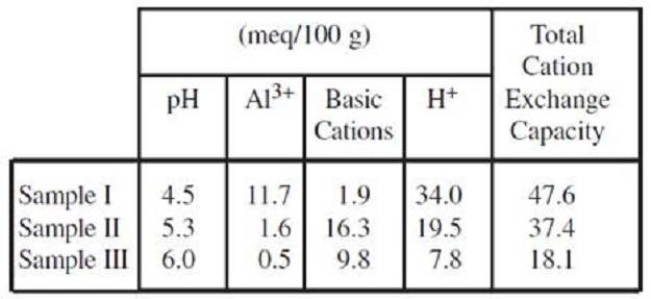
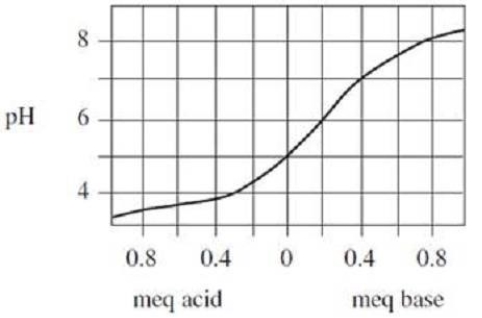
Figure 1

A pH-dependent charge develops when hydrogen dissociates from hydroxyl moieties on the outer surfaces of the clay micelles. This leaves negatively-charged oxygen atoms to which basic cations may adsorb. Likewise, a large pH-dependent charge develops when hydrogen dissociates from carboxylic acids and phenols in organic matter.

In most clays, permanent charges brought about by substitution account for anywhere from half to nearly all of the total cation-exchange capacity. Soils very high in organic matter contain primarily pH-dependent charges.

In a research study, three samples of soil were leached with a 1 N solution of neutral KCl, and the displaced A13+ and basic cations measured. The sample was then leached again with a buffered solution of BaCl2 and triethanolamine at pH 8.2, and the displaced H+ measured. Table 1 gives results for three soils tested by this method.

Table 1

Due to the buffering effect of the soil’s cationexchange capacity, just measuring the soil solution’s pH will not indicate how much base is needed to change the soil pH. In another experiment, measured amounts of acid and base were added to 10gram samples of well-mixed soil that had been collected from various locations in a field. The volumes of the samples were equalized by adding water. The results were recorded in Figure 2.

Figure 2.

What would be the effect of leaching the three soil samples in Table 1 with a buffered BaCl2 solution at pH 9.5 instead of 8.3?

Select an option, then click Submit answer.

  • The measured permanent charge would be greater.

  • The measured pH-dependent charge would be greater.

  • The measured permanent charge would be smaller.

  • The measured pH-dependent charge would be smaller.