X-rays are produced by a device which beams electrons with an energy between 103 and 106 eV at a metal plate. The electrons interact with the metal plate and are stopped by it. Much of the energy of the incoming electrons is released in the form of X-rays, which are high-energy photons of electromagnetic radiation. An example of such a device is shown below. Electrons are accelerated from the cathode towards the anode by an electric field.
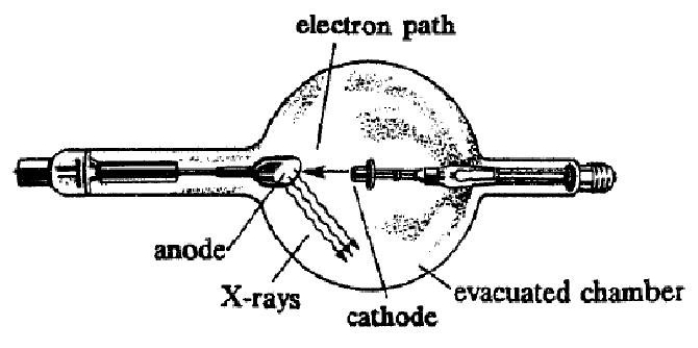
There are two mechanisms by which the X-rays are produced within the metal. The first mechanism is called bremsstrahlung, which is German for “breaking radiation.” X-rays are emitted by the electrons as they are brought to rest by interactions with the positive nuclei of the anode.
The second mechanism occurs when an incoming electron knocks an inner electron out of one of the metal atoms of the anode. This electron is replaced by an electron from a higher energy level of the atom, and a photon making up the energy difference is emitted.
X-rays are absorbed by a material when they pass through it. The amount of X-rays absorbed increases with the density of the material. In addition, lower energy X-rays are more likely to be absorbed than higher energy X-rays. (Note: 1 eV = 1.6 x 10⁻¹⁹ J; Planck’s constant h = 4.1 x 10⁻¹⁵ eV•s; speed of light c = 3 x 10⁸ m/s.)
What is the direction of the electric field that accelerates the electrons?
Select an option, then click Submit answer.
Reference / correct answer:
From the anode toward the cathode
This question involves the use of information in the passage along with some basic knowledge of electric fields and forces. In the second paragraph of the passage, we are told that electrons are accelerated from the cathode to the anode by an electric field. Now we have to figure out the direction of the electric field that would cause the electrons to move in that way. When the electric field lines are drawn, the arrows always point from the positive charge to the negative charge. So the direction of the electric field is the direction in which a positive charge would accelerate in that field. Since electrons are negative charges, they will be accelerated in the direction opposite to that of the electric field. We are pointing from the anode toward the cathode. Therefore, answer choice A is correct.