A study of young and middle-aged men in the United States has found that the men whose diet was high in saturated fat also had a high amount of blood cholesterol. In another experiment, when the blood cholesterol level of laboratory rabbits was raised by feeding them exclusively on cholesterol, fat deposits formed in their blood vessels. Similar fat deposits are found in human patients of heart disease. Therefore, to reduce the occurrence of heart disease, people should reduce their dietary consumption of saturated fat.
Each of the following, if true, weakens the above argument EXCEPT:
Select an option, then click Submit answer.
Reference / correct answer:
An analysis of studies done on more than 600,000 men and women has established that blood cholesterol is inversely associated with the risk of death from infectious respiratory and digestive diseases.
Argument construction
Premise 1: A study of young and middle-aged men in the United States has found that the men whose diet was high in saturated fat (SF) also had a high amount of blood cholesterol (BC).
So, this premise can be simplified as: High SF is correlated with high BC in young and middle-aged American males.
Premise 2: In another experiment, when the blood cholesterol level (BC) of laboratory rabbits was raised by feeding them on cholesterol, fat deposits (FD) were found in their blood vessels.
This premise can be simplified as: In lab rabbits, when BC became high, FD formed.
Premise 3: Similar fat deposits (FD) are found in human patients of heart disease (HD).
So, per this premise, FD is correlated with HD in humans.
By combining these three premises, the following conclusion is drawn:
Conclusion: To reduce the occurrence of heart disease, people should reduce their dietary consumption of saturated fat.
In simpler form: To reduce HD, people should reduce SF.
The structure of this argument can be visually depicted as under:
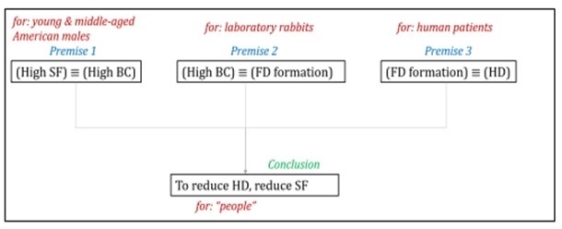
There are a few things to note about the way this argument is drawn:
The argument's conclusion draws broad generalizations whereas the premises are not similarly general in their scope:
1. Premise 1 mentions a finding about one demographic - young and middle -aged American men – while the conclusion drawn is a generalization that seems to apply to all "people," irrespective of age, gender or nationality.
2. Premise 2 mentions a finding about laboratory rabbits while the conclusion drawn is about humans. The argument confounds correlation with causation.
This is proved by the conclusion that reducing SF will cause reduced occurrence of heart disease. However, the premises do not offer grounds for such causality:
1. Premise 1 only states that in one particular group, high SF is correlated with high BC. We cannot infer from this whether it is high SF that caused high BC, or whether high BC caused high SF (for example, by inducing cravings for food that is high SF), or whether some other third factor was the cause of both high SF and high BC (for example, if the individuals of this particular group have a genetic predisposition towards higher BC than other ethnic and/or age groups and also have a diet that is high in SC).
2. In Premise 2, since FD follows an increase in BC, the said increase in BC does seem to cause the FD; however, this causal link is still an assumption and is not explicitly stated by the argument. Alternate explanations might be possible. For example, since these rabbits were fed exclusively on cholesterol, perhaps they developed deficiency of some vital nutrient X (which they usually got from their normal diet) and it was the lack of this nutrient X that caused the formation of FD. With such an explanation, one can see that if the rabbits had continued to consume as much cholesterol as they did in this study but along with the required amounts of X, they would not have formed FD.
3. In Premise 3, FD is found in human patients of HD. This is not enough to conclusively establish that FD causes HD in humans. For example, when the virus of common cold enters the human body, the body activates its immune system and produces antibodies to neutralize that virus. There is a brief period when, if a blood sample is taken from the body, both the virus and the antibodies will be found in it. From this coexistence, drawing a conclusion that the antibodies produced/caused the virus would be wrong. Correlation does not always imply causality, and even when it does, the direction of that causality is not always clear (if A and B coexist, then does A cause B or does B cause A?).
 Not only does the argument make an unreasonable assumption that high SF causes high HD, but it also assumes that the converse of this statement would be true – that is, low SF would cause low HD.
1. The evidence presented in premises 1 and 2 is about high SF and high blood cholesterol. Using this evidence to draw the conclusion that low SF would have the opposite effect to that of high SF is fallacious.
2. For example, the following statement is true: "high stress causes high blood pressure." However, the converse of this - "low stress causes low blood pressure" – is not true.
This is a 'Weaken EXCEPT' question. Therefore, four of the answer choices will weaken the argument. We will be looking for the single statement that does not weaken it.
Let us analyze the options one by one.
Answer choices explanation
[The bodily reactions of animal models to internal or external stimulants…] This option is incorrect. This statement does weaken the argument by suggesting that the use of premise 2 (which describes the bodily reaction of an animal model to high BC) to draw a conclusion about the bodily reaction of the humans to high BC may not be correct. Without this premise, the conclusion cannot hold.
[The per capita consumption of saturated fat in the United States has decreased…] This option is incorrect. This statement does weaken the argument by providing empirical evidence that in the same period in which SF decreased, HD increased by a lot more. This suggests that some factor, other than SF, causes HD and therefore disproves the causal assumptions that went into the drawing of the conclusion.
[An analysis of studies done on more than 600,000 men and women has…] This option is correct. This statement does not weaken the argument. From this statement, we learn some benefits of high blood cholesterol and risks of low blood cholesterol. However, the argument's main concern was not whether the overall impact of high blood cholesterol on human health is beneficial or not. The argument suggests only one specific effect of high blood cholesterol – that it causes heart disease. Likewise, the conclusion is only concerned about reducing HD. If reducing HD by reducing SF has some other side-effects (like increased risk of infections, as this option statement seems to suggest), then so be it. These are "other" side-effects and are outside the scope of the argument. The author is only claiming that reducing SF will reduce HD. He is not claiming that reducing SF will reduce the occurrence of all kinds of diseases.
[A study that covered more than 10,000 individuals has found…] This option is incorrect. This statement weakens the argument. It states that in humans, high blood cholesterol does not lead to HD. This directly disproves the subsidiary conclusion that can be drawn by combining premises 2 and 3 while also assuming that correlation implies causation, this subsidiary conclusion being that high blood cholesterol leads to HD.
[In a study where the dietary saturated fat consumption of young...] This option is incorrect. It weakens the argument. It shows that the extrapolation of premise 1 to all humans (as has been done in the argument) was incorrect. When females of a similar age-group and nationality as the men in the study that is cited in premise 1 ate a high SF diet, their blood cholesterol did not increase. This suggests that there is not a simple causal link between high SF and high BC. The chain of causations on which the conclusion rests therefore stands broken.
