The print circulation of The World Tribune has shown a 40 percent decline in the past two years. However, the traffic on the newspaper's website has increased by 30 percent during the same period. The website contains many news sections and blogs that are not featured in the print newspaper but are the most read pages of the website. Therefore, to maintain its profits, the newspaper has decided to discontinue its still-profitable print edition and to introduce more content on the website that is similar to the exclusive content on the most read pages of the website.
Which one of the following is an assumption on which the decision of The World Tribune depends?
Select an option, then click Submit answer.
Reference / correct answer:
Introducing more content similar to the exclusive content on the most read pages of the website will increase the newspaper's website traffic further.
Argument construction
This argument features two versions/modes in which The World Tribune newspaper is available: the Print Mode and the newspaper's website (called the Web Mode henceforth).
Over the past 2 years:
 The Print Mode's circulation has decreased by 40% - Premise 1 The Web Mode's traffic has increased by 30% - Premise 2
The website contains many news sections and blogs that are not featured in the print newspaper but are the most read pages of the website. This is Premise 3.
The Conclusion drawn (= the decision made) by the newspaper from these three premises is that:
to maintain profits, the newspaper should:
discontinue the still-profitable Print Mode introduce more exclusive content on the website that is similar to the most read pages of the website.
When we analyze the premises of this argument, we realize that from Premises 2 and 3, the decision-makers at the newspaper have assumed that the increase in the Web Mode's traffic is due to the exclusive content that makes for the website's most read pages. It is due to this assumption that they have decided to introduce more such content on the Web Mode. It can also be said that these decision-makers believe (assume) that because such content led to an increase in the website traffic in the past two years, introducing more such content will inevitably increase the website traffic in the future too. That is, they are assuming that a past relationship between two metrics (amount of exclusive content that forms the most-read pages of the Web Mode, website traffic) that held in the past will hold in the future too.
Further, the explicit goal of the newspaper is "to maintain its profits." However, the decision that it has taken concerns its reach – because the reach ("circulation") of the
Print Mode was decreasing while the reach ("traffic") of the Web Mode was increasing, the newspaper decided to kill the still-profitable Print Mode and focus solely on the Web Mode and take measures to increase the traffic of the Web Mode further. So, one necessary assumption that the decision-makers have made is that the increase in profits from increasing the traffic of the Web Mode will at least offset (if not exceed) the loss of profits due to closing down the Print Mode.
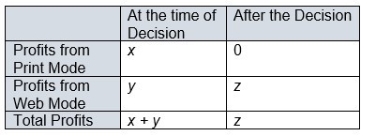
The decision-makers assume that this decision will enable them to "maintain profits," that is:
z ≥ x + y => z − y ≥ x
=> (Post-decision Increase in profit from Web-Mode) ≥ (Post-decision Loss of profit from Print-Mode)
Therefore, to sum up, the assumptions that have gone into the newspaper's decision are:
over the past two years, the increase in the Web Mode's traffic was due to the exclusive content that makes for the website's most read pages in the future too, introducing more such content will continue to drive an increase in the Web Mode's traffic (Post-decision Increase in profit from Web-Mode) ≥ (Post-decision Loss of profit from Print-Mode)
In analyzing the options in an assumption question, the Negation Test often comes in handy. Since a necessary assumption is, by definition, vital for the conclusion to be logically valid, we can test an answer choice by deeming it to be false. If, upon doing so, the conclusion no longer holds, this means that the answer choice in question is indeed a necessary assumption.
Let's analyze each option one by one.
Answer choices explanation
[The print circulation of the newspaper would not have declined further in the near future.] This option is incorrect. Suppose the print circulation of the newspaper would have declined further in the near future. Then, the perception that the Print Mode is a sinking business would be further strengthened and the newspaper's decision to kill the Print Mode would be validated. So, if we Negate this answer choice, the conclusion (= decision made by the newspaper) stands strengthened, instead of being demolished. Therefore, this answer choice fails the Negation Test.
[To access the content on the newspaper's website, the readers of the website will be willing …] This option is incorrect. Let the revenue that the print edition of the newspaper earned per reader each month (at the time of the decision) be dollars. Suppose the readers of the newspaper's website are not willing to pay a subscription fees of dollars per month for access to the website content. Does this necessarily mean that the newspaper will not be able to maintain its profits? No. For example, suppose the readers of the website are only willing to pay a monthly subscription fees of dollars. If the number of website readers is more than ten times the number of print-edition readers (which it very well might be, because, from the argument, we only know the percentage changes in readership of the print-edition and the website traffic, and not the actual numbers), then the revenue from the website subscription fees will be greater than the revenue from the print-edition. If the costs of the website are not greater than the costs of the print-edition, then the profits from the website will be greater than the profits that the print-edition earned at the time of the decision. Therefore, negating this answer choice does not necessarily impact the conclusion.
[The print circulation of the newspaper declined in the past two years…] This option is incorrect. Suppose the print circulation did not decline in the past two years because of the content offered in the Web Mode but due to some other reason. The facts of the case still remain the same – the print circulation was declining, the Web Mode traffic was increasing, and the newspaper wanted to maintain its profits. So, negating this answer choice has no impact whatsoever on the conclusion drawn.
[The revenue earned from increased website traffic will not be less than…] This option is incorrect. Suppose the revenue earned from increased website traffic is indeed less than the revenue lost by discontinuing the print edition. However, if the costs incurred by the newspaper for the Web Mode are far lesser than those for the Print Mode, then profits earned by the newspaper for the Web Mode can still be greater than or equal to the profits earned for the Print Mode. Therefore, the conclusion ("to maintain profits," kill the Print Mode and put more of XYZ type of traffic-increasing content on the Web Mode) can still stand. Therefore, this answer choice fails the Negation Test.
[Introducing more content similar to the exclusive content on the most …] This option is correct. Suppose that introducing more content similar to the exclusive content on the most read pages of the website will not increase the newspaper's website traffic further. The newspaper had assumed: (More such content --> More Web Traffic --> More Profit from Web-Mode that would at least offset the loss of profit from Print-mode). The negation of this answer choice breaks this chain of assumptions and therefore suggests that the newspaper's decision may not result in greater profit from Web-Mode that would at least offset the loss of profit from Print-Mode. Therefore, the profits of the newspaper may not be maintained. The negation of this answer choice substantially weakens the decision made by the newspaper. Therefore, this answer choice represents a necessary assumption on which this decision depends.
