70-764 Administering a SQL Database Infrastructure

Loading demo links...

Showing 10–12 of 20 questions

Question 10

Overview

General Overview

ADatum Corporation has offices in Miami and Montreal.

The network contains a single Active Directory forest named adatum.com. The offices connect to each other by using a WAN link that has 5-ms latency.

Select all that apply, then click Submit answer.

  • Datum standardizes its database platform by using SQL Server 2014 Enterprise edition.
    Databases
    Each office contains databases named Sales, Inventory, Customers, Products, Personnel, and Dev.
    Servers and databases are managed by a team of database administrators. Currently, all of the database administrators have the same level of permissions on all of the servers and all of the databases.
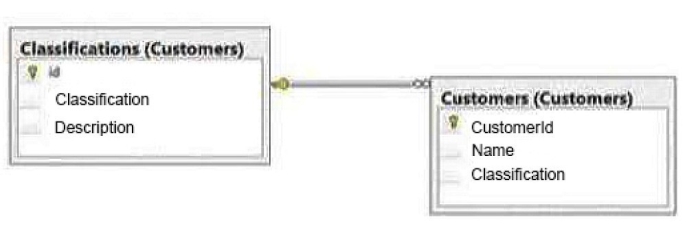
    The Customers database contains two tables named Customers and Classifications. The following graphic shows the relevant portions of the tables:
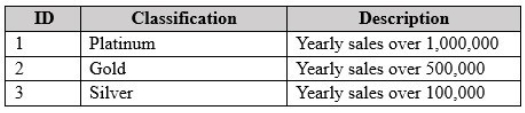
    The following table shows the current data in the Classifications table:
    The Inventory database is updated frequently.
    The database is often used for reporting. A full backup of the database currently takes three hours to complete.
    Stored Procedures
    A stored procedure named USP_1 generates millions of rows of data for multiple reports. USP_1 combines data from five different tables from the Sales and Customers databases in a table named Table1.
    After Table1 is created, the reporting process reads data from Table1 sequentially several times. After the process is complete, Table1 is deleted.
    A stored procedure named USP_2 is used to generate a product list. The product list contains the names of products grouped by category.
    USP_2 takes several minutes to run due to locks on the tables the procedure accesses. The locks are caused by USP_1 and USP_3.
    A stored procedure named USP_3 is used to update prices. USP_3 is composed of several UPDATE statements called in sequence from within a transaction.
    Currently, if one of the UPDATE statements fails, the stored procedure fails. A stored procedure named USP_4 calls stored procedures in the Sales, Customers, and Inventory databases.
    The nested stored procedures read tables from the Sales, Customers, and Inventory databases. USP_4 uses an EXECUTE AS clause.
    All nested stored procedures handle errors by using structured exception handling. A stored procedure named USP_5 calls several stored procedures in the same database. Security checks are performed each time USP_5 calls a stored procedure.
    You suspect that the security checks are slowing down the performance of USP_5. All stored procedures accessed by user applications call nested stored procedures. The nested stored procedures are never called directly.
    Design Requirements Data Recovery
    You must be able to recover data from the Inventory database if a storage failure occurs. You have a Recovery Time Objective (RTO) of 5 minutes.
    You must be able to recover data from the Dev database if data is lost accidentally. You have a Recovery Point Objective (RPO) of one day.
    Classification Changes
    You plan to change the way customers are classified. The new classifications will have four levels based on the number of orders. Classifications may be removed or added in the future. Management requests that historical data be maintained for the previous classifications. Security A group of junior database administrators must be able to manage security for the Sales database. The junior database administrators will not have any other administrative rights.
    Datum wants to track which users run each stored procedure.
    Storage
    ADatum has limited storage. Whenever possible, all storage space should be minimized for all databases and all backups.
    Error Handling
    There is currently no error handling code in any stored procedure.
    You plan to log errors in called stored procedures and nested stored procedures. Nested stored procedures are never called directly.
    You need to recommend a solution for the planned changes to the customer classifications. What should you recommend? (Each correct answer presents part of the solution. Choose all that apply.)
    Add a row to the Customers table each time a classification changes.

  • Add columns for each classification to the Customers table.

  • Add a table to track any changes made to the classification of each customer.

  • Add a column to the Classifications table to track the status of each classification.

  • Implement change data capture.

Question 11

You have an SQL Server 2014 server named SQL1. You are designing a performance monitoring solution. You need to monitor the following events on SQL1: A deadlock graph

Missing column statistics

CPU performance statistics

A batch of completed Transact-SQL statements

Which two tools should you use? Each correct answer presents a complete solution.

Select all that apply, then click Submit answer.

  • dynamic management views

  • Database Engine Tuning Advisor

  • SQL Server Profiler

  • Activity Monitor

  • Data Profile Viewer

Question 12

General Overview

You are the Senior Database Administrator (DBA) for a software development company named Leafield Solutions. The company develops software applications custom designed to meet customer requirements.

Requirements Leafield Solutions has been asked by a customer to develop a web-based Enterprise Resource Planning and Management application. The new application will eventually replace a desktop application that the customer is currently using. The current application will remain in use while the users are trained to use the new webbased application.

You need to design the SQL Server and database infrastructure for the web-based application.

Databases

You plan to implement databases named Customers, Sales, Products, Current_Inventory, and TempReporting.

The Sales database contains a table named OrderTotals and a table named SalesInfo.

A stored procedure named SPUpdateSalesInfo reads data in the OrderTotals table and modifies data in the SalesInfo table.

The stored procedure then reads data in the OrderTotals table a second time and makes further changes to the information in the SalesInfo table.

The Current_Inventory database contains a large table named Inv_Current. The Inv_Current table has a clustered index for the primary key and a nonclustered index. The primary key column uses the identity property.

The data in the Inv_Current table is over 120GB in size. The tables in the Current_Inventory database are accessed by multiple queries in the Sales database.

Another table in the Current_Inventory database contains a self-join with an unlimited number of hierarchies. This table is modified by a stored procedure named SPUpdate2.

An external application named ExternalApp1 will periodically query the Current_Inventory database to generate statistical information. The TempReporting database contains a single table named GenInfo.

A stored procedure named SPUPdateGenInfo combines data from multiple databases and generates millions of rows of data in the GenInfo table.

The GenInfo table is used for reports.

When the information in GenInfo is generated, a reporting process reads data from the Inv_Current table and queries information in the GenInfo table based on that data. The GenInfo table is deleted after the reporting process completes. The Products database contains tables named ProductNames and ProductTypes.

Current System

The current desktop application uses data stored in a SQL Server 2005 database named DesABCopAppDB. This database will remain online and data from the Current_Inventory database will be copied to it as soon as data is changed in the Current_Inventory database.

SQL Servers

A new SQL Server 2012 instance will be deployed to host the databases for the new system. The databases will be hosted on a Storage Area Network (SAN) that provides highly available storage.

Design Requirements

Your SQL Server infrastructure and database design must meet the following requirements:

Confidential information in the Current_ Inventory database that is accessed by ExternalApp1 must be securely stored.

Direct access to database tables by developers or applications must be denied.

The account used to generate reports must have restrictions on the hours when it is allowed to make a connection.

Deadlocks must be analyzed with the use of Deadlock Graphs.

In the event of a SQL Server failure, the databases must remain available.

Software licensing and database storage costs must be minimized.

Development effort must be minimized.

The Tempdb databases must be monitored for insufficient free space.

Failed authentication requests must be logged.

Every time a new row is added to the ProductTypes table in the Products database, a user defined function that validates the row must be called before the row is added to the table.

When SPUpdateSalesInfo queries data in the OrderTotals table the first time, the same rows must be returned along with any newly added rows when SPUpdateSalesInfo queries data in the OrderTotals table the second time.

You need to plan the SQL Server 2012 deployment that meets the design requirements. Which of the following steps should you perform?

Select all that apply, then click Submit answer.

  • Upgrade the existing SQL Server 2005 server to SQL Server 2012.

  • Install one new server running SQL Server 2012.

  • Install two new servers running SQL Server 2012

  • Configure Failover Clustering

  • Configure AllwaysOn