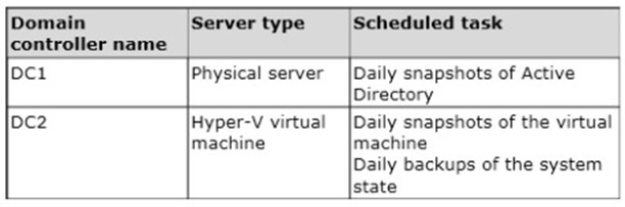
You are a network administrator of an Active Directory domain named contoso.com.
You have a server named Server1 that runs Windows Server 2012 R2. Server1 has the DHCP Server server role and the Network Policy Server role service installed.
You enable Network Access Protection (NAP) on all of the DHCP scopes on Server1. You need to create a DHCP policy that will apply to all of the NAP non-compliant DHCP clients.
Which criteria should you specify when you create the DHCP policy?
Select an option, then click Submit answer.
Reference / correct answer:
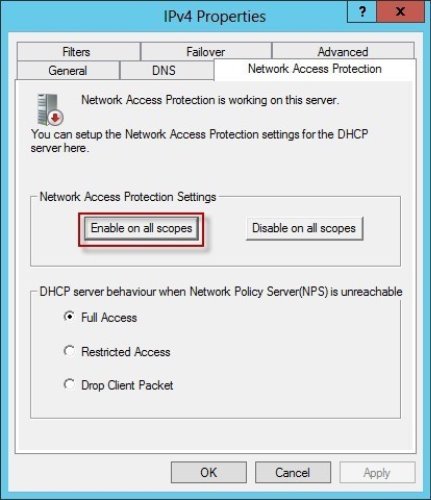
To configure a NAP-enabled DHCP server
 On the DHCP server, click Start, click Run, in Open, type dhcpmgmt. smc, and then press ENTER.
In the DHCP console, open \IPv4.
Right-click the name of the DHCP scope that you will use for NAP client computers, and then click Properties.
On the Network Access Protection tab, under Network Access Protection Settings, choose Enable for this scope, verify that Use default Network Access Protection profile is selected, and then click OK.
In the DHCP console tree, under the DHCP scope that you have selected, right-click Scope Options, and then click Configure Options.
On the Advanced tab, verify that Default User Class is selected next to User class.
Select the 003 Router check box, and in IP Address, under Data entry, type the IP address for the default gateway used by compliant NAP client computers, and then click Add.
Select the 006 DNS Servers check box, and in IP Address, under Data entry, type the IP address for each router to be used by compliant NAP client computers, and then click Add.
Select the 015 DNS Domain Name check box, and in String value, under Data entry, type your organization's domain name (for example, woodgrovebank. local), and then click Apply. This domain is a full-access network assigned to compliant NAP clients. 10.On the Advanced tab, next to User class, choose Default Network Access Protection Class. 11.Select the 003 Router check box, and in IP Address, under Data entry, type the IP address for the default gateway used by noncompliant NAP client computers, and then click Add. This can be the same default gateway that is used by compliant NAP clients. 12.Select the 006 DNS Servers check box, and in IP Address, under Data entry, type the IP address for each DNS server to be used by noncompliant NAP client computers, and then click Add. These can be the same DNS servers used by compliant NAP clients. 13.Select the 015 DNS Domain Name check box, and in String value, under Data entry, type a name to identify the restricted domain (for example, restricted. Woodgrovebank. local), and then click OK. This domain is a restricted-access network assigned to noncompliant NAP clients.
Click OK to close the Scope Options dialog box. Close the DHCP console.
Reference: http: //technet.microsoft.com/en-us/library/dd296905%28v=ws.10%29.aspx