70-411 Administering Windows Server 2012

Loading demo links...

Showing 7–9 of 15 questions

Question 7 (Volume B)

Your network contains an Active Directory domain named adatum.com. The domain contains a server named Server1 that runs Windows Server 2012 R2. Server1 is configured as a Network Policy Server (NPS) server and as a DHCP server.

The network contains two subnets named Subnet1 and Subnet2. Server1 has a DHCP scope for each subnet.

You need to ensure that noncompliant computers on Subnet1 receive different network policies than noncompliant computers on Subnet2.

Which two settings should you configure? (Each correct answer presents part of the solution. Choose two.)

Select all that apply, then click Submit answer.

  • The NAP-Capable Computers conditions

  • The NAS Port Type constraints

  • The Health Policies conditions

  • The MS-Service Class conditions

  • The Called Station ID constraints

Question 8 (Volume B)

Your network contains two Active Directory forests named contoso.com and adatum.com. The contoso.com forest contains a server named

Server1.contoso.com. The adatum.com forest contains a server named server2. adatum.com. Both servers have the Network Policy Server role service installed.

The network contains a server named Server3. Server3 is located in the perimeter network and has the Network Policy Server role service installed.

You plan to configure Server3 as an authentication provider for several VPN servers.

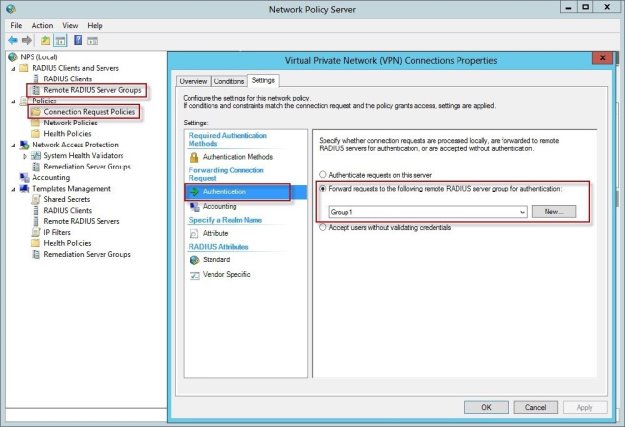
You need to ensure that RADIUS requests received by Server3 for a specific VPN server are always forwarded to Server1.contoso.com.

Which two should you configure on Server3? (Each correct answer presents part of the solution.

Choose two.)

Select all that apply, then click Submit answer.

  • Remediation server groups

  • Remote RADIUS server groups

  • Connection request policies

  • Network policies

  • Connection authorization policies

Question 9 (Volume A)

Your network contains an Active Directory domain named contoso.com. The domain contains a server named NPS1 that has the Network Policy Server server role installed. All servers run Windows Server 2012 R2.

You install the Remote Access server role on 10 servers.

You need to ensure that all of the Remote Access servers use the same network policies.

Which two actions should you perform? (Each correct answer presents part of the solution. Choose two.)

Select all that apply, then click Submit answer.

  • Configure each Remote Access server to use the Routing and Remote Access service (RRAS) to authenticate connection requests.

  • On NPS1, create a remote RADIUS server group. Add all of the Remote Access servers to the remote RADIUS server group.

  • On NPS1, create a new connection request policy and add a Tunnel-Type and a Service-Type condition.

  • Configure each Remote Access server to use a RADIUS server named NPS1.

  • On NPS1, create a RADIUS client template and use the template to create RADIUS clients.