HPE6-A79 Aruba Certified Mobility Expert Written Exam

Loading demo links...

Showing 4–6 of 10 questions

Question 4

A network administrator is in charge of a Mobility Master (MM) – Mobility Controller (MC) based WLAN. The administrator has deployed an Airwave Management Platform (AMP) server in order to improve the monitoring capabilities and generate reports and alerts.

The administrator has configured SNMPv3 and Admin credentials on both the MMs and MCs and has created Groups and Folders in the AMP server. What two additional steps must the administrator do in order to let Airwave monitor the network devices? (Choose two.)

Select all that apply, then click Submit answer.

  • Manually add the Active MM and wait for automatic Discovery.

  • Map the AMP’s IP address with a mgmt-config profile in the MM.

  • Set the AMP’s IP address and Org string as DHCP option 43.

  • Manually add each MM, MC and Access Point in the AMP server.

  • Move “New” devices into a group and folder in Airwave.
Question 5

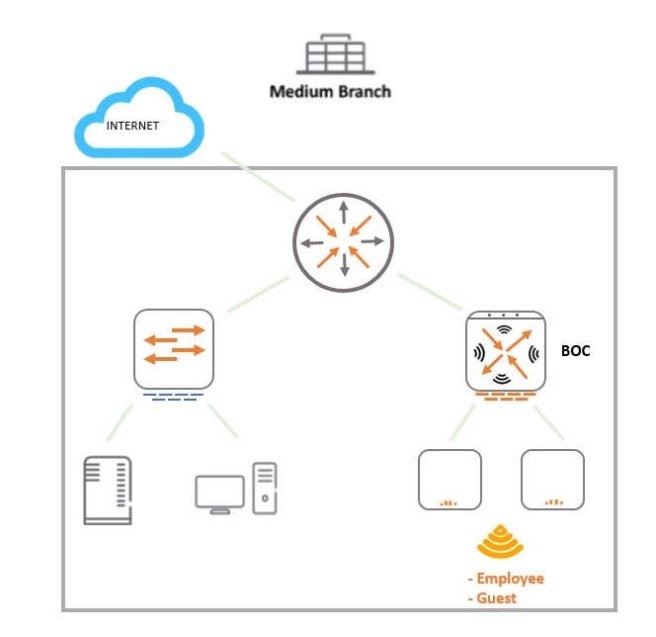
Refer to the exhibit.

A 7008 Branch Office Controller (BOC) is deployed in a remote office behind a core router. This core does not support 802.1q encapsulation. The Mobility Controller (MC) is the gateway for two tunneling mode SSIDs, as shown in the exhibit.

Which two different configuration options ensure that wireless users are able to reach the branch network through the router? (Choose two.)

Select all that apply, then click Submit answer.

  • Configure all ports of the BOC as access ports on the controller VLAN, and change the gateway of clients to the core router IP.

  • Configure the uplink of the BOC as an access port on the controller VLAN, and add static routes in the router for the SSID VLAN subnets.

  • Configure the uplink of the BOC as a trunk port that permits the controller and the SSID VLANs. The controller VLAN must be native.

  • Configure the uplink of the BOC as an access port on the controller VLAN, and enable NAT for the SSID VLANs.

  • Configure the uplink of the BOC as a trunk port, tagging the controller and the SSOD VLANs, and enable NAT for the SSID VLANs.

Question 6

A company with 535 users deploys an Aruba solution with more than 1000 Aruba APs, two 7220 Mobility Controllers, and a single Mobility Master (MM) virtual appliance at the campus server farm. The MCs run a HA Fast failover group in dual mode and operate at 50% AP capacity.

If there is an MM or MC failure, the network administrator must ensure that the network is fully manageable and the MC load does not exceed 80%.

What can the network administrator do to meet these requirements?

Select an option, then click Submit answer.

  • Place the APs in the same hierarchy level.

  • Create a cluster with AP load balancing.

  • Enable oversubscription in the HA group.

  • Add an MC and an MM in the server farm.

  • Add an MM and enable DC redundancy.

  • Place the APs in two different AP-Groups.