HPE6-A79 Aruba Certified Mobility Expert Written Exam

Loading demo links...

Showing 1–3 of 10 questions

Question 1

HOTSPOT

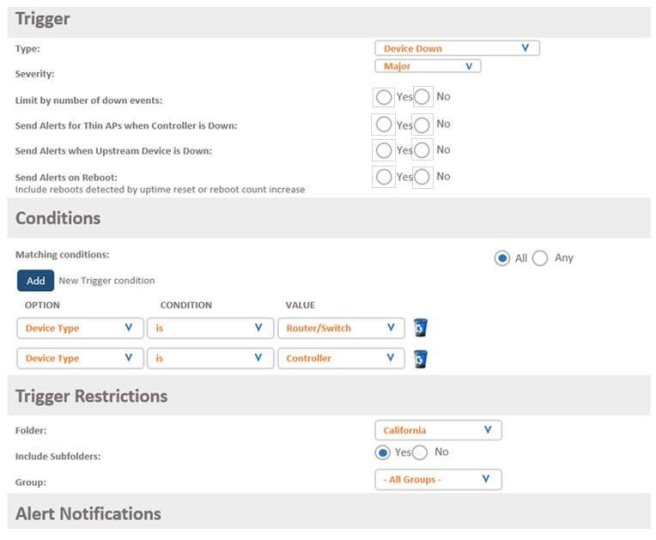
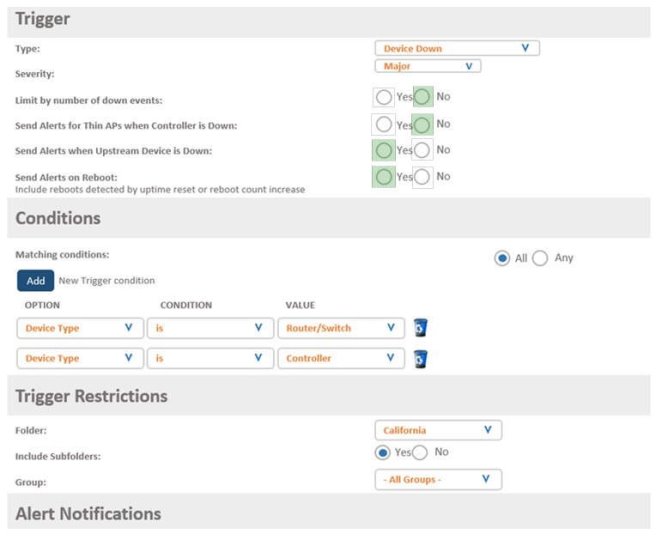
A network administrator wants to receive a major alarm every time a controller or an Aruba switch goes down for either a local or an upstream device failure. Which alarm definition must the network administrator create to accomplish this?

Hot Area:

Answer is in the explanation below.

Question 2

A network administrator has updated the ArubaOS code of a standalone Mobility Controller (MC) that is used for User-Based Tunneling (UBT) to a newer early release. Ever since the MC seems to reject PAPI sessions from the switch with the 10.1.10.10 IP address. Also the controller’s prompt is now followed by a star mark: “(MC_VA) [mynode] *#”

When opening a support ticket, an Aruba TAC engineer asks the administrator to gather the crash logs and if possible replicate UBT connection attempts from the switch while running packet captures of PAPI traffic on the controller and obtain the PCAP files. The administrator has a PC with Wireshark and TFTP server using the 10.0.20.20 IP address.

What commands must the administrator issue to accomplish these requests? (Choose two.)
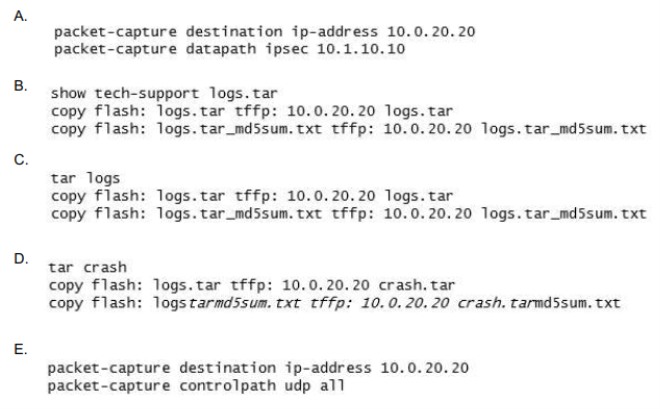
Select all that apply, then click Submit answer.

  • Option A

  • Option B

  • Option C

  • Option D

  • Option E

Question 3

An organization owns a fully functional multi-controller Aruba network with a Virtual Mobility Master (VMM) in VLAN20. They have asked a network consultant to deploy a redundant MM on a different server. The solution must offer the lowest convergence time and require no human interaction in case of failure.

The servers host other virtual machines and are connected to different switches that implement ACLs to protect them. The organization grants the network consultant access to the servers only, and appoints a network administrator to assist with the deployment.

What must the network administrator do so the network consultant can successfully deploy the solution? (Choose two.)

Select all that apply, then click Submit answer.

  • Allocate VLAN20 to the second server, and extend it throughout the switches, then reserve one IP address for the second MM and another IP address for its gateway.

  • Allocate VLAN20 to the second server, and permit routing between them, then reserve one IP address for the second MM and another IP address for its gateway.

  • Configure an ACL entry that permits IP protocol 50, UDP port 500, and multicast IP 224.0.0.18.

  • Allocate VLAN20 to the second server, and extend it throughout the switches, then reserve one IP address for the second MM and another for the VIP.

  • Configure an ACL entry that permits UDP 500, TCP 4500, and multicast IP 224.0.0.5.