
ITIL 4 Foundation: The Service Value System in Plain English
ITIL 4 Foundation: The Service Value System in Plain English
Most people who fail ITIL 4 Foundation do not fail because the material is hard. They fail because the words look familiar and mean something slightly different from what they expect. Service, value, practice, incident, problem — ordinary words, each carrying a precise ITIL definition, and the exam tests whether you know the ITIL meaning rather than the everyday one. This post is the plain-English version of the framework's core: the Service Value System, the model the whole exam is built around. Learn it properly and the rest of the syllabus — the principles, the dimensions, the value chain, the practices — stops being a list to memorise and starts being one connected idea.
The Exam You Are Actually Taking
ITIL 4 Foundation is PeopleCert's entry-level service management certification, and it is a short exam by certification standards. That is the first thing to get straight, because a surprising amount of the material circulating about it is wrong on the basic facts — including, at the time of writing, parts of our own exam page, which quotes a 90-minute duration and a 70% pass mark in its FAQ. The published figures are different, and they are the ones the exam runs on.
ITIL 4 Foundation exam facts
The exam is 40 multiple-choice questions, each with one correct answer, taken closed-book in 60 minutes. The pass mark is 65%, which means 26 correct answers out of 40 — you can afford 14 wrong and still pass, though that margin disappears fast if one topic has been under-revised. There is no negative marking, so a guessed answer can only help. Candidates sitting in a language that is not their native language get 25% extra time, about 75 minutes. The published exam fee is USD $463 — confirm it at booking, because prices vary by region and PeopleCert changes them. You book and sit the exam through PeopleCert, online proctored from home or at a test centre, in 12 languages including English.
Who should take it, and what it is not
There is no work-experience requirement and no technical prerequisite. What PeopleCert does require is an accredited training course before you sit the exam — the voucher is normally sold as part of a training package, so check that your course includes the exam before you pay for anything separately. The credential itself has no alphanumeric exam code like SY0-701 or AZ-900; it is simply ITIL 4 Foundation. It is also not a technical exam. There is no lab, no simulation, no command line. It tests whether you understand how IT services create value and how the pieces of a service organisation fit together. If you are a service desk analyst, a support engineer, an IT manager, or anyone whose work touches services that other people depend on, it is aimed at you. The certificate is valid for three years, renewed through PeopleCert's continuing-professional-development route.
How the syllabus is weighted
PeopleCert publishes nine syllabus topics and — unusually — no percentage weightings for them, so there is no domain to game. The topics are: key concepts of service management, the guiding principles, the four dimensions, the service value system, the service value chain, the ITIL practices, continual improvement, service level agreements, and key metrics. The exam spreads its 40 questions across all of them, which is why the study plan below works through the framework in order rather than cherry-picking the familiar parts. The syllabus version in force is v4.2.0, published in March 2025.
What "Service" Actually Means in ITIL 4
Everything in ITIL 4 hangs off one definition, and the exam will test it: a service is a means of enabling value co-creation by facilitating outcomes that customers want to achieve, without the customer having to manage specific costs and risks. Three words in that sentence do the work, and each one is a common exam trap.
Value is defined by the consumer
Value is not what the provider thinks it delivered. It is what the consumer experiences, and it changes over time and in different circumstances. A reporting dashboard that was valuable last quarter can be worthless this quarter if the business question changed. The exam likes questions where a technically excellent service scores badly because nobody asked the consumer what outcome they wanted. If an answer choice describes value from the provider's point of view, it is usually wrong.
Outcomes, not outputs
An outcome is a result the consumer wants — a new starter working on day one, a customer able to place an order, a month-end close that finishes on time. An output is what the provider produces — a laptop imaged, a ticket closed, a report generated. Outputs matter only insofar as they produce outcomes. This is the distinction behind the exam's favourite kind of question: a team that hit every output target while the consumer's outcome got worse has failed, however good its numbers look.
Costs and risks the consumer does not manage
The last clause is the point of having a service at all. The consumer pays for the outcome and does not have to manage the costs and risks of producing it — the provider carries those. When a service is withdrawn and the consumer has to build the capability themselves, they take the costs and risks back. Any exam answer that shifts risk onto the consumer without them gaining control of the outcome is describing a bad service, not a good one.
Utility and warranty: the two halves of value
ITIL splits value into two parts, and the exam tests the split constantly. Utility is fitness for purpose: does the service do what is needed? A laptop that cannot run the software the job requires has no utility, however reliable it is. Warranty is fitness for use: is the service available when needed, at the capacity needed, secure enough, and continuously enough? A laptop that runs everything but is unavailable half the morning has no warranty. A service only has value when it has both. The common trap is an answer that fixes one half while ignoring the other — faster incident response does not help if the service keeps failing, and perfect availability does not help if the service does the wrong thing.
The Service Value System, Piece by Piece
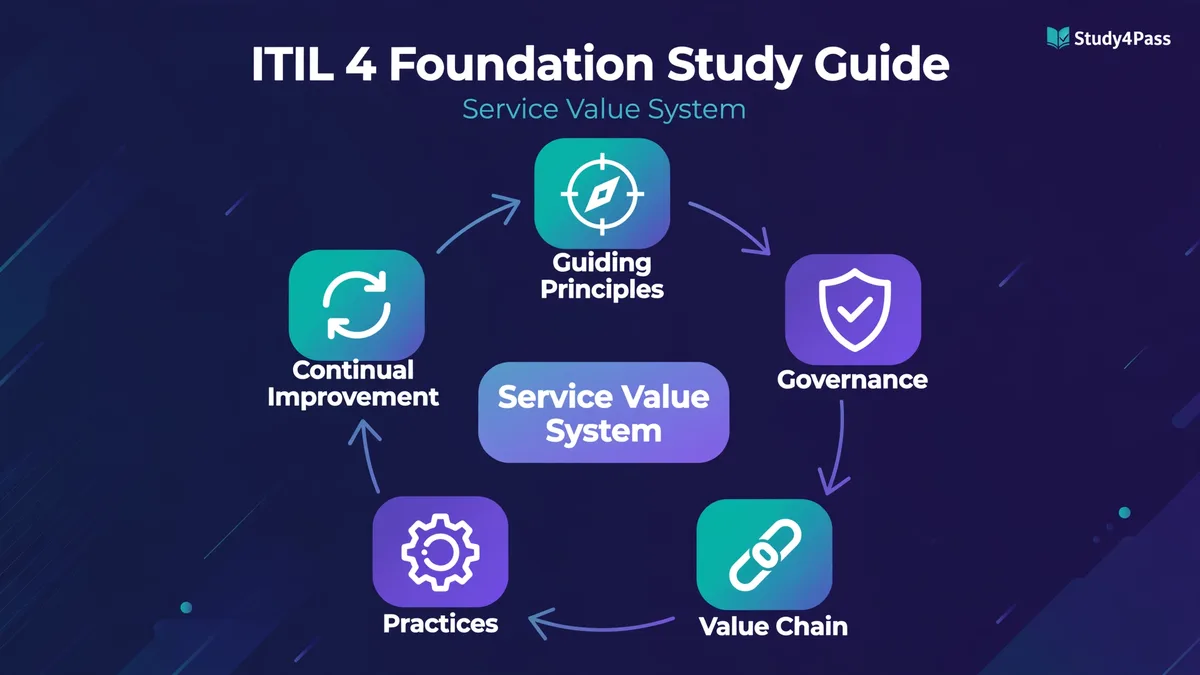
The Service Value System is ITIL 4's central model: how all the components and activities of an organisation work together to facilitate value creation. It has five components, and the exam expects you to name them and explain how they connect: the guiding principles, governance, the service value chain, the practices, and continual improvement. Opportunity and demand go in one side; value comes out the other.
The seven guiding principles
The guiding principles are recommendations that guide an organisation in all circumstances, regardless of its goals or structure. They are the most heavily tested part of Foundation, and the exam usually tests them through short scenarios rather than straight definitions — a situation is described, and you pick the principle it illustrates or violates.
Focus on value
Everything the organisation does should link, directly or indirectly, to value for the stakeholders. When a team is asked to justify a piece of work, "because the process says so" is never the right answer in ITIL 4.
Start where you are
Do not start from scratch when something already exists. Assess the current state honestly, reuse what works, and only build what is missing. This is the principle behind the exam questions where a consultant proposes discarding a working process — the right answer is almost always to keep and improve it.
Progress iteratively with feedback
Work in small steps, get feedback, and adjust. Large, untested changes are how services break. If a scenario describes a big-bang rollout with no pilot and no feedback loop, the principle being violated is this one.
Collaborate and promote visibility
Work across silos and make the work visible. Hidden work cannot be improved, and decisions made without the people affected are usually wrong. The exam tests this with scenarios where one team changes something without telling the teams downstream.
Think and work holistically
No service, practice, or team exists in isolation. Consider the whole system — which is why this principle recommends considering all four dimensions (below) before acting. The trap answer in holistic questions is the one that optimises a single team at the expense of the service as a whole.
Keep it simple and practical
Remove what does not add value. If a process has steps nobody can explain the purpose of, they should go. Exam questions here usually offer a complicated control as the tempting wrong answer and the simple effective one as the right answer.
Optimise and automate
Optimise first, then automate — never automate a broken process, because automation only makes it fail faster. Human intervention should be kept for the work where it genuinely adds value. This ordering, optimise before automate, is itself a favourite exam point.
Governance: who decides
Governance is how an organisation is directed and controlled. In the SVS it sits above the value chain: it sets direction, makes sure the organisation complies with its obligations, and evaluates performance. The exam distinction that matters is governance versus management. Governance decides what should be done and whether it is being done well; management plans, organises, and runs the work. A service owner who approves a change to a service is governing; the team that implements the change is managing.
The service value chain: six activities
The service value chain is the operating model at the centre of the SVS — six activities the organisation combines into value streams to respond to demand and create value. The activities are plan, improve, engage, design and transition, obtain or build, and deliver and support. A value stream is a specific sequence of these activities for a specific service: onboarding a new starter, for example, runs engage (find out what the starter needs), plan (agree the standard laptop and access), obtain or build (procure and configure), deliver and support (hand it over and support it), with improve running across all of it. The exam tests the activities by purpose: plan ensures a shared understanding of vision, current status and improvement direction; improve ensures continual improvement of products, services and practices; engage provides a good understanding of stakeholder needs and transparency; design and transition ensures products and services meet stakeholder expectations for quality, costs and time to market; obtain or build ensures service components are available when and where needed; deliver and support ensures services are delivered and supported according to agreed specifications. Learn each purpose in one sentence and the scenario questions answer themselves.
The practices: 15 purposes, 7 in detail
A practice is a set of organisational resources designed for performing work or accomplishing an objective. ITIL 4 defines 34 practices in total, and Foundation covers 15 of them: you need to know the purpose of all 15, and seven of them in detail. The seven examined in detail are continual improvement, change control, incident management, problem management, service request management, the service desk, and service level management. The eight you need at purpose level are deployment management, IT asset management, monitoring and event management, release management, service configuration management, information security management, relationship management, and supplier management.
The seven in detail, and their classic confusions
Continual improvement aligns the organisation's practices and services with changing business needs through ongoing improvement of products, services and practices. Change control maximises the number of successful changes by managing risk, authorising changes and managing the change schedule — note the name: ITIL 4 calls it change control, not change management, and the exam will use the new name. Incident management restores normal service operation as quickly as possible and minimises adverse impact; problem management reduces the likelihood and impact of incidents by identifying their underlying causes. The incident-versus-problem distinction is the single most tested pair in the exam: an incident is an unplanned interruption or reduction in quality, a problem is the cause of one or more incidents, and fixing the incident is not the same as fixing the problem. Service request management handles pre-defined, user-initiated requests — a password reset, a standard laptop — through a fulfilment process that is separate from incident handling. The service desk is the single point of contact between the service provider and users, capturing demand for incident resolution and service requests. Service level management sets clear business-based targets for service levels and ensures delivery is measured against them; the service level agreement is the documented agreement between provider and consumer, and the exam expects you to know that an SLA is agreed with the consumer, not imposed on them.
Continual improvement: the model and the habit
Continual improvement is both a practice and a component of the SVS, because it applies to everything else. Its model has seven steps: what is the vision, where are we now, where do we want to be, how do we get there, take action, did we get there, and how do we keep the momentum. The exam tests the order and the logic — you cannot plan how to get there before you know where you are, and you cannot claim success without checking whether you got there. The improvement register is where improvement ideas are captured and tracked; an idea that is never recorded is an idea that will be lost. The practical point for candidates is that continual improvement is not a project with an end date. It is the habit that keeps the other four SVS components honest.
The Four Dimensions of Service Management
The four dimensions are the perspectives from which every component of the SVS should be considered. If any one of them is ignored, the service will eventually fail or not meet expectations of quality or efficiency. The dimensions are organisations and people, information and technology, partners and suppliers, and value streams and processes. The exam tests them through PESTLE — political, economic, social, technological, legal and environmental factors — which are the external forces that act on each dimension.
Organisations and people
Culture, structure, roles, responsibilities, staffing and competences. A technically perfect service fails if the team running it has no authority to act, or if the culture punishes people for reporting incidents. Exam questions here are usually about a team that has the right tools but the wrong structure around them.
Information and technology
What information is managed by the services, what supporting information and knowledge is needed, how it is protected, managed, archived and disposed of, and whether the technology is compatible with the current architecture and viable in the future. The trap is treating technology as the answer: a new tool that does not fit the architecture is a new problem, not a solution.
Partners and suppliers
Every organisation depends on external parties, from cloud providers to hardware vendors, with differing levels of integration and formality. The exam tests whether you know the relationship has to be managed deliberately — a supplier whose performance is never measured is a risk, not a convenience.
Value streams and processes
How the organisation's work is actually organised: value streams are the series of steps that create and deliver products and services, and processes are the activities that transform inputs into outputs. A process that is efficient on paper but sits in a value stream nobody owns will still fail the consumer.
A Two-Week Study Plan
ITIL 4 Foundation rewards steady reading over cramming, because the exam tests understanding of a connected framework rather than recall of isolated facts. Two weeks at about an hour a day is enough for most candidates who have already done the accredited training; without training, allow three weeks and treat the first week as reading time.
Week 1: learn the framework
Days 1–2: the key concepts — service, value, utility and warranty, outcomes versus outputs, service offerings, service relationships, and the service consumer's roles (customer, user, sponsor). Write each definition in your own words; if you cannot explain utility versus warranty to a colleague in one sentence, you have not learned it yet. Days 3–4: the seven guiding principles, one at a time, each with a real example from your own workplace. Days 5–6: the four dimensions and the SVS, drawn as a diagram from memory — the act of drawing it is what makes the connections stick. Day 7: the service value chain, learning the purpose of each of the six activities until you can state it in a sentence.
Week 2: drill the practices and the exam
Days 8–10: the 15 practices — purposes of all 15, then the seven in detail, with special attention to the pairs the exam confuses: incident versus problem, change control versus release management, service request versus incident, service level management versus monitoring and event management. Days 11–12: full timed practice sets of 40 questions in 60 minutes, including the free 15-question demo to calibrate first, then the full 369-question bank in timed Exam Simulation. Day 13: review every question you got wrong and every question you guessed right, reading the explanation each time — the reasoning behind an answer is what the real exam tests. Day 14: light review only. Re-read your one-sentence definitions, re-draw the SVS from memory, and stop. Cramming new material the night before a definitions exam is how candidates turn known answers into confused ones.
The pacing rule
Sixty minutes for 40 questions is 90 seconds each, which sounds generous and is, provided you do not stall. Answer the questions you know first, flag the ones that need thought, and come back to them. Because there is no negative marking, never leave a question blank — a guess on a question you do not know is free, and an unanswered question is a guaranteed miss.
Exam Day: What Catches People Out
The exam's traps are consistent, and knowing them in advance is worth several marks. First, the v3 language trap: if an answer uses ITIL v3 terms — service strategy, service design, service transition, service operation as lifecycle stages, or "change management" instead of change control — it is describing the old framework, not the one being examined. Second, the "best" trap: several answers can sound reasonable, and the exam asks for the best one, which is usually the answer that follows the guiding principles rather than the one that follows habit. Third, the definition trap: two answers can use the same words in a different order, and only one matches the ITIL definition exactly. Finally, the scenario trap: the exam describes a situation and asks which practice or principle applies. The right answer is the one that fits the situation described, not the practice you happen to know best.
After the exam: where the cert leads
Foundation is the entry point to the ITIL 4 certification scheme and a prerequisite for everything above it: the Managing Professional and Strategic Leader streams and the extension modules. For most candidates the immediate value is simpler: it is the certification hiring managers ask for on service desk, support and IT management roles, because it signals that a candidate understands how services work rather than just how one tool works. It pairs naturally with a technical certification — a service desk analyst with Foundation and A+, or an administrator with Foundation and AZ-104, can explain both the technology and the service around it, which is exactly the combination service organisations hire for.
ITIL 4 Foundation: Frequently Asked Questions
How hard is ITIL 4 Foundation?
It is a moderate exam. Candidates who have done the accredited training and worked through practice questions usually pass first time; candidates who try to memorise definitions without understanding the framework struggle, because the questions test application through scenarios rather than recall. The 65% pass mark is forgiving, but only if your knowledge covers the whole syllabus — a candidate who knows the practices cold and nothing about the SVS can still fail.
How long should I study?
About two weeks at an hour a day after the training course, or three weeks if you are starting from zero. The training itself is typically two days. The most common mistake is spending all the time on the practices and none on the guiding principles and the SVS — the principles alone are worth more marks than any single practice.
What happens if I fail?
You can retake it. PeopleCert's retake rules and fees are published with the exam booking, so check them when you book rather than after a fail. The useful step after a fail is the score breakdown: it shows which syllabus areas cost you marks, and that is exactly what your second attempt should be built around.
ITIL 4 Foundation is a short exam about a big idea: services exist to create value for the people who use them, and everything else — principles, dimensions, value chains, practices — is machinery for doing that reliably. Learn the Service Value System until you can draw it from memory and explain each piece in a sentence, and the rest of the syllabus falls into place around it. When you are ready to test yourself, start with the free ITILFND-V4 practice test — 369 questions and answers — and try the 15-question free demo first to calibrate, no signup, with an explanation and the Ask AI panel on every question.