Free S90.08B – SOA Design & Architecture Lab with Services & Microservices Practice Test Question

Free demo downloads

Loading demo links...

Showing 1–5 of 5 questions

Question 1

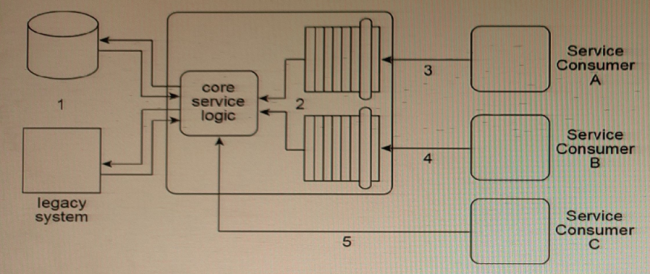
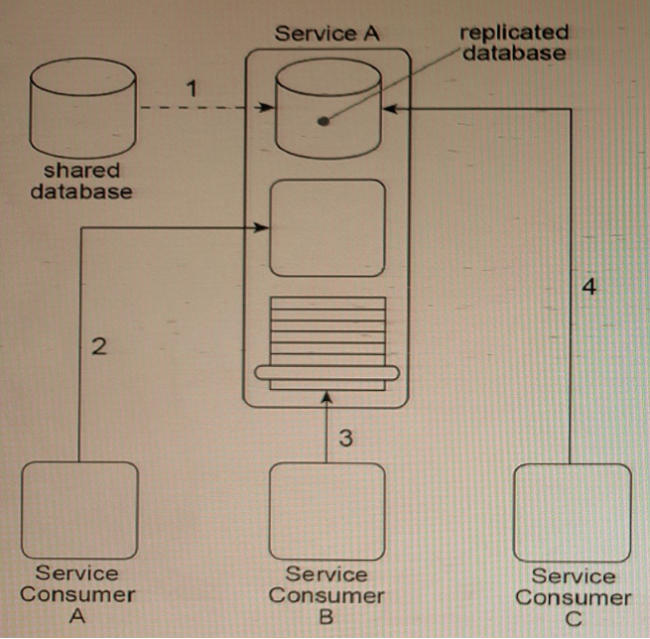
The architecture for Service A displayed in the figure shows how the core logic of Service A has expanded over time to connect to a database and a proprietary legacy system (1), and to support two separate service contracts (2) that are accessed by different service consumers.

The service contracts are fully decoupled from the service logic. The service logic is therefore coupled to the service contracts and to the underlying implementation resources (the database and the legacy system).

Service A currently has three service consumers. Service Consumer A and Service Consumer B access Service A's two service contracts (3, 4). Service Consumer C bypasses the service contracts and accesses the service logic directly (5).

You are told that the database and legacy system that are currently being used by Service A are being replaced with different products. The two service contracts are completely decoupled from the core service logic, but there is still a concern that the introduction of the new products will cause the core service logic to behave differently than before.

What steps can be taken to change the Service A architecture in preparation for the introduction of the new products so that the impact on Service Consumers A and B is minimized? What further step can be taken to avoid consumer-to-implementation coupling with Service Consumer C?

Select an option, then click Submit answer.

  • ○

    The Service Fagade pattern can be applied to position fagade components between the core service logic and Service Consumers A and B. These fagade components will be designed to regulate the behavior of Service The Service Abstraction principle can be applied to hide the implementation details of the core service logic of Service A, thereby shielding this logic from changes to the implementation. The Schema Centralization pattern can be applied to force Service Consumer C to access Service A via one of its existing service contracts.
  • ○

    A third service contract can be added together with the application of the Contract Centralization pattern. This will force Service Consumer C to access Service A via the new service contract. The Service Fagade pattern can be applied to position a fagade component between the new service contract and Service Consumer C in order to regulate the behavior of Service A. The Service Abstraction principle can be applied to hide the implementation details of Service A so that no future service consumers are designed to access any of Service A's underlying resources directly.

  • ○

    The Service Fagade pattern can be applied to position fagade components between the core service logic and the two service contracts. These fagade components will be designed to regulate the behavior of Service A. The Service Loose Coupling principle can be applied to avoid negative forms of coupling.

  • ○

    The Service Fagade pattern can be applied to position fagade components between the core service logic and the implementation resources (the database and the legacy system). These fagade components will be designed to insulate the core service logic of Service A from the changes in the underlying implementation resources. The Schema Centralization and Endpoint Redirection patterns can also be applied to force Service Consumer C to access Service A via one of its existing service contracts.
Ask AI for More Explanation

— your own AI account, opens inside the app

About the S90.08B Free Practice Test

Thinking of taking the SOA Design & Architecture Lab with Services & Microservices (S90.08B) exam? This free SOA practice test is the place to start. The 5 questions are a free sample of the full Study4Pass practice set of 17 questions, so you can check your level before you commit to the real exam. The free sample is made up of 5 single-answer questions, each with a full explanation. Questions are spread across the areas that matter most on the real exam: Such as service design, Service composition, Service security and Service governance. The duration of the SOA S90.08B exam is 90 minutes.

The target audience for the SOA S90.08B exam is professionals who are involved in the development and implementation of service-oriented architecture (SOA) solutions. There are no prerequisites for the SOA S90.08B Exam.

  • Certification: SOA Design & Architecture Lab with Services & Microservices (S90.08B)
  • Vendor: SOA
  • Free on this page: 5 practice questions with answers and explanations
  • Full practice set: 17 questions

Treat this sample as a diagnostic. Answer honestly, check the explanation after every question, and note which topics feel shaky. A short, focused review of those topics is worth more than re-reading everything — and the full set lets you drill them topic by topic.

A good way to use this page: take the whole sample in one sitting, then go back over every explanation with fresh eyes. Mark the topics that felt uncertain, not just the ones you got wrong — uncertain answers are unmarked risk on the real exam. One or two focused passes like this usually move a score more than days of passive reading.

Inside the full S90.08B practice set:

  • All 17 questions with answers and explanations
  • Timed Exam Simulation that mirrors the real exam pressure
  • Topic Training to drill one domain at a time
  • Ask AI for More Explanation on every question
  • Flag questions and review them before you finish

How to use this S90.08B free practice test

Answer a question, then check the result to see the correct answer and the explanation behind it. Work at your own pace — there is no timer and no signup. Stuck on a concept? This is an AI-Enabled practice test: use Ask AI on any question and get the underlying concept explained in plain words, so you learn the reasoning instead of memorizing answers. When the free sample feels comfortable, the full set of 17 questions adds timed Exam Simulation, topic-by-topic training, and flagged-question review — the closest thing to exam day you can get before the real thing.

What to study for each S90.08B domain

  • Such as service design — Use the practice questions to find your gaps in Such as service design first, then read the official SOA documentation for anything you missed.
  • Service composition — For Service composition, focus on understanding why each correct answer is right; the real exam rewards reasoning over recall.
  • Service security — Drill Service security with the questions above, and revisit any explanation that surprises you — surprises are exactly what to fix before the exam.
  • Service governance — Work through the Service governance questions until the reasoning behind each answer is clear — guessing your way past this area will show up on exam day.
  • And microservices architecture — Use the practice questions to find your gaps in And microservices architecture first, then read the official SOA documentation for anything you missed.

S90.08B practice test — quick questions

Is this S90.08B practice test free?

Yes. Every question on this page — all 5 of them — is free to use, and you never need to create an account to try them.

How many questions are in the full S90.08B set?

The full Study4Pass set for S90.08B has 17 practice questions. This page gives you 5 of them free so you can judge the quality and difficulty first.

Does the free test show the answers?

Yes. Check any question to reveal the correct answer and its explanation, and use Ask AI whenever you want the underlying concept explained step by step.

Is this the real S90.08B exam?

No — these are practice questions built to match the S90.08B domains and difficulty level, so you can prepare for the real exam with confidence.

Practice Tests Related to S90.08B