What is the value of the stepVar variable after the processing of records in a Batch Job?
Select an option, then click Submit answer.
- ○ -1
- ○ 0
- ○ Null
- ○ Last value from flow
Loading demo links...
Showing 1–15 of 15 questions
What is the value of the stepVar variable after the processing of records in a Batch Job?
Select an option, then click Submit answer.
What is the object type returned by the File List operation?
Select an option, then click Submit answer.
In the Database On Table Row operation, what does the Watermark column enable the On Table Row operation to do?
Select an option, then click Submit answer.
What is the main purpose of flow designer in Design Center?
Select an option, then click Submit answer.
What DataWeave 2.0 type can be used as input to a mapObject operation?
Select an option, then click Submit answer.
What is the correct syntax to reference a fragment in RAML?
Select an option, then click Submit answer.
Where would you create SLA Tiers for an API?
Select an option, then click Submit answer.
What does the zip operator do in DataWeave?
Select an option, then click Submit answer.
What is the face of CloudHub and integrates with Platform Services?
Select an option, then click Submit answer.
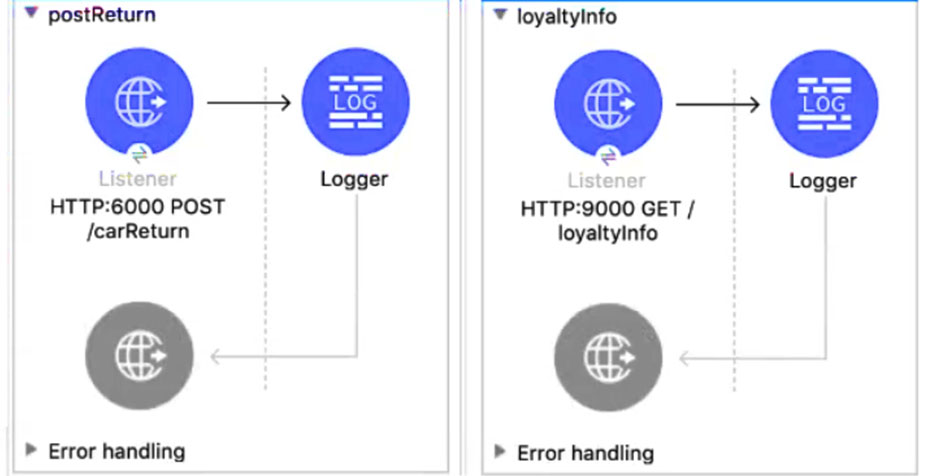
Refer to the exhibits. The Mule application has multiple HTTP Listeners contained in various configuration XML files. Each HTTP Listener is configured with the same host and with the port number, path, and operation shown in its display name. What is the minimum number of global elements that must be defined to support all these HTTP Listeners?


Select an option, then click Submit answer.
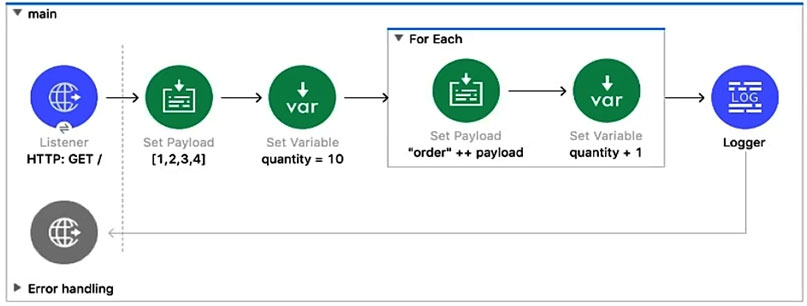
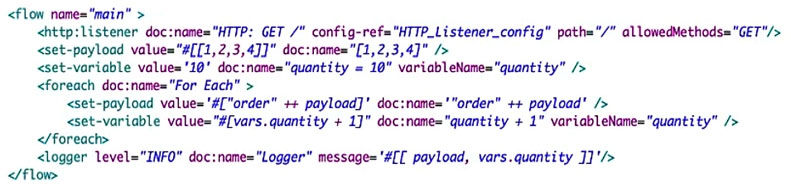
Refer to the exhibits. What payload and quantity are logged at the end of the main flow?


Select an option, then click Submit answer.
Why would a Mule application use the ${http.port} property placeholder for its HTTP Listener port when it is deployed to CloudHub?
Select an option, then click Submit answer.
Refer to the exhibit. What DataWeave expression transforms the example XML input to the CSV output? A. B. C. D.


Answer is in the explanation below.
Refer to the exhibit. The Default scope in the Choice router recursively calls the color flow. A web client sends a PUT request to the HTTP Listener with payload “Blue”. What response is returned to the web client?

Select an option, then click Submit answer.
Refer to the exhibits. The updateTemp and getTemp flows share the same default object store. A web client sends one GET request to the test flow's HTTP Listener, which causes the test flow to call the updateTemp flow. After the test flow returns a response, the web client then sends a different GET request to the getTemp flow's HTTP Listener. The test flow is not called a second time. What response is returned from the request to the getTemp flow's HTTP Listener?


Select an option, then click Submit answer.


Prepare for the MuleSoft Certified Developer - Level 1 (Mule 4) (MCD-LEVEL-1) exam with this free practice test from Study4Pass, built around the real Mulesoft syllabus. The 15 questions come free from the full 160-question Study4Pass practice set — a quick, honest check of where you stand. The free sample includes 14 single-answer and 1 interactive questions — the same mix of formats you will meet in the full set. The set follows the real exam’s spread of topics: Designing APIs and Integrations, Building APIs and Integrations, Deploying and Managing APIs and Integrations and Securing APIs and Integrations. The MuleSoft-Certified-Developer-Level-1 exam is a certification exam provided by MuleSoft that demonstrates a developer's knowledge and skills in developing and deploying applications based on MuleSoft's Anypoint Platform.
The target audience for the MuleSoft Certified Developer Level 1 Exam is software developers and architects who have experience developing integration solutions using MuleSoft Anypoint Platform. The Mulesoft Certified Developer Level 1 exam requires candidates to have a minimum of 6 months of hands-on experience with Mulesoft Anypoint Platform.
Work through the questions one at a time and read every explanation, even for the ones you get right — the reasoning behind an answer is what the real exam tests. If one area keeps costing you marks, you have found exactly what to revise before exam day.
Think of the result as a map, not a verdict. The questions you miss point straight at the topics that need work, and the explanations tell you why the correct option wins. Candidates who loop through that cycle — practise, review the reasoning, re-test — walk into the real exam having already seen their weak spots and fixed them.
Inside the full MCD-LEVEL-1 practice set:
There is no clock and no account needed. Answer each question, check the result, and read the explanation before moving on. For anything that still feels unclear, Ask AI is built into this AI-Enabled practice test — it explains the concept behind the question so the next one like it gets easier. When the free sample feels comfortable, the full set of 160 questions adds timed Exam Simulation, topic-by-topic training, and flagged-question review — the closest thing to exam day you can get before the real thing.
Yes. Every question on this page — all 15 of them — is free to use, and you never need to create an account to try them.
The full Study4Pass set for MCD-LEVEL-1 has 160 practice questions. This page gives you 15 of them free so you can judge the quality and difficulty first.
Yes. Check any question to reveal the correct answer and its explanation, and use Ask AI whenever you want the underlying concept explained step by step.
No — these are practice questions built to match the MCD-LEVEL-1 domains and difficulty level, so you can prepare for the real exam with confidence.