Question 1(Describe an analytics workload on Azure)
DRAG DROP
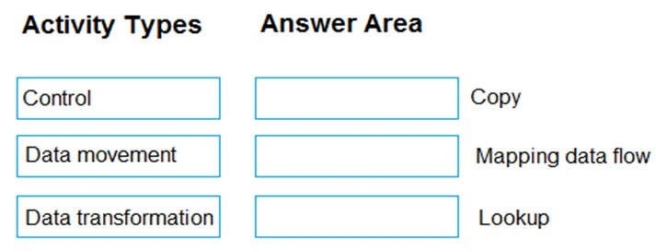
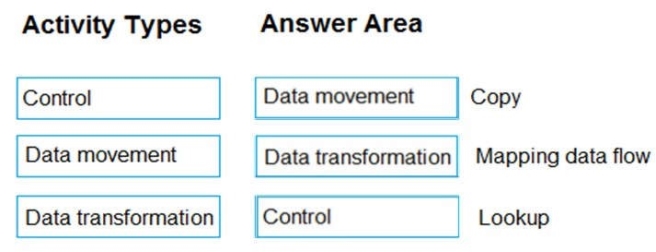
Match the types of activities to the appropriate Azure Data Factory activities.
To answer, drag the appropriate activity type from the column on the left to its Data Factory activity on the right. Each activity type may be used once, more than once, or not at all.
NOTE: Each correct match is worth one point.
Select and Place:
Answer is in the explanation below.
Ask AI for More Explanation
— your own AI account, opens inside the app
Reference / correct answer:
Box 1: Data movement
Box 2: Data transformation
A pipeline could contain a set of activities that ingest and clean log data, and then kick off a mapping data flow to analyze the log data.
Box 3: Control
Lookup Activity is a control flow activity.
Lookup Activity can be used to read or look up a record/ table name/ value from any external source. This output can further be referenced by succeeding activities.
Question 2(Describe an analytics workload on Azure)
DRAG DROP
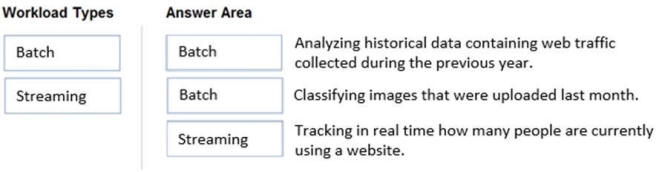
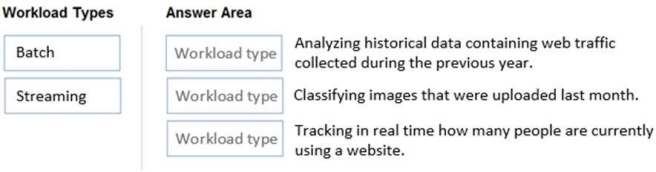
Match the types of workloads to the appropriate scenarios.
To answer, drag the appropriate workload type from the column on the left to its scenario on the right. Each workload type may be used once, more than once, or not at all.
NOTE: Each correct match is worth one point.
Select and Place:
Answer is in the explanation below.
Ask AI for More Explanation
— your own AI account, opens inside the app
Reference / correct answer:
Box 1: Batch
The batch processing model requires a set of data that is collected over time while the stream processing model requires data to be fed into an analytics tool, often in micro-batches, and in real-time.
The batch Processing model handles a large batch of data while the Stream processing model handles individual records or micro-batches of few records. In Batch Processing, it processes over all or most of the data but in Stream Processing, it processes over data on a rolling window or most recent record.
Which two activities can be performed entirely by using the Microsoft Power BI service? Each correct answer presents a complete solution. (Choose two.)
NOTE: Each correct selection is worth one point.
Select all that apply, then click Submit answer.
○
report and dashboard creation
○
report sharing and distribution
○
data modeling
○
data acquisition and preparation
Ask AI for More Explanation
— your own AI account, opens inside the app
Reference / correct answer:
report and dashboard creation
data acquisition and preparation
Question 11(New Update)
What is a primary characteristic of a relational database?
Select an option, then click Submit answer.
○
data is queried and manipulated by using a variant of the SQL language
○
a flexible data structure
○
a lack of dependencies between tables
○
a large amount of duplicate data
Ask AI for More Explanation
— your own AI account, opens inside the app
Reference / correct answer:
data is queried and manipulated by using a variant of the SQL language
Question 12(Describe core data concepts)
Which storage solution supports access control lists (ACLs) at the file and folder level?
Select an option, then click Submit answer.
○
Azure Data Lake Storage
○
Azure Queue storage
○
Azure Blob storage
○
Azure Cosmos DB
Ask AI for More Explanation
— your own AI account, opens inside the app
Reference / correct answer:
Azure Data Lake Storage
Azure Data Lake Storage Gen2 implements an access control model that supports both Azure role-based access control (Azure RBAC) and POSIX-like access control lists (ACLs).
This free practice test covers the Microsoft Azure Data Fundamentals (DP-900) exam from Microsoft. The 15 questions are a free sample of the full Study4Pass practice set of 297 questions, so you can check your level before you commit to the real exam. The free sample includes 5 single-answer, 4 multiple-answer, 2 drag-and-drop, 2 interactive and 2 hands-on lab questions — the same mix of formats you will meet in the full set. Questions are spread across the areas that matter most on the real exam: Describe core data concepts, Identify considerations for relational data on Azure, Describe considerations for working with non-relational data on Azure and Describe an analytics workload on Azure. The real exam requires a score of 700 out of 1,000 to pass. Microsoft DP-900 is a certification exam for the Microsoft Azure Data Fundamentals certification.
The Microsoft DP-900 exam is designed for IT professionals who have experience implementing, managing, and monitoring an Azure data platform. The Microsoft DP-900 exam is designed to measure a candidate's ability to architect, deploy, secure, monitor, and optimize a Microsoft Azure data solution.
Certification: Microsoft Azure Data Fundamentals (DP-900)
Vendor: Microsoft
Free on this page: 15 practice questions with answers and explanations
Full practice set: 297 questions
Treat this sample as a diagnostic. Answer honestly, check the explanation after every question, and note which topics feel shaky. A short, focused review of those topics is worth more than re-reading everything — and the full set lets you drill them topic by topic.
A good way to use this page: take the whole sample in one sitting, then go back over every explanation with fresh eyes. Mark the topics that felt uncertain, not just the ones you got wrong — uncertain answers are unmarked risk on the real exam. One or two focused passes like this usually move a score more than days of passive reading.
Inside the full DP-900 practice set:
All 297 questions with answers and explanations
Timed Exam Simulation that mirrors the real exam pressure
Topic Training to drill one domain at a time
Ask AI for More Explanation on every question
Flag questions and review them before you finish
How to use this DP-900 free practice test
Answer a question, then check the result to see the correct answer and the explanation behind it. Work at your own pace — there is no timer and no signup. Stuck on a concept? This is an AI-Enabled practice test: use Ask AI on any question and get the underlying concept explained in plain words, so you learn the reasoning instead of memorizing answers. Ready for more? The full 297-question set adds a timed Exam Simulation mode, topic training for your weak areas, and a flagged-question review, so you can practise the way the real exam feels.
What to study for each DP-900 domain
Describe core data concepts (25–30%) — This is the largest section of the DP-900 exam at 25–30% — give it the most study time, and do not book the exam until these questions feel comfortable.
Identify considerations for relational data on Azure (20–25%) — Use the practice questions to find your gaps in Identify considerations for relational data on Azure first, then read the official Microsoft documentation for anything you missed.
Describe considerations for working with non-relational data on Azure (15–20%) — For Describe considerations for working with non-relational data on Azure, focus on understanding why each correct answer is right; the real exam rewards reasoning over recall.
Describe an analytics workload on Azure (25–30%) — This is the largest section of the DP-900 exam at 25–30% — give it the most study time, and do not book the exam until these questions feel comfortable.
DP-900 practice test — quick questions
Is this DP-900 practice test free?
Yes — the 15 questions on this page are completely free, with no signup and no payment details needed.
How many questions are in the full DP-900 set?
297 questions. The 15 free questions above are a sample of that full set, in the same style and topic balance.
Does the free test show the answers?
Yes — every question shows the correct answer with an explanation, and Ask AI can explain the concept behind a question in plain words if you want to go deeper.
Is this the real DP-900 exam?
No. This is a practice test: the questions are written to mirror the real DP-900 exam’s topics and difficulty, not copied from it.