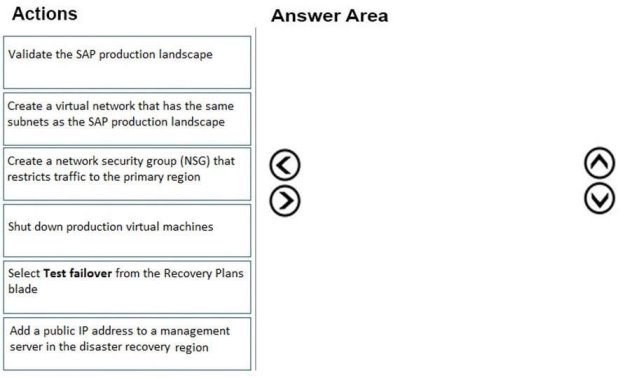
You use Azure Site Recovery to protect an SAP production landscape.
You need to validate whether you can recover the landscape in the event of a failure. The solution must minimize the impact on the landscape.
Which four actions should you perform in sequence? To answer, move the appropriate actions from the list of actions to the answer area and arrange them in the correct order.
Select and Place:
Answer is in the explanation below.
Ask AI for More Explanation
— your own AI account, opens inside the app
Reference / correct answer:
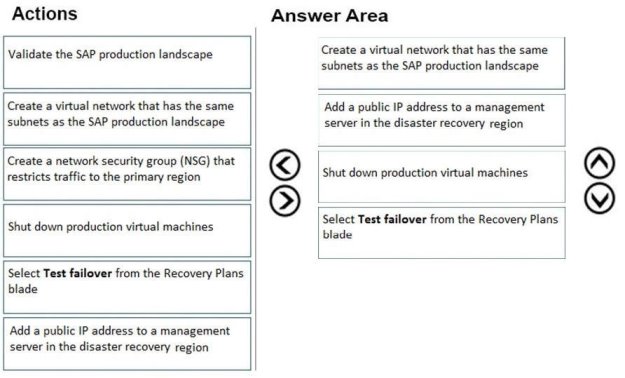
Step 1: Create a virtual network...
We recommended that for test failover, you choose a network that's isolated from the production recovery site network specific in the Compute and Network settings for each VM. By default, when you create an Azure virtual network, it is isolated from other networks. The test network should mimic your production network:
The test network should have same number of subnets as your production network. Subnets should have the same names. The test network should use the same IP address range.
Step 2: Add a public IP address...
Because Site Recovery does not replicate the cloud witness, we recommend that you deploy the cloud witness in the disaster recovery region.
Step 3: Shut down production virtual machines
Make sure that the primary VM is shut down when you run the test failover. Otherwise there will be two VMs with the same identity, running in the same network at the same time. This can lead to unexpected consequences.
Step 4: Select Test failover from the Recovery Plans blade
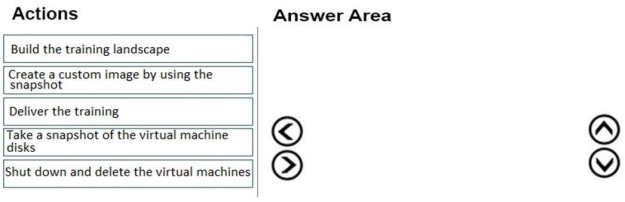
You are designing a training landscape that will be used 10 times a year.
You need to recommend a solution to create the training landscape. The solution must meet the following requirements:
Minimize the effort to build the training landscape. Minimize costs.
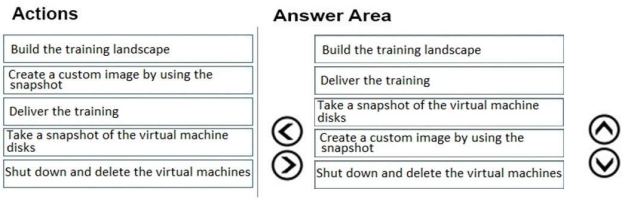
In which order should you recommend the actions be performed for the first training session? To answer, move all actions from the list of actions to the answer area and arrange them in the correct order.
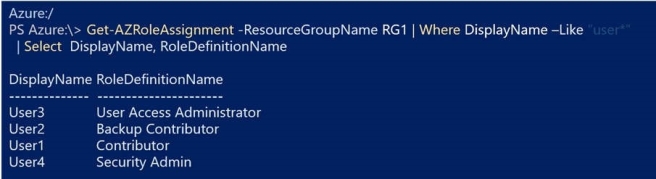
You have an Azure subscription that contains a resource group named RG1. The role assignments for RG1 are shown in the following exhibit.
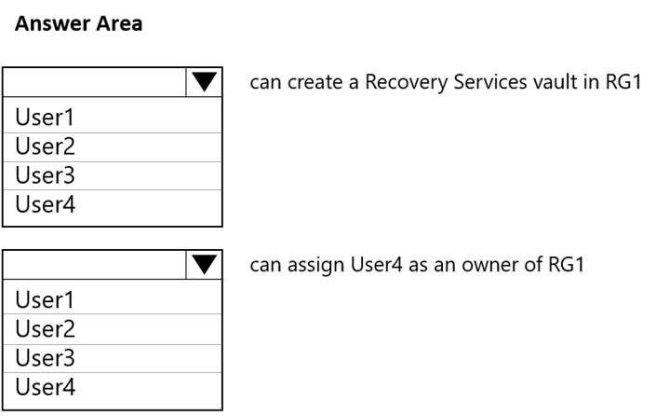
Use the drop-down menus to select the answer choice that completes each statement based on the information presented in the graphic.
NOTE: Each correct selection is worth one point.
Hot Area:
Answer is in the explanation below.
Ask AI for More Explanation
— your own AI account, opens inside the app
Reference / correct answer:
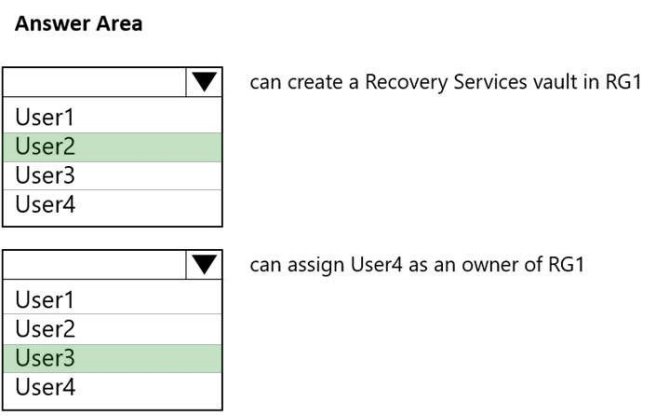
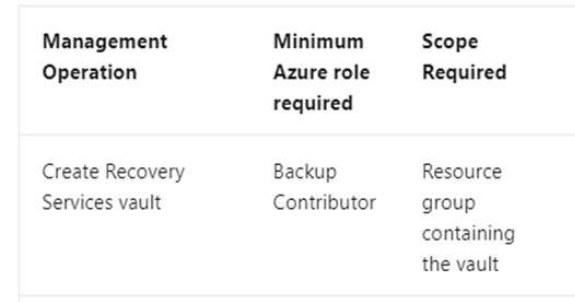
Box 1: User2
Note:
Backup Contributor - This role has all permissions to create and manage backup except deleting Recovery Services vault and giving access to others. Imagine this role as admin of backup management who can do every backup management operation.
Box 2: User3
The User Access Administrator role lets you manage user access to Azure resources.
You have an existing on-premises SAP landscape that is hosted on VMware VSphere.
You plan to migrate the landscape to Azure.
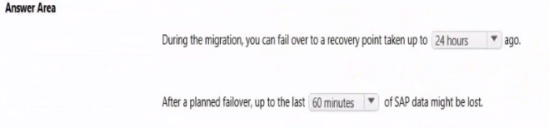
You configure the Azure Site Recovery replication policy shown in the following exhibit.
Answer is in the explanation below.
Ask AI for More Explanation
— your own AI account, opens inside the app
Reference / correct answer:
seetheexplanationforbelowimage:
Explanation.
Answer selected as in image below.
Question 6(New Update)
You plan to migrate an SAP database from Oracle to Microsoft SQL Server by using the SQL Server Migration Assistant (SSMA).
You are configuring a Proof of Concept (PoC) for the database migration You plan to perform the migration multiple times as part of the PoC.
You need to ensure that you can perform the migrations as quickly as possible. The solution must ensure that all Oracle schemas are migrated.
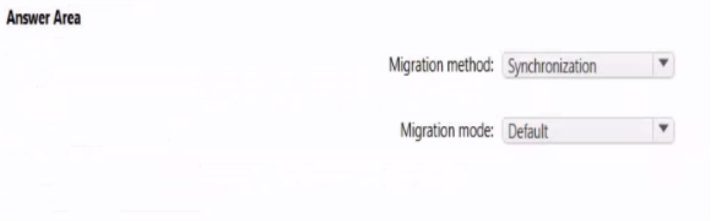
Which migration method and migration mode should you use? To answer, select the appropriate options in the answer area
NOTE: Each correct selection is worth one point.
Answer is in the explanation below.
Ask AI for More Explanation
— your own AI account, opens inside the app
Reference / correct answer:
seetheexplanationforbelowimage:
Explanation.
Answer selected as in image below.
Question 7(New Update)
You have an SAP production landscape on Azure that contains the virtual machines shown in the following table.
VM1 cannot connect to an employee self-service application hosted on VM2.
You need to identify what is causing the issue.
Which two options in Azure Network Watcher should you use? Each correct answer presents part of the solution.
NOTE: Each correct selection is worth one point
Select all that apply, then click Submit answer.
○
Connection troubeshoot
○
Connection monitor
○
IP flow verify
○
Network Performance Monitor
Ask AI for More Explanation
— your own AI account, opens inside the app
Reference / correct answer:
Connection troubeshoot
IP flow verify
Question 8(Mixed Questions)
You are migrating SAP to Azure. The ASCS application servers are in one Azure zone, and the SAP database server in in a different Azure zone. ASCS/ERS is configured for high availability.
During performance testing, you discover increased response times in Azure, even though the Azure environment has better computer and memory configurations than the on-premises environment.
During the initial analysis, you discover an increased wait time for Enqueue.
What are three possible causes of the increased wait time? Each correct answer presents a complete solution.
NOTE: Each correct selection is worth one point.
Select all that apply, then click Submit answer.
○
a missing Enqueue profile
○
disk I/O during Enqueue backup operations
○
misconfigured load balancer rules and health check probes for Enqueue and ASCS
○
active Enqueue replication
○
network latency between the database server and the SAP application servers
Ask AI for More Explanation
— your own AI account, opens inside the app
Reference / correct answer:
misconfigured load balancer rules and health check probes for Enqueue and ASCS
active Enqueue replication
network latency between the database server and the SAP application servers
E: The network latency across Availability Zones is not the same in all Azure regions. In some cases, you can deploy and run the SAP application layer across different zones because the network latency from one zone to the active DBMS VM is acceptable. But in some Azure regions, the latency between the active DBMS VM and the SAP application instance, when deployed in different zones, might not be acceptable for SAP business processes.
You plan to migrate an SAP ERP Central Component (SAP ECC) production system to Azure.
You are reviewing the SAP EarlyWatch Alert report for the system.
You need to recommend sizes for the Azure virtual machines that will host the system.
Which two sections of the report should you review? Each correct answer presents a complete solution.
NOTE: Each correct selection is worth one point.
Select all that apply, then click Submit answer.
○
Hardware Capacity
○
Patch Levels under SAP Software Configuration
○
Hardware Configuration under Landscape
○
Database and ABAP Load Optimization
○
Data Volume Management
Ask AI for More Explanation
— your own AI account, opens inside the app
Reference / correct answer:
Hardware Capacity
Database and ABAP Load Optimization
It is important to note that there are 2 types of data collected for Hardware Capacity.
Performance Data - e.g. CPU and Memory utilization data.
Hardware Capacity data shown in the EWA is measuring CPU and Memory utilization data. This is known as Performance Data.
Configuration Data - e.g. OS information, CPU type.
It is also collecting system information about the host such as hardware manufacturer, CPU type etc. This is known as Configuration Data.
Incorrect Answers:
E: Data Volume Management focuses on whether the collection of DVM content for the EarlyWatch Alert report is not performed, not activated, or not possible because the SAP Solution Manager system does not meet the technical requirements.
You have an SAP production landscape on Azure that contains the virtual machines shown in the following table.
VM1 cannot connect to an employee self-service application hosted on VM2.
You need to identify what is causing the issue.
Which two options in Azure Network Watcher should you use? Each correct answer presents part of the solution.
NOTE: Each correct selection is worth one point
Select all that apply, then click Submit answer.
○
Connection troubeshoot
○
Connection monitor
○
IP flow verify
○
Network Performance Monitor
Ask AI for More Explanation
— your own AI account, opens inside the app
Reference / correct answer:
Connection troubeshoot
IP flow verify
Question 11(New Update)
You have an SAP production landscape that uses SAP HANA databases on Azure.
You need to deploy a disaster recovery solution to the SAP HANA databases. The solution must meet the following requirements:
• Support failover between Azure regions.
• Minimize data loss in the event of a failover.
What should you deploy?
Select an option, then click Submit answer.
○
Azure Site Recovery
○
Always On availability group
○
HANA system replication that uses asynchronous replication
○
HANA system replication that uses synchronous replication
Ask AI for More Explanation
— your own AI account, opens inside the app
Reference / correct answer:
HANA system replication that uses asynchronous replication
Question 12(New Update)
You have a n SAP environment on Azure.
Your on-premises network uses a 1-Gbps ExpresRoute circuit to connect to Azure Private peering is enabled on the circuit. The default route (0.0.0.0/0) from the on-premises network is advertised
You need to resolve the issue without modifying the ExpresRoute circuit. The solution must minimize administrative effort. What should you do?
Select an option, then click Submit answer.
○
Create a user-defined route tint redirects traffic to the Blob storage.
○
Create an application security group.
○
Change the backup solution to use a third-party software that can write to the Blob storage.
○
Enable virtual network service endpoints.
Ask AI for More Explanation
— your own AI account, opens inside the app
Reference / correct answer:
Enable virtual network service endpoints.
Private endpoint enables connectivity between the consumers from the same ExpressRoute.
Note: Consult with SAP HANA on Microsoft Service Management. If they advise you to increase the bandwidth of the SAP HANA on Azure (Large Instances) ExpressRoute circuit, create an Azure support request. (You can request an increase for a single circuit bandwidth up to a maximum of 10 Gbps.)
You are planning a highly available SAP HANA deployment on Azure virtual machines.
You need to recommend a solution for monitoring TCP latency between the SAP application and the database tiers on the TCP socket layer.
What should you include in the recommendation?
Select an option, then click Submit answer.
○
the Azure Network Watcher reachability report
○
Azure Extension for SAP
○
the NIPING command
○
the PING command
Ask AI for More Explanation
— your own AI account, opens inside the app
Reference / correct answer:
the Azure Network Watcher reachability report
Question 14(New Update)
You plan to migrate an SAP environment to Azure.
You need to recommend a solution to migrate the SAP application servers to Azure. The solution must
minimize downtime and changes to the environments.
What should you include in the recommendation?
Select an option, then click Submit answer.
○
Azure Storage Explorer
○
Azure Import/Export service
○
AzCopy
○
Azure Site Recovery
Ask AI for More Explanation
— your own AI account, opens inside the app
Reference / correct answer:
Azure Site Recovery
Site Recovery is used to manage and orchestrate disaster recovery of on-premises machines and Azure VMs. However, it can also be used for migration. Migration uses the same steps as disaster recovery with one exception. In a migration, failing machines over from your on-premises site is the final step. Unlike disaster recovery, you can't fail back to on-premises in a migration scenario.
You have an SAP HANA on Azure (Large Instances) deployment.
You need to generate hearth check log files for the Deployment.
What should you do?
Select an option, then click Submit answer.
○
From a SSH session on the HANA Large instance node. Run/var/waagent/Microsoft.AzureCAT.AzureEnhancedMonitoring.MonitorX64Linux-1.0.082/AzuredMonitoring –monitoring.
○
From the Azure portal, select New support request.
○
From A SSH session on the HANA large instances node, run/opt/sgi/health_check/microsoft_tdi-sh.
○
From the Azure portal, select Diagnose and solve problems.
Ask AI for More Explanation
— your own AI account, opens inside the app
Reference / correct answer:
From A SSH session on the HANA large instances node, run/opt/sgi/health_check/microsoft_tdi-sh.
About the AZ-120 Free Practice Test
This page holds a free practice test for the Planning and Administering Microsoft Azure for SAP Workloads (AZ-120) certification from Microsoft. The 15 questions come free from the full 255-question Study4Pass practice set — a quick, honest check of where you stand. The free sample includes 5 single-answer, 4 multiple-answer, 2 drag-and-drop, 2 interactive and 2 hands-on lab questions — the same mix of formats you will meet in the full set. The set follows the real exam’s spread of topics: Deployment and Configuration of Azure Compute Resources, Configuration of Azure Storage, Configuration of Azure Networking and Configuration of Azure Security. Microsoft AZ-120 is an exam for the Microsoft Azure Administrator certification.
The Microsoft AZ-120 Exam is designed for IT professionals who want to validate their skills and knowledge in the design and implementation of Microsoft Azure infrastructure solutions. The prerequisite for Microsoft AZ-120 Exam is having knowledge of the following topics: Azure Administration, Azure Storage, Azure Networking, Azure Security, Azure Monitoring, Azure Disaster Recovery and High Availability, and…
Certification: Planning and Administering Microsoft Azure for SAP Workloads (AZ-120)
Vendor: Microsoft
Free on this page: 15 practice questions with answers and explanations
Full practice set: 255 questions
Work through the questions one at a time and read every explanation, even for the ones you get right — the reasoning behind an answer is what the real exam tests. If one area keeps costing you marks, you have found exactly what to revise before exam day.
Think of the result as a map, not a verdict. The questions you miss point straight at the topics that need work, and the explanations tell you why the correct option wins. Candidates who loop through that cycle — practise, review the reasoning, re-test — walk into the real exam having already seen their weak spots and fixed them.
Inside the full AZ-120 practice set:
All 255 questions with answers and explanations
Timed Exam Simulation that mirrors the real exam pressure
Topic Training to drill one domain at a time
Ask AI for More Explanation on every question
Flag questions and review them before you finish
How to use this AZ-120 free practice test
There is no clock and no account needed. Answer each question, check the result, and read the explanation before moving on. For anything that still feels unclear, Ask AI is built into this AI-Enabled practice test — it explains the concept behind the question so the next one like it gets easier. Ready for more? The full 255-question set adds a timed Exam Simulation mode, topic training for your weak areas, and a flagged-question review, so you can practise the way the real exam feels.
What to study for each AZ-120 domain
Deployment and Configuration of Azure Compute Resources — This topic covers the deployment and configuration of Azure compute resources such as virtual machines, virtual networks, virtual hard disks, and other related services.
Configuration of Azure Storage — This topic covers the configuration of Azure storage services such as Azure Blob Storage, Azure Queue Storage, and Azure Table Storage.
Configuration of Azure Networking — This topic covers the configuration of Azure networking services such as Azure Virtual Network, Azure Express Route, and Azure Load Balancers.
Configuration of Azure Security — This topic covers the configuration of Azure security services such as Azure Security Center, Azure Key Vault, and Azure Active Directory.
Configuration of Azure Monitoring and Management — This topic covers the configuration of Azure monitoring and management services such as Azure Automation, Azure Monitor, and Azure Advisor.
AZ-120 practice test — quick questions
Is this AZ-120 practice test free?
Yes — the 15 questions on this page are completely free, with no signup and no payment details needed.
How many questions are in the full AZ-120 set?
255 questions. The 15 free questions above are a sample of that full set, in the same style and topic balance.
Does the free test show the answers?
Yes — every question shows the correct answer with an explanation, and Ask AI can explain the concept behind a question in plain words if you want to go deeper.
Is this the real AZ-120 exam?
No. This is a practice test: the questions are written to mirror the real AZ-120 exam’s topics and difficulty, not copied from it.
 Minimize the effort to build the training landscape.



 Performance Data - e.g. CPU and Memory utilization data.
