Question 1
DRAG DROP
Match these terms with their description.
Select and Place:
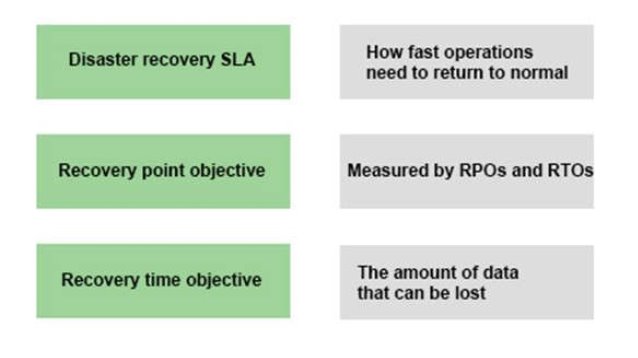
Answer is in the explanation below.
Loading demo links...
Showing 1–20 of 20 questions
DRAG DROP
Match these terms with their description.
Select and Place:
Answer is in the explanation below.
Which two of the following LTM load balancing methods require the least amount of resources? (Choose two.)
Select all that apply, then click Submit answer.
Round robin
Ratio
Observed
Fastest
Predictive
Least connections
Which two must be included in a Wide-IP definition for the Wide-IP to resolve a DNS query? (Choose two.)
Select all that apply, then click Submit answer.
a name
a monitor
a load balancing method
one or more virtual servers
Which of the following user roles have access to make changes to security policies? (Choose two.)
Select all that apply, then click Submit answer.
Guest
Operator
Administrator
Web Application Security Editor
Select the key reasons F5 is able to handle DNS DDoS attacks so effectively? Select two.
Select all that apply, then click Submit answer.
F5 can ensure a DNS DDoS attack is not successful.
F5 has high performance DNS services.
F5 can answer the DNS queries directly.
With Global Traffic Manager (GTM), F5 completely stops all DNS DDoS attacks.
F5 can ensure a customer never faces a DNS DDoS attack.
iQuery is a proprietary protocol that distributes metrics gathered from which three sources? (Choose three.)
Select all that apply, then click Submit answer.
SNMP
DNS root servers
path probes such as ICMP
monitors from LTM Systems
monitors from Generic Host Servers
Which three properties can be assigned to nodes? (Choose three.)
Select all that apply, then click Submit answer.
ratio values
priority values
health monitors
connection limits
load balancing mode
Which three of the following statements describe a data center object?
Select all that apply, then click Submit answer.
It attempts to match a DNS request with a configured wide IP.
It is attached to multiple Internet links.
It becomes available for use when an assigned server is up.
It retains statistics for each data center.
It is a logical representation of a physical location.
It specifies how users access the Internet.
Which of the following mitigation techniques is based on anomaly detection? (Choose two)
Select all that apply, then click Submit answer.
Brute force attack prevention
Cross site request forgery prevention
Web scraping attack prevention
Parameter tampering prevention
When configuring monitors for individual pool members, which three options can be selected? (Choose three.)
Select all that apply, then click Submit answer.
inherit the pool's monitor
choose a default monitor
inherit the Wide-IP's monitor
assign a monitor to the specific pool member
do not assign any monitor to the specific pool member
A site is load balancing to a pool of web servers. Which statement is true concerning BIG-IP's ability to verify whether the web servers are functioning properly or not?
Select an option, then click Submit answer.
Web server monitors can test the content of any page on the server.
Web server monitors always verify the contents of the index.html page.
Web server monitors can test whether the server's address is reachable, but cannot test a page's content.
Web server monitors can test the content of static web pages, but cannot test pages that would require the web server to dynamically build content.
Which persistence method will always recognize a client when the client returns to the same virtual server?
Select an option, then click Submit answer.
SSL
MSRDP
expression [universal]
No persistence method work in all situations.
source address
An inline ASM configuration requires:
Select an option, then click Submit answer.
Two network connections
None of the above
Two disk drives
Two power supplies
With standard DNS, assuming no DNS request failures, which process describes the normal resolution process on a "first time" DNS request?
Select an option, then click Submit answer.
Client requests address from root server, root server returns IP address to Authoritative DNS, Authoritative DNS returns requested IP address, LDNS returns requested IP address to client.
Client requests address from LDNS, LDNS requests from GTM, GTM requests from Authoritative DNS, Authoritative DNS returns requested IP address, LDNS returns requested IP address to client.
Client requests address from LDNS, Authoritative DNS receives request from root server, root server returns LDNS address, LDNS returns client address, Authoritative DNS returns requested IP address, LDNS returns requested IP address to client.
Client requests address from LDNS, LDNS requests from root server, root server returns Authoritative DNS address, LDNS requests from Authoritative DNS, Authoritative DNS returns requested IP address, LDNS returns requested IP address to client.
The default staging-tightening period for attack signatures and wildcard entities is?
Select an option, then click Submit answer.
5 days
7 days
10 days
30 days
Network Security personnel are entirely responsible for web application security.
Select an option, then click Submit answer.
True
False
The Flow Login feature prevents which web vulnerability from occurring?
Select an option, then click Submit answer.
Buffer overflow
Cookie poisoning
Forceful browsing
Cross site scripting
Which action will take place when a failover trigger is detected by the active system?
Select an option, then click Submit answer.
The active device will take the action specified for the failure.
The standby device also detects the failure and assumes the active role.
The active device will wait for all connections to terminate and then failover.
The standby device will begin processing virtual servers that have failed, but the active device will continue servicing the functional virtual servers.
Which of the following TMOS feature enables BIG-IP to scale performance based to the available CPU cores?
Select an option, then click Submit answer.
Clustered multi-processing
OneConnect
HTTP class
Session persistence
Auto Last Hop
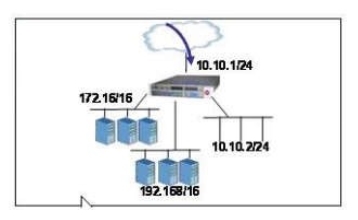
An LTM has the 3 virtual servers, 2 SNATs, four self IP addresses defined and the networks shown in the graphic below. Selected options for each object are shown below. Settings not shown are at their defaults. Assume port exhaustion has not been reached.
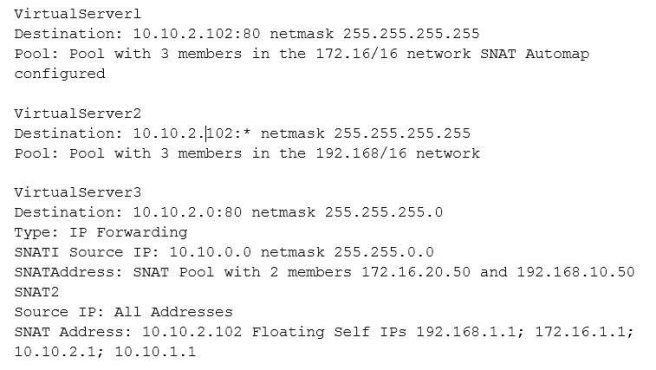
A connection attempt is made with a source IP and port of 10.20.10.50:2222 and a destination IP and port of 10.10.2.102:80. When the request is processed, what will be the source and destination IP addresses?
Select an option, then click Submit answer.
Source IP: 10.20.10.50; Destination IP: pool member in the 172.16/16 network
Source IP: 172316.20.50; Destination IP: pool member in the 182.16/16 network
Source IP: 192.168.1.1; Destination IP: pool member in the 192.168/16 network
The request will be dropped.
Source IP: 10.20.10.50; Destination IP: pool member in the 192.168/16 network
Source IP: 182.16.1.1; Destination IP: pool member in the 172316/16 network
Source IP: 192.168.10.50; Destination IP: pool member in the 192.168/16 network
Source IP:192.168.10.50; Destination IP: pool member in the 192.168./16 network
This page holds a free practice test for the Application Delivery Fundamentals (101) certification from F5. The 20 questions come free from the full 460-question Study4Pass practice set — a quick, honest check of where you stand. The free sample includes 10 single-answer, 9 multiple-answer and 1 drag-and-drop questions — the same mix of formats you will meet in the full set. The set follows the real exam’s spread of topics: Networking Fundamentals, Application Delivery Fundamentals, BIG-IP Access Policy Manager (APM) and BIG-IP Local Traffic Manager (LTM). F5 101 is an exam that tests a candidate's knowledge of F5 Networks' BIG-IP products and services.
The target audience for the F5 101 exam is IT professionals who have a minimum of six months of experience working with F5 products. The F5 101 exam requires you to have at least six months of experience with F5 products and technologies.
Work through the questions one at a time and read every explanation, even for the ones you get right — the reasoning behind an answer is what the real exam tests. If one area keeps costing you marks, you have found exactly what to revise before exam day.
Think of the result as a map, not a verdict. The questions you miss point straight at the topics that need work, and the explanations tell you why the correct option wins. Candidates who loop through that cycle — practise, review the reasoning, re-test — walk into the real exam having already seen their weak spots and fixed them.
Inside the full 101 practice set:
There is no clock and no account needed. Answer each question, check the result, and read the explanation before moving on. For anything that still feels unclear, Ask AI is built into this AI-Enabled practice test — it explains the concept behind the question so the next one like it gets easier. Ready for more? The full 460-question set adds a timed Exam Simulation mode, topic training for your weak areas, and a flagged-question review, so you can practise the way the real exam feels.
Yes — the 20 questions on this page are completely free, with no signup and no payment details needed.
460 questions. The 20 free questions above are a sample of that full set, in the same style and topic balance.
Yes — every question shows the correct answer with an explanation, and Ask AI can explain the concept behind a question in plain words if you want to go deeper.
No. This is a practice test: the questions are written to mirror the real 101 exam’s topics and difficulty, not copied from it.