A metropolitan area that has a population of more than 10 million and a population density of more than 2000 people per square kilometer is termed a megacity. Among the metropolitan areas of the United States, X and Z are megacities but Y is not.
If the statements above are true, each of the following statements must also be true EXCEPT:
Select an option, then click Submit answer.
Reference / correct answer:
Y is a metropolitan area with a population density of less than 2000 people per square kilometer.
Argument construction
This argument is about one specific type of areas, namely 'metropolitan' areas, and further about a sub-type of metropolitan areas, namely 'megacities.' So, the hierarchy of the areas is like this:  All Areas
1. Non-metropolitan areas
2. Metropolitan areas (MA henceforth)
1. Megacities (MC henceforth)
2. Non-megacities
From this visual representation, it is easy to see to draw inferences like: All MC are MA but the vice-versa is not true.
The first statement of the argument is also its Premise 1. A metropolitan area that has a population of more than 10 million and a population density of more than 2000 people per square kilometer is termed a megacity.
From this premise, we learn that to be termed a MC, a MA must fulfill two conditions – it should have:
1. Population > 10 million and
2. Population Density > 2000 per sq. km.
It is important to note that the word used to join the two conditions together in one sentence is 'and', not 'or.' This tells us that it is important that a MA fulfill both these conditions to get termed as a MC. Suppose it fulfills only condition 1 but not condition 2? Sorry, that won't do.
We may depict the 'and' requirement visually using the idea of overlapping sets as follows:
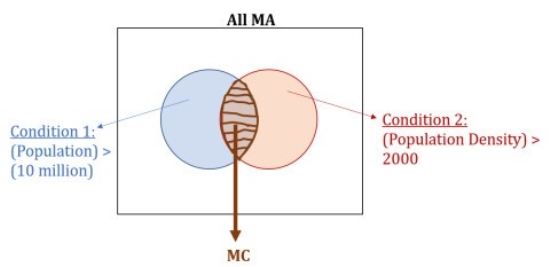
So, for a MA to be termed a MC, it must lie in the brown zone of the above diagram.
Now, coming to the second statement of the argument, which is also Premise 2: Among the metropolitan areas of the United States, X and Z are megacities but Y is not.
The first thing to note is the phrase "among the metropolitan areas of the United States." From this, we can be sure that the names that follow in this statement are all MA of the United States. So,
X and Z are MA of the US
Y is an MA of the US
Among these three MA of the US,
X and Z are MC. This means, they do fulfill both the conditions mentioned in Premise 1. So, we may infer that both X and Z have: 1. Population > 10 million and
2. Population Density > 2000 per sq. km.
Y is not a MC. What may we infer from this fact? Refer to the visual depiction above. If Y is not a MC, this means that it does not lie in the brown zone of the diagram. So, the possible zones in which Y may lie in the above diagram are:
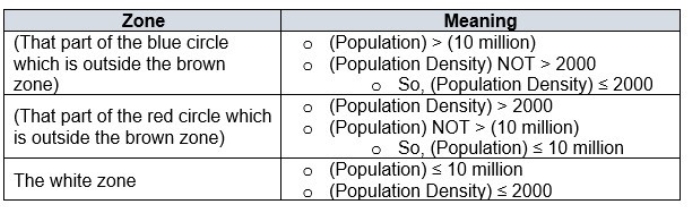
Let us analyze the options one by one.
Answer choices explanation
[Y is a metropolitan area with a population density of less than…] This option is correct. As discussed in the 'Argument Construction' part above, it is possible that Y lies in 'that part of the red circle which is outside the brown zone,' and, therefore, has a population density greater than 2000. Thus, this answer choice does not contain a "must be true" statement.
[X is a metropolitan area with a population density of more than...] This option is incorrect. This inference indeed must be true. We have already drawn this inference in the analysis done by us in the 'Argument Construction' part above.
[Z is a metropolitan area with a population of more than 10 million.] This option is incorrect. This inference indeed must be true. We have already drawn this inference in the analysis done by us in the 'Argument Construction' part above.
[X is a metropolitan area with a population of more than 10 million.] This option is incorrect. This inference indeed must be true. We have already drawn this inference in the analysis done by us in the 'Argument Construction' part above.
[At least some metropolitan areas of the United States have…] This option is incorrect. This inference indeed must be true. We know from the argument that there at least 2 MA in the US that have a population density >2000 (X and Z). So, even if no other MA in the US has a population density >2000, this option statement still holds true. Note that though inferring generalizations from specific facts is usually risky, the reason why this particular generalization works is because it is cautious in what it is claiming. Its claim is merely that "at least some" MA fulfill Condition 2 of becoming a MC. Had the claim been more exaggerated, like say, "Most MA fulfill Condition 2" or to go in the opposite direction, "Very few MA fulfill Condition 2," then the generalization would have ceased to be a "must be true" statement, because the facts of the case – which mentions only 3 of all the MA of the US – would have been insufficient to support the extent of the claim.
