QSDA2022 Qlik Sense Data Architect Certification Exam-2022

Loading demo links...

Showing 7–9 of 10 questions

Question 7

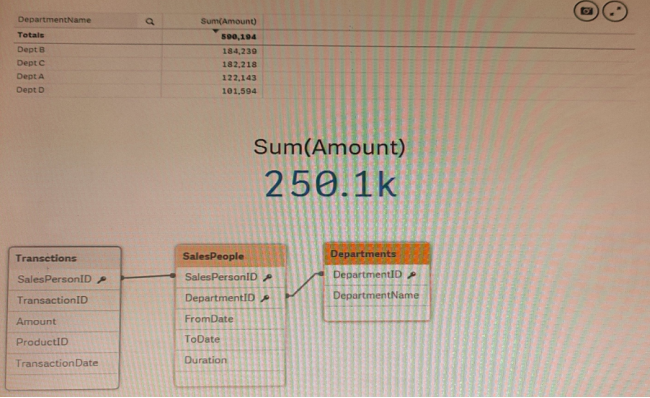
Refer to the exhibits.

An app is built to analyze salesperson performance by department. Departments are unique within the Departments table, but Salespeople often move between departments. A strict business rule states that a salesperson must be associated with ONLY one department at all times.

The data architect creates a summary of department performance and notices the values are incorrect. The total sales KPI shows the correct result.

How should the data architect modify the data model to correct this issue?

Select an option, then click Submit answer.

  • Create a bridge table between the Departments and Salespeople tables to resolve the many-to-many relationship
  • Create a bridge table between the Transactions and Salespeople tables to resolve the many-to-many relationship
  • Join the Departments and Salespeople tables to resolve the many-to-many relationship
  • Join the Transactions and Salespeople tables to resolve the many-to-many relationship
Question 8

A data architect of an organization that has implemented Qlik Sense on Windows needs to load large amounts of data from a database that is continuously updated

New records are added, and existing records get updated and deleted. Each record has a LastModified field.

All existing records are exported into a QVD file. The data architect wants to load the records into Qlik Sense efficiently.

Which steps should the data architect take to meet these requirements?


Select an option, then click Submit answer.

  • 1. Load the existing data from the QVD
    2. Load the new and updated data from the database without the rows that have just been loaded from the QVD and concatenate with data from the QVD
    3. Load all records from the key field from the database and use an INNER JOIN on the previous table
     

  • 1. Load the existing data from the QVD
    2. Load new and updated data from the database Concatenate with the table loaded from the QVD.
    3. Create a separate table for the deleted rows and use a WHERE NOT EXISTS to remove these records
     

  • 1. Use a partial LOAD to load new and updated data from the database.
    2. Load the existing data from the QVD without the updated rows that have just been loaded from the database and concatenate with the new and updated records
    3. Use the PEEK function to remove the deleted rows
     

  • 1. Load the new and updated data from the database.
    2. Load the existing data from the QVD without the updated rows that have just been loaded from the database and concatenate with the new and updated records.
    3. Load all records from the key field from the database and use an INNER JOIN on the previous table.

Question 9

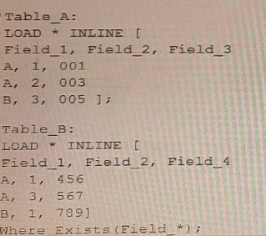
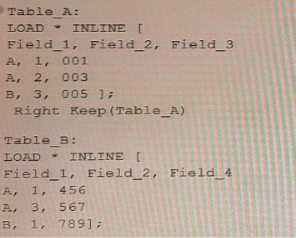
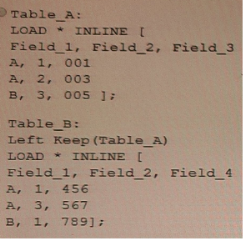
Refer io the exhibit.

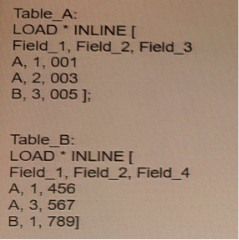
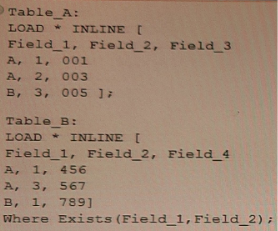
A data architect needs to modify the script to ONLY load rows from Table_B when Field_1 and Field_2 are the same as in Table_A. (For example, only the row containing A, 1, 456 should be loaded from Table_B.)

Which script should the data architect use?

A)

B)

C)

D)

Select an option, then click Submit answer.

  • Option A

  • Option B

  • Option C

  • Option D