1z0-632 PeopleSoft PeopleTools 8.5x Implementation Essentials

Loading demo links...

Showing 1–3 of 10 questions

Question 1

Which two statements are true about how PeopleCode on the SavePreChange and SavePostChange events is processed?

(Choose two.)

Select all that apply, then click Submit answer.

  • When placed at the component record level, such PeopleCode triggers a Save when a row is changed

  • When placed at the component record level, such PeopleCode runs once per row when the user clicks Save
  • When placed at the component record level, such PeopleCode runs once when the user clicks Save

  • When placed at the component level, such PeopleCode triggers a Save when data on the page is changed

  • When placed at the component level, such PeopleCode runs once when the user clicks Save

  • When placed at the component level, such PeopleCode runs once per row when the user clicks Save
Question 2

Identify three true statements describing PeopleTools tables. (Choose three.)

Select all that apply, then click Submit answer.

  • PeopleTools tables can be updated equally using PeopleTools, such as Application Designer, or the SQL editing tool for your database platform

  • PeopleTools tables use the naming convention of having the prefix PD*, as in PSRECDEFN

  • PeopleTools tables store metadata that defines the elements of a PeopleSoft application

  • PeopleTools tables contain the same content, regardless of the PeopleSoft application installed on the database

  • PeopleTools tables have a consistent structure, regardless of the PeopleSoft application installed on the database

  • PeopleTools tables are empty until the implementation team has loaded the application’s transactional data

Question 3

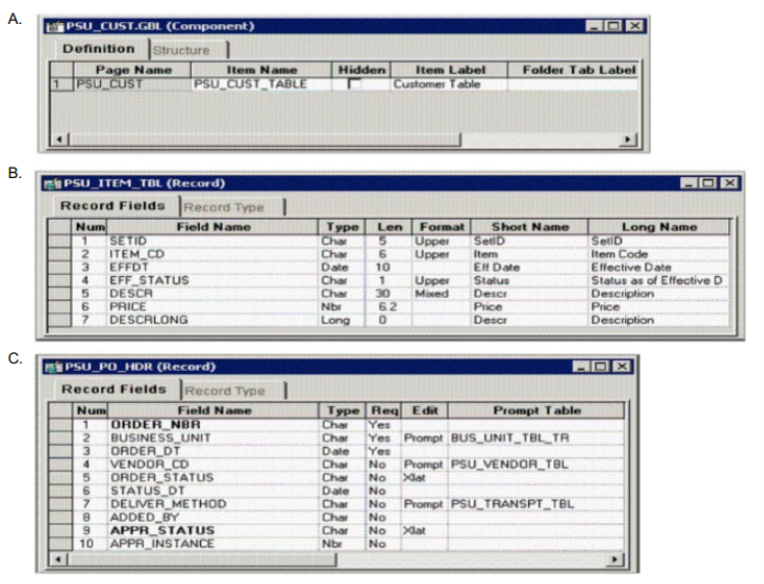
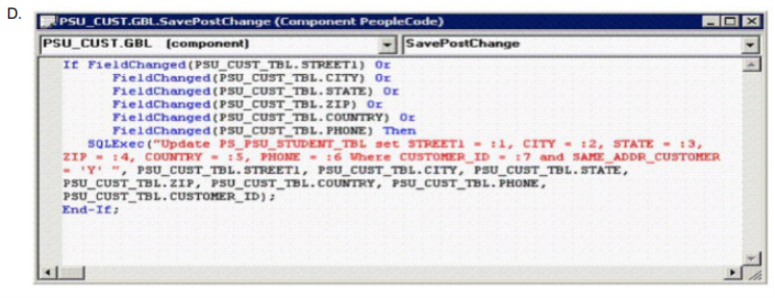
Select the two Application Designer definitions that demonstrate how referential integrity is maintained in PeopleSoft applications. (Select two.)

Select all that apply, then click Submit answer.

  • Option A

  • Option B

  • Option C

  • Option D