HOTSPOT
Background
You are the database administrator for Contoso, Ltd. The company has 200 offices around the world. The company has corporate executives that are located in offices in London, New York, Toronto, Sydney, and Tokyo.
Contoso, Ltd. has a Microsoft Azure SQL Database environment. You plan to deploy a new Azure SQL Database to support a variety of mobile applications and public websites.
The company is deploying a multi-tenant environment. The environment will host Azure SQL Database instances. The company plans to make the instances available to internal departments and partner companies. Contoso is in the final stages of setting up networking and communications for the environment.
Existing Contoso and Customer instances need to be migrated to Azure virtual machines (VM) according to the following requirements:
 Contoso instances – should use the method requiring the least administrative effort to migrate instances to Azure Vms.
Customer instances – should use a method that allows customers to bring their own licenses to Azure VMs. Customers have approved down time for the migration.
The company plans to deploy a new order entry application and a new business intelligence and analysis application. Each application will be supported by a new database. Contoso creates a new Azure SQL database named Reporting. The database will be used to support the company's financial reporting requirements. You associate the database with the Contoso Azure Active Directory domain.
Each location database for the data entry application may have an unpredictable amount of activity. Data must be replicated to secondary databases in Azure datacenters in different regions.
To support the application, you need to create a database named contosodb1 in the existing environment.
Objects
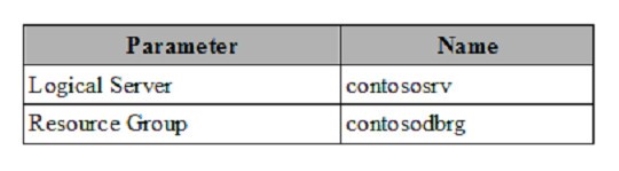
Database
The contosodb1 database must support the following requirements:
a size of at least 200 gigabytes (GB)
1,000 concurrent sessions
point-in-time restore to any point in the two weeks prior to a failure minimize costs
Application
For the business intelligence application, corporate executives must be able to view all data in near real-time with low network latency.
Contoso has the following security, networking, and communications requirements:
Multi-Location Load Balancing – to ensure customers have access to their tenants at multiple Azure locations across the world.
Secure Message/Data Flow – to securely support communication between Azure and on-premises applications and services.
Accounts should support accessing external domain resources and be configured in the most secure and lowest-maintenance way possible, including meeting the company policy of regular service account password changes.
You need to create the contosodb1 database.
How should you complete the Azure PowerShell command? To answer, select the appropriate Azure PowerShell segments in the answer area.
Hot Area:
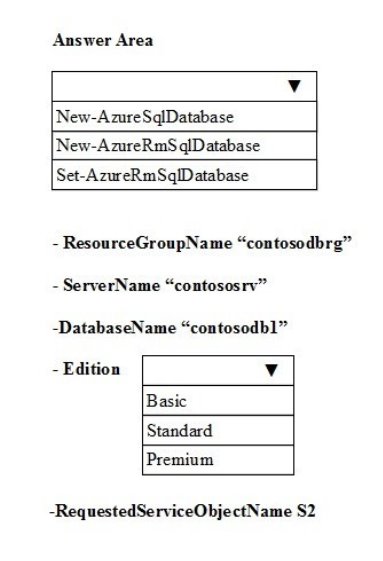
Answer is in the explanation below.
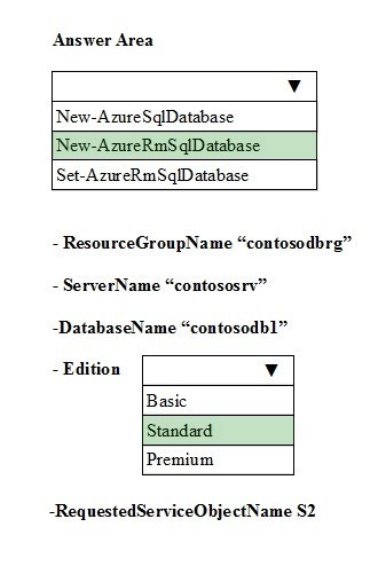
 a size of at least 200 gigabytes (GB)
