JN0-681 Data Center - Professional (JNCIP-DC)

Loading demo links...

Showing 4–6 of 10 questions

Question 4

Which two statements define the use of route targets and route distinguishers in an EVPN? (Choose two.)

Select all that apply, then click Submit answer.

  • Route targets ensure that routes from different clients remain unique within the data center domain.

  • Route targets identify the VRF into which the route should be placed.
  • Route distinguishers ensure that routes from different clients remain unique within the data center domain.

  • Route distinguishers identify the VRF into which the route should be placed.
Question 5

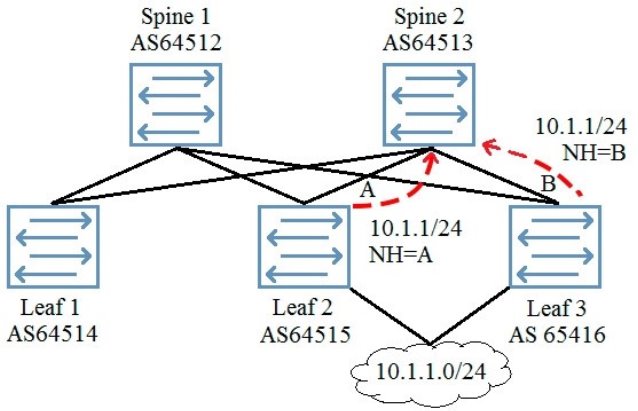
Referring to the exhibit, each node in the IP fabric is peering to its directly attached neighbor using EBGP. Each node is peering using physical interface IP addresses. Leaf 2 and Leaf 3 are advertising the 10.1.1/24 network into EBGP. Spine 2 must be configured so that it can load-share traffic destined to the 10 1.1/24 network over both next-hop A and next-hop B.

Which two actions must be performed to accomplish this task? (Choose two.)

Select all that apply, then click Submit answer.

  • Use a load-balancing policy applied to the forwarding table.

  • Use multipath multiple-AS.

  • Use advertise-inactive.

  • Use multihop.

Question 6

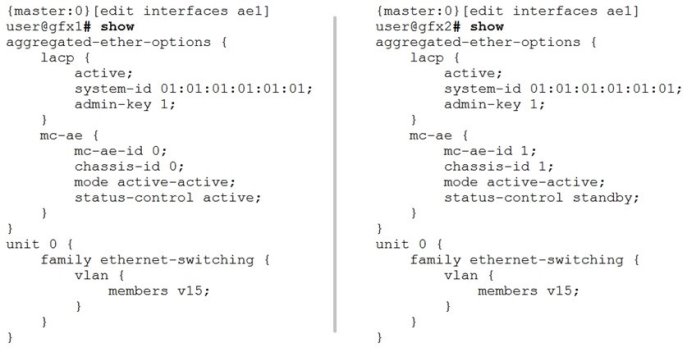
You have configured a new MC-LAG connection to a host. After committing the configuration, the MC-LAG link is not functioning properly.

Referring to the exhibit, how would you solve this problem?

Select an option, then click Submit answer.

  • Change the chassis-id on qfx1 to 1.

  • Configure a system-id on qfx1 that is different from the system-id on qfx2.

  • Configure the status-control on qfx2 to active.

  • Change the mc-ae-id on qfx1 to 1.