HPE6-A46 Delta - Implementing Aruba Campus Switching Solutions

Loading demo links...

Showing 7–9 of 10 questions

Question 7

Refer to the exhibit.
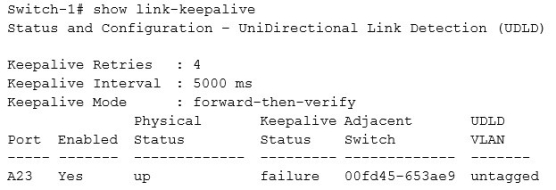
Switch-1 and Switch-2 connect on interface A23. The switches experience a connectivity issue. The network administrator sees that both switches show this interface as up. The administrator sees the output shown in the exhibit on Switch-1.

What is a typical issue that could cause this output?

Select an option, then click Submit answer.

  • a hardware issue, such as a broken cable

  • asymmetric routing introduced by a routing configuration error

  • an issue with queuing, caused by mismatched QoS settings

  • mismatched IP addresses on the VLAN for the link

Question 8

Refer to the exhibits.

Exhibit 1

Exhibit 2

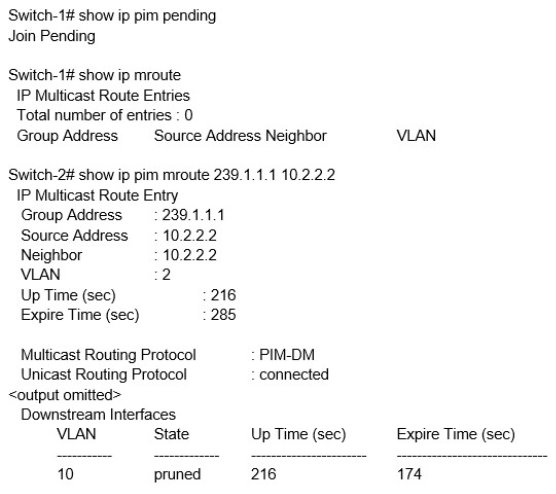
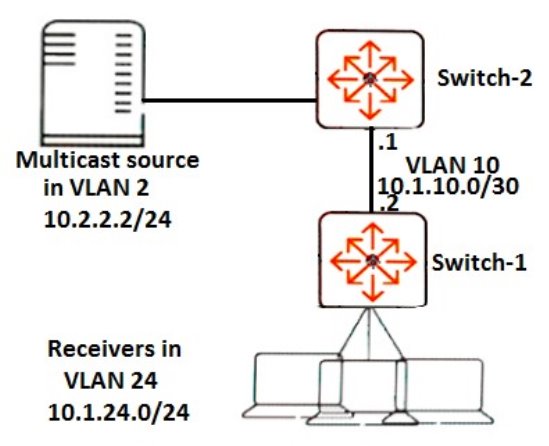
A network administrator sets up PIM-DM to route traffic from the multicast source to clients in VLAN 24. The server begins to forward multicasts, and the clients are set up to receive them. However, the multicasts do not reach the clients.

Based on the output, what should the administrator verify?

Select an option, then click Submit answer.

  • that VLAN 24 on Switch-1 runs both IGMP and PIM-DM

  • that Switch-2 has PIM-DM enabled on VLAN 10

  • that state refreshes are enabled on Switch-2

  • that Switch-1 has selected Switch-2 as its RP for 239.1.1.1


Question 9

A network uses MSTP and has AOS-Switches at the access layer. The company wants edge ports on the access layer switches to meet these criteria:

✑ They prevent all rogue switches that run STP, RSTP, or MSTP from connecting to the network.

✑ If a rogue switch connects and is then replaced by a proper endpoint, the port recovers automatically without IT staff involvement.

How should the network administrator set up the edge ports to meet these requirements?

Select an option, then click Submit answer.

  • Enable loop protection with a timeout period.

  • Enable BPDU filtering.

  • Enable both root guard and BPDU protection.

  • Enable BPDU protection with a timeout period.