HPE6-A41 Applying Aruba Switching Fundamentals for Mobility

Loading demo links...

Showing 4–6 of 10 questions

Question 4

Refer to the exhibit.

This switch currently assigns all VLANs to MSTP instance 0 or the Internal Spanning Tree (IST).

Which statement correctly describes interface 21?

Select an option, then click Submit answer.

  • The interface is down at Layer 2; it is not available for sending or receiving any traffic.

  • The interface does not forward or accept data traffic, but it is ready to start forwarding if interface 19 fails.

  • The interface is an edge port but has received Bridge Protocol Data Units (BPDUs), so it is disabled.

  • The interface does not support spanning tree; it is possible that it will introduce a loop in the network.
Question 5

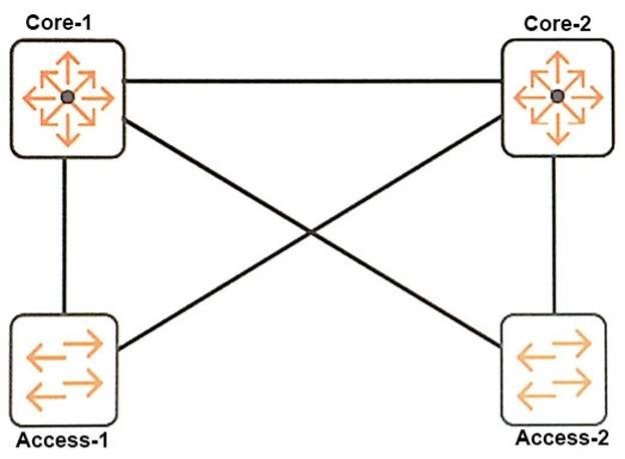
Refer to the exhibits.

Exhibit 1

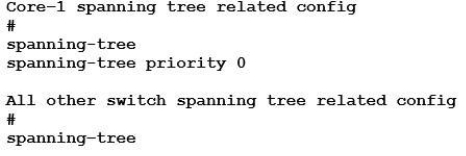
Exhibit 2

A network uses RSTP, as shown in the exhibits. The network administrator wants switches to use the link that connects to Core-2 to forward some of the traffic. The administrator enters these commands on every switch shown in the exhibit:

The administrator then discovers that the links to Core-2 still did not forward any traffic.

What should the administrator do to enable these links to carry traffic?

Select an option, then click Submit answer.

  • Activate the MSTP region configuration on all switches.

  • Lower the port cost on the links that connect to Core-2 on the access layer switches.

  • Configure Core-2 with spanning tree priority 0 in instance 2.

  • Change the spanning tree mode to MSTP on all switches.

Question 6

What is one advantage of OSPF over static routing?

Select an option, then click Submit answer.

  • OSPF allows ArubaOS switches to use default routes, while static routes cannot use 0.0.0.0/0 as the destination network.

  • OSPF has a lower default administrative distance than static routing on ArubaOS switches.

  • OSPF better meets the needs of a complex topology with many redundant routes that static routing.

  • OSPF permits load sharing traffic over multiple routes, while static routing does not.
