300-515 Implementing Cisco Service Provider VPN Services (SVPI)

Loading demo links...

Showing 4–6 of 10 questions

Question 4 (VPN Architecture)

Which two frames can be configured on an Ethernet flow point? (Choose two.)

Select all that apply, then click Submit answer.

  • of a specific VLAN

  • with different type of service values

  • with identical type of service value

  • with different class of service values

  • with no tags

Question 5 (Layer 3 VPNs)

Which two statements about MPLS L3 VPN RDs are true? (Choose two.)

Select all that apply, then click Submit answer.

  • They enable EIGRP to use address families to separate traffic between IPv4 and VPNv4.

  • They are represented as 32-bit values

  • They are represented as 64-bit values.

  • They enable OSPF to import and export routes into the global routing table of a router.

  • They allow BGP to uniquely identify duplicate routes.

Question 6 (Layer 3 VPNs)

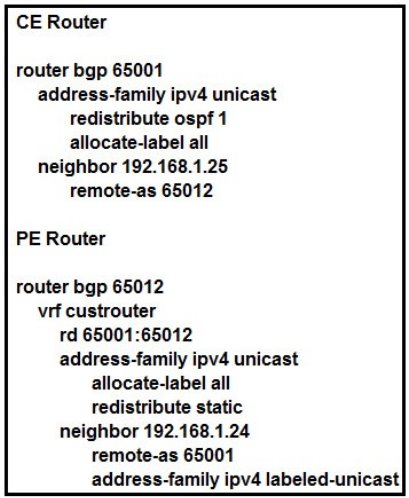
Refer to the exhibit. The CE router has established a BGP peering with the PE router, and the CE will use the core infrastructure of the PE as a backbone carrier to support CSC. Which additional task can you perform to complete the configuration?

Select an option, then click Submit answer.

  • Configure static routing on the CE router.

  • Configure the address-family ipv4 labeled-unicast command under the neighbor configuration of the CE router for the PE.

  • Change the rd value to 65001:65001 under the VRF section of the PE router.

  • Configure OSPF on the PE router.