300-420 Designing Cisco Enterprise Networks (ENSLD)

Loading demo links...

Showing 4–6 of 15 questions

Question 4 (Advanced Enterprise Campus Networks)

A network engineer must segregate three interconnected campus networks using IS-IS routing. A two-layer hierarchy must be used to support large routing domains and to avoid more specific routes from each campus network being advertised to other campus network routers automatically. Which two actions does the engineer take to accomplish this segregation? (Choose two.)

Select all that apply, then click Submit answer.

  • Designate two IS-IS routers as BDR routers at the edge of each campus, and configure one BDR for all Level 1 routers and one BDR for all Level 2 routers.

  • Designate two IS-IS routers from each campus to act as Level 1/Level 2 backbone routers at the edge of each campus network.

  • Assign the same IS-IS NET value for each campus, and configure internal campus routers with Level 1/Level 2 routing.

  • Utilize different MTU values for each campus network segment. Level 2 backbone routers must utilize a larger MTU size of 9216.

  • Assign a unique IS-IS NET value for each campus, and configure internal campus routers with Level 1 routing.
Question 5 (Network Services)

An organization is designing a detailed QoS plan that limits bandwidth to specific rates. Which two parameters are supported by the traffic policing feature? (Choose two.)

Select all that apply, then click Submit answer.

  • violating

  • marking

  • shaping

  • bursting

  • conforming

Question 6 (New Update)

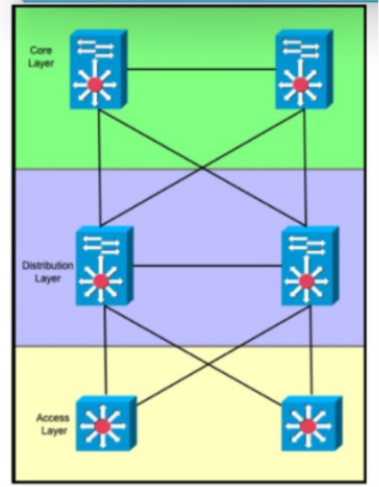
Refer to the exhibit. An engineer Is designing a multicampus Layer 3 Infrastructure using EIGRP as the routing protocol. The design must provide quick replies to queries In the event of a downlink, prevent unnecessary queries, and ensure that traffic does not unnecessarily transit the access layer. Which two actions must the engineer take for the network design? (Choose two.)

Select all that apply, then click Submit answer.

  • Configure core layer switches as stub routers.

  • Configure distribution layer switches to summarize routes to the core layer.

  • Configure access layer switches as stub routers.

  • Configure access layer and core layer switches as stub routers.

  • Configure access layer switches to summarize routes to the distribution layer.