200-301 Cisco Certified Network Associate

Loading demo links...

Showing 13–15 of 20 questions

Question 13 (Network Access)

On a corporate network, hosts on the same VLAN can communicate with each other, but they are unable to communicate with hosts on different VLANs. What is needed to allow communication between the VLANs?

Select an option, then click Submit answer.

  • a router with subinterfaces configured on the physical interface that is connected to the switch

  • a router with an IP address on the physical interface connected to the switch

  • a switch with an access link that is configured between the switches
  • a switch with a trunk link that is configured between the switches

Question 14 (New Update)

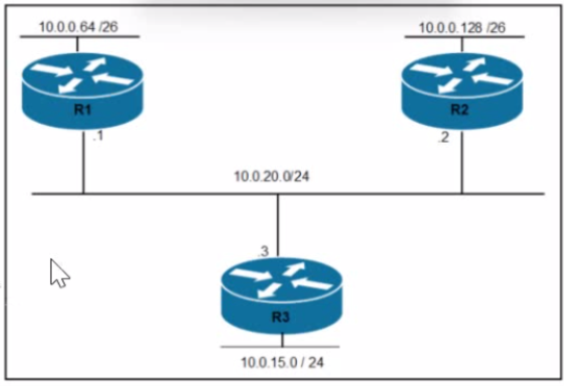
Refer to the exhibit.

Rooter R1 is added to the network and configured with tie 10 0 0 64/26 and 10.0.20.0/24 subnets However traffic destined for the LAN on R3 is not access. Which command when executed on R1 defines a tunic route to reach the R3 LAN?

A)

B)

C)

Select an option, then click Submit answer.

  • Option

  • Option

  • Option

Question 15 (Network Fundamentals)

How do TCP and UDP differ in the way they provide reliability for delivery of packets?

Select an option, then click Submit answer.

  • TCP does not guarantee delivery or error checking to ensure that there is no corruption of data, UDP provides message acknowledgement and retransmits data if lost.

  • TCP provides flow control to avoid overwhelming a receiver by sending too many packets at once, UDP sends packets to the receiver in a continuous stream without checking.

  • TCP is a connectionless protocol that does not provide reliable delivery of data; UDP is a connection-oriented protocol that uses sequencing to provide reliable delivery.

  • TCP uses windowing to deliver packets reliably; UDP provides reliable message transfer between hosts by establishing a three-way handshake.

