4A0-103 Alcatel-Lucent Multiprotocol Label Switching

Loading demo links...

Showing 13–15 of 15 questions

Question 13 (Volume C)

Click on the exhibit.
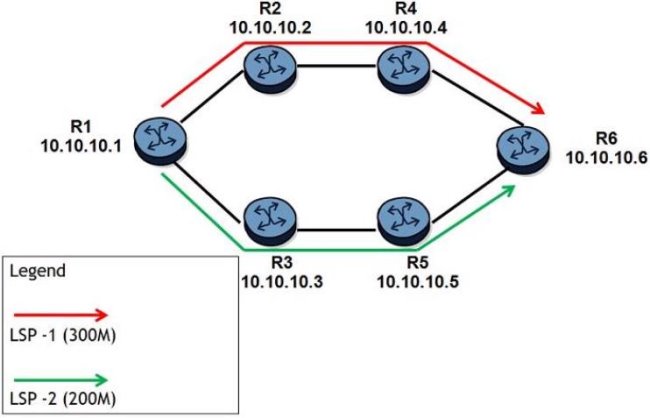
C:\Documents and Settings\David\Desktop\1.jpg

Initially, all links along the path R1-R2-R4-R6 have 400Mbps unreserved bandwidth and all links along the path R1-R3-R5-R6 have 800Mbps unreserved bandwidth. Shared Explicit reservation style is used and Make-Before-Break is enabled. Both fully loose LSPs have been signaled as shown. Later, the configured bandwidth for LSP-1 is changed to 400Mbps. Which of the following is TRUE?

Select an option, then click Submit answer.

  • After a new path for LSP-1 is established on R1-R3-R5-R6, the old path is torn down.

  • After the old path for LSP-1 is torn down, the new path is established on R1-R3-R5-R6.

  • LSP-1 will stay on R1-R2-R4-R6 because there is enough bandwidth on the existing path.

  • LSP-1 will be torn down because CSPF fails to find a new path.
Question 14 (Volume B)

Which of the following regarding MPLS Encapsulation is FALSE?

Select an option, then click Submit answer.

  • The customer's Layer 2 header is preserved at the iLER for Layer 2 services.

  • The customer's Layer 2 Header is preserved at the iLER for Layer 3 services.

  • The service provider's Layer 2 header is added at the iLER for Layer 2 services.

  • The service provider's Layer 2 header is added at the iLER for Layer 3 services.

Question 15 (Volume C)

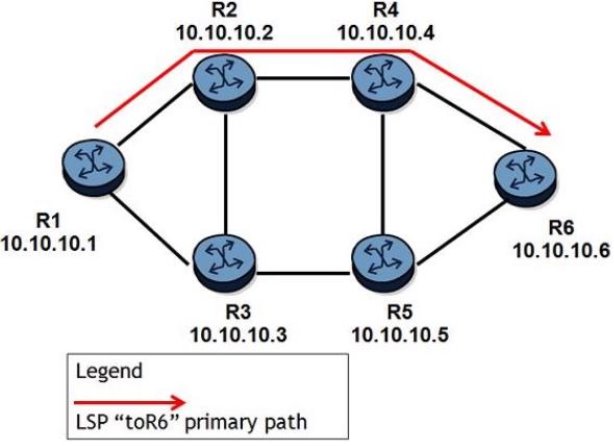
Click on the exhibit.

C:\Documents and Settings\David\Desktop\1.jpg

An LSP traverses R1-R2-R4-R6 and facility fast reroute with link protection is enabled. All links have the same cost. Which of the following about PLRs and MPs is TRUE?

Select an option, then click Submit answer.

  • R1, R2, and R4 can be PLRs; R6 is the MP.

  • R1, R2, and R4 can be PLRs; R2, R4, and R6 are MPs.

  • R1, R2, R3, R4, and R5 can be PLRs; R6 is the MP.

  • R1, R2, R3. R4, and R5 can be PLRs; R2, R4, and R6 is the MP.