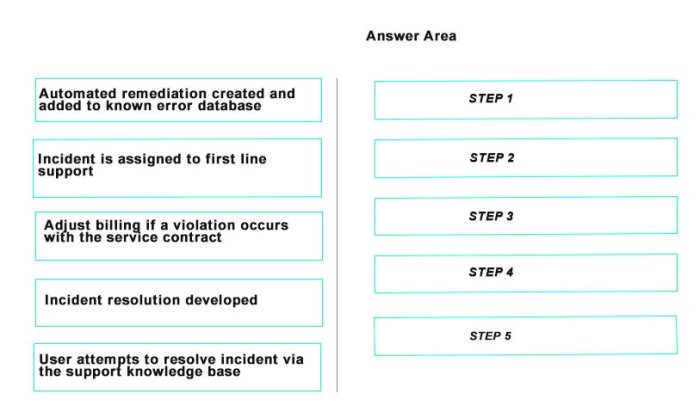
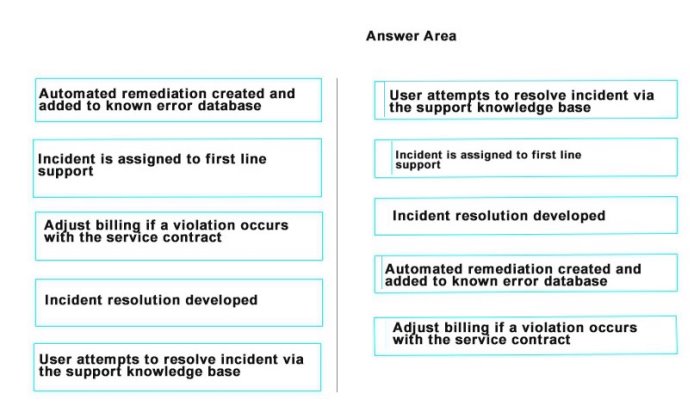
A company has an incident process in place for the cloud services that they support. What is the correct order of steps for an incident process?
Select and Place:

Answer is in the explanation below.
Loading demo links...
Showing 1–10 of 10 questions
A company has an incident process in place for the cloud services that they support. What is the correct order of steps for an incident process?
Select and Place:

Answer is in the explanation below.
An organization is deploying services in an existing private cloud. The lines of business have concerns about service performance in planned services. How should IT address these performance concerns?
Select an option, then click Submit answer.
Cloud architect defines appropriate performance in the cloud design.
Service manager defines appropriate performance in the SLA.
Cloud administrator defines appropriate performance in the SLA.
Cloud administrator defines appropriate performance in the cloud design.
A company has an IT organization that is separated into teams that support different underlying technologies. Each team has its own budget and manages its own tools. They have a clear understanding of current performance, capacity, and events. Team response to assigned help desk tickets is satisfactory.
The company intends to deploy a private cloud and provide services to internal customers. What service operation management challenge may this company face?
Select an option, then click Submit answer.
Inability to provide accurate pricing models
Inability to calculate fixed costs
Time consuming root cause analysis
Lack of control over service placement
You have been approached by a company to recommend a service model given the following economic drivers:
In addition, developers would like independent control to test and provision their own environments.
What is the most appropriate service model to recommend?
Select an option, then click Submit answer.
PaaS
BaaS
IaaS
SaaS
A European company has been providing web services within their private cloud. They now wish to make these web services available globally by using a public cloud provider. You are hired as a cloud architect to help them with this transition. In your analysis, you find that a different hypervisor is being used by the public cloud provider.
As the enterprise elastically provisions resources, what is a possible solution if the hypervisors are different?
Select an option, then click Submit answer.
Modify the access role in the current service template to allow connection to the public cloud
Recalibrate the current service template and deploy it in the public cloud
Define a different service template to deploy in the public cloud
Use a second service catalog to deploy the existing service template in the public cloud
A company plans to offer CRM, CDN, and ERP services. According to NIST, which services categories correspond to these offerings?
Select an option, then click Submit answer.
CRM: PaaS; CDN: PaaS; ERP: IaaS
CRM: IaaS; CDN: IaaS; ERP: SaaS
CRM: IaaS; CDN: SaaS; ERP: PaaS
CRM: SaaS; CDN: IaaS; ERP: SaaS
You have been hired by a large, global manufacturing company to help them plan for cloud services.
During discussions with the local employees, you document which applications are most important to the business. You also gather and document key performance metrics. You find:
-Some applications are rarely used
-Mission critical applications require 99.99% uptime to meet the SLAs
-Corporate email is proprietary and confidential information
-Certain applications must comply with country specific regulations
What should you use to determine proper application placement?
Select an option, then click Submit answer.
Application level gap analysis
Cloud security alliance controls matrix
Cloud services assessment
Workload analysis for right-sourcing
An IT organization wishes to adopt ITaaS to offer services to customers. What should the organization consider when designing services?
Select an option, then click Submit answer.
Manage the entire service lifecycle with the goal of zero-touch orchestration and service installation
Use different service template for different business units to design all the services to be offered
Ensure services are tightly coupled so that each service operates effectively
Ensure that each service has dedicated resources available all the time in the resource pool
What key features do Web Scale infrastructure and applications share that contribute to their success?
Select an option, then click Submit answer.
Intelligent hyper-optimized applications, clustered architecture, low OPEX, and HA design
HA design, distributed architecture, low OPEX, and design for failure
Clustered architecture, design for failure, HA design, and intelligent hyper-optimized applications
Design for failure, intelligent hyper-optimized applications, distributed architecture, and low OPEX
An organization is deploying services in a private cloud. Consumers are calling IT because they are seeing performance issues within the deployed services. How should IT troubleshoot and identify these performance issues?
Select an option, then click Submit answer.
Cloud administrator uses the monitoring tools
Service manager uses the monitoring tools
Cloud architect uses the metering tools
Cloud administrator uses the metering tools
Prepare for the Cloud Services Expert Exam for Cloud Architects (E20-920) exam with this free practice test from Study4Pass, built around the real EMC syllabus. You will find 10 free questions, drawn from the full Study4Pass practice set of 108 questions for this exam. The free sample includes 9 single-answer and 1 drag-and-drop questions — the same mix of formats you will meet in the full set. The questions follow the same topic balance as the real exam: VNX Architecture and Configuration, VNX Storage Pool Design and Implementation, VNX File System Design and Implementation and VNX Replication and Backup Solutions. The EMC E20-920 exam is an assessment of an individual's knowledge and skills related to the EMC Data Domain System Administration.
The target audience for the EMC E20-920 exam is storage administrators, storage engineers, and system engineers who want to demonstrate their knowledge in storage systems, data protection, and data security. The EMC E20-920 exam does not have any official prerequisites.
Use the sample the way you would use the real thing: answer each question on your own first, then open the explanation and make sure you understand why the right answer is right. That habit — reasoning instead of memorizing — is what carries over to exam day. When a topic keeps tripping you up, that is your study plan telling you where to go next.
When you finish the sample, do not just count the score — read it. Every missed question names a topic, and the full set lets you train that topic on its own until it stops costing you marks. That loop of test, review and targeted practice is how this set is designed to be used, from the first free question to the last simulation.
Inside the full E20-920 practice set:
Pick an answer for each question and check it straight away — the correct answer and a full explanation appear under the question. There is no time limit and nothing to sign up for. When an explanation is not enough, use Ask AI: this is an AI-Enabled practice test, and Ask AI explains the concept behind the question in plain language. When the free sample feels comfortable, the full set of 108 questions adds timed Exam Simulation, topic-by-topic training, and flagged-question review — the closest thing to exam day you can get before the real thing.
Yes. Every question on this page — all 10 of them — is free to use, and you never need to create an account to try them.
The full Study4Pass set for E20-920 has 108 practice questions. This page gives you 10 of them free so you can judge the quality and difficulty first.
Yes. Check any question to reveal the correct answer and its explanation, and use Ask AI whenever you want the underlying concept explained step by step.
No — these are practice questions built to match the E20-920 domains and difficulty level, so you can prepare for the real exam with confidence.