Question 1
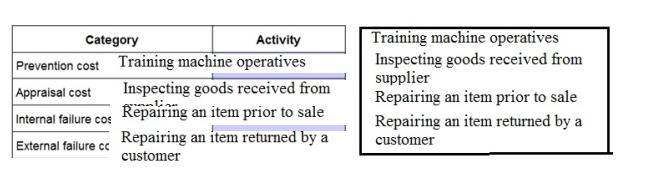
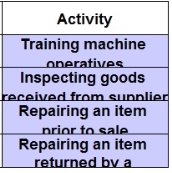
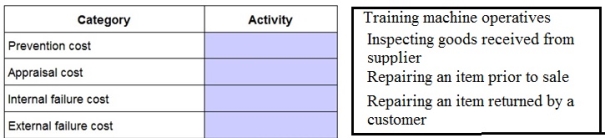
Place each of the activities described below against the correct classification of quality costs.
Answer is in the explanation below.
Loading demo links...
Showing 1–10 of 10 questions
Place each of the activities described below against the correct classification of quality costs.
Answer is in the explanation below.
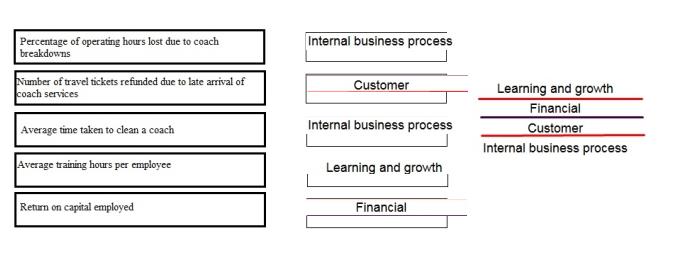
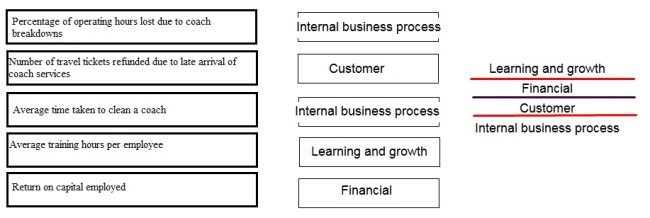
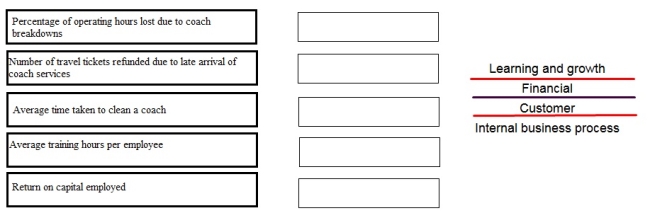
A Balanced Scorecard is being prepared for a coach passenger transport company. Place the correct perspective of the Balanced Scorecard against each performance measure.
Answer is in the explanation below.
An organization produces only two products. Each month it produces 1,000 units of product A and 10,000 units of product B.
Using traditional absorption costing the products have very similar unit costs. However when costs are calculated using activity-based costing (ABC), product A's unit cost is significantly higher than that of product B.
Which of the following factors has the potential to cause this difference?
Select ALL that apply.
Select all that apply, then click Submit answer.
ABC cost calculations are not simply volume-related.
ABC costs are driven only by the volume of output.
ABC considers only marginal costs.
ABC uses multiple cost drivers to trace overhead costs to products.
ABC considers only direct costs.
Which of the following statements are correct with regard to responsibility centres?
Select ALL that apply.
Select all that apply, then click Submit answer.
Revenue centre managers have a lower level of decision-making authority than profit centre managers.
Revenue centre managers and profit centre managers are accountable for controllable costs only.
Profit centre managers and investment centre managers are responsible for the majority of operating costs incurred.
Investment centre managers have a higher level of managerial authority than profit centre managers.
Managers of profit centres have authority over the level of investment in working capital but managers of cost centres do not.
Which TWO of the following actions taken during the budgetary planning process will result in the creation of budgetary slack?
Select all that apply, then click Submit answer.
Overestimating costs
Underestimating costs
Underestimating revenues
Overestimating revenues
Overestimating profit
The Chief Executive of a large manufacturing company has made the following comment.
"All of our competitors are using both just-in-time(JIT) and Total Quality Management (TQM) whereas we have never used either. Consequently we are lagging behind our competitors because their levels of inventory and quality costs are significantly below ours. I want to see JIT fully implemented, both for purchasing and for production, in 4 weeks' time and TQM fully implemented 4 weeks after that."
Which of the following provide appropriate advice to the Chief Executive?
Select ALL that apply.
Select all that apply, then click Submit answer.
Full implementation of JIT is unlikely to be successful unless a TQM environment has first been established.
Implementing TQM from scratch within 8 weeks should be feasible for a large manufacturing company, but implementing JIT within 4 weeks is unlikely to be feasible.
Total quality costs are likely to begin declining immediately once the process of implementing TQM has commenced.
JIT offers the long run prospect of significantly reducing inventory.
It would be possible to implement TQM without implementing JIT.
It is not possible to implement JIT for production without first implementing JIT for purchasing.
A positive net present value (NPV) has been calculated for a project to launch a new product. An additional calculation is required to identify the sensitivity of the NPV to changes in the forecast total sales volume.
The present value of which of the following would be used in the calculation?
Select an option, then click Submit answer.
Contribution
Operating profit
Fixed overheads
Net profit
It is often claimed that a two-part transfer pricing system offers a number of advantages to organizations which use it.
Which of the following statements is NOT an advantage of using a two-part transfer pricing system?
Select an option, then click Submit answer.
Transfers are made at the marginal cost of the supplying division and both divisions should be able to report profits from inter-divisional trading.
The receiving division is made aware of and charged for the full cost of obtaining intermediate products from other divisions.
It stimulates planning, communication and coordination amongst divisions.
The agreed fixed fee simply compensates the supplying division for incurring the fixed costs associated with the item transferred.
A company is considering two mutually exclusive projects, an analysis of which is given below:
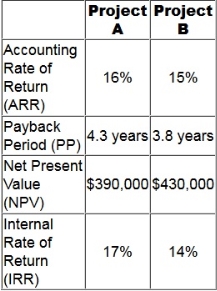
The company's cost of capital is 12%.
Assuming an objective of maximising shareholders' wealth, which project would be recommmended?
Select an option, then click Submit answer.
Project B because it has the higher net present value.
Project B because it has the shorter payback period.
Project A because it has the higher accounting rate of return.
Project A because it has the higher internal rate of return.
A product requires one each of three different components.
Faulty components are identified only at the end of the manufacturing process.
The following average fault rates have been identified:
Component A – 1 in 100
Component B – 1 in 20
Component C – 1 in 10
The probability that a unit of finished product contains no faulty components is:
Select an option, then click Submit answer.
0.84645
0.00005
0.99231
0.97692
Thinking of taking the Advanced Management Accounting (P2) exam? This free Cima practice test is the place to start. You will find 10 free questions, drawn from the full Study4Pass practice set of 184 questions for this exam. The free sample includes 4 single-answer, 4 multiple-answer and 2 drag-and-drop questions — the same mix of formats you will meet in the full set. The questions follow the same topic balance as the real exam: Performance Management, Decision-Making, Risk Management and Financial Strategy. CIMA P2, also known as Advanced Management Accounting, is a professional-level examination that is part of the Chartered Institute of Management Accountants (CIMA) professional qualification.
The CIMA P2 Exam is designed for students who have completed the CIMA Operational Level and are looking to progress to the CIMA Strategic Level. The Prerequisite for Cima P2 Exam is to have passed the Cima P1 Exam or Cima Operational Case Study Exam.
Use the sample the way you would use the real thing: answer each question on your own first, then open the explanation and make sure you understand why the right answer is right. That habit — reasoning instead of memorizing — is what carries over to exam day. When a topic keeps tripping you up, that is your study plan telling you where to go next.
When you finish the sample, do not just count the score — read it. Every missed question names a topic, and the full set lets you train that topic on its own until it stops costing you marks. That loop of test, review and targeted practice is how this set is designed to be used, from the first free question to the last simulation.
Inside the full P2 practice set:
Pick an answer for each question and check it straight away — the correct answer and a full explanation appear under the question. There is no time limit and nothing to sign up for. When an explanation is not enough, use Ask AI: this is an AI-Enabled practice test, and Ask AI explains the concept behind the question in plain language. When the free sample feels comfortable, the full set of 184 questions adds timed Exam Simulation, topic-by-topic training, and flagged-question review — the closest thing to exam day you can get before the real thing.
Yes. Every question on this page — all 10 of them — is free to use, and you never need to create an account to try them.
The full Study4Pass set for P2 has 184 practice questions. This page gives you 10 of them free so you can judge the quality and difficulty first.
Yes. Check any question to reveal the correct answer and its explanation, and use Ask AI whenever you want the underlying concept explained step by step.
No — these are practice questions built to match the P2 domains and difficulty level, so you can prepare for the real exam with confidence.