THEA-Test Texas Higher Education Assessment - Mathematics, Reading Comprehension

Loading demo links...

Showing 13–15 of 20 questions

Question 13 (Reading Comprehension)

When using a metal file, always remember to bear down on the forward stroke only. On the return stroke, lift the file clear of the surface to avoid dulling the instrument's teeth. Only when working on very soft metals is it advisable to drag the file's teeth slightly on the return stroke. This helps clear out metal pieces from between the teeth.

It is best to bear down just hard enough to keep the file cutting at all times. Too little pressure uses only the tips of the teeth; too much pressure can chip the teeth. Move the file in straight lines across the surface. Use a vice to grip the work so that your hands are free to hold the file. Protect your hands by equipping the file with a handle. Buy a wooden handle and install it by inserting the pointed end of the file into the handle hole.

Protect your hands by

Select an option, then click Submit answer.

  • dulling the teeth

  • dragging the teeth on the backstroke

  • using a vise

  • installing a handle

  • wearing safety gloves

Question 14 (Math)

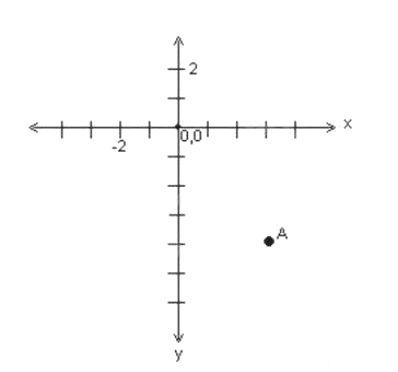
What are the coordinates of point A on the following graph?

Select an option, then click Submit answer.

  • (−3, −4)

  • (−4, 3)

  • (3, −4)

  • (−4, −3)

  • (3, 4)

Question 15 (Reading Comprehension)

Marie Curie was one of the most accomplished scientists in history. Together with her husband, Pierre, she discovered radium, an element widely used for treating cancer, and studied uranium and other radioactive substances. Pierre and Marie's amicable collaboration later helped to unlock the secrets of the atom.

Marie was born in 1867 in Warsaw, Poland, where her father was a professor of physics. At the early age, she displayed a brilliant mind and a blithe personality. Her great exuberance for learning prompted her to continue with her studies after high school. She became disgruntled, however, when she learned that the university in Warsaw was closed to women. Determined to receive a higher education, she defiantly left Poland and in 1891 entered the Sorbonne, a French university, where she earned her master's degree and doctorate in physics.

Marie was fortunate to have studied at the Sorbonne with some of the greatest scientists of her day, one of whom was Pierre Curie. Marie and Pierre were married in 1895 and spent many productive years working together in the physics laboratory. A short time after they discovered radium, Pierre was killed by a horse-drawn wagon in 1906. Marie was stunned by this horrible misfortune and endured heartbreaking anguish. Despondently she recalled their close relationship and the joy that they had shared in scientific research. The fact that she had two young daughters to raise by herself greatly increased her distress.

Curie's feeling of desolation finally began to fade when she was asked to succeed her husband as a physics professor at the Sorbonne. She was the first woman to be given a professorship at the worldfamous university. In 1911 she received the Nobel Prize in chemistry for isolating radium. Although Marie Curie eventually suffered a fatal illness from her long exposure to radium, she never became disillusioned about her work. Regardless of the consequences, she had dedicated herself to science and to revealing the mysteries of the physical world.

Marie ___ by leaving Poland and traveling to France to enter the Sorbonne.

Select an option, then click Submit answer.

  • challenged authority

  • showed intelligence

  • behaved

  • was distressed

  • answer not available in article