This passage is adapted from Bryan Walsh, “Whole Food Blues: Why Organic Agriculture May Not Be So Sustainable.” ©2012 by Time Incorporated.
When it comes to energy, everyone loves efficiency. Cutting energy waste is one of those goals that both sides of the political divide can agree on, even if they sometimes diverge on how best to get there. Energy efficiency allows us to get more out of our given resources, which is good for the economy and (mostly) good for the environment as well. In an increasingly hot and crowded world, the only sustainable way to live is to get more out of less. Every environmentalist would agree.
But change the conversation to food, and suddenly efficiency doesn’t look so good. Conventional industrial agriculture has become incredibly efficient on a simple land to food basis. Thanks to fertilizers, mechanization and irrigation, each American farmer feeds over 155 people worldwide. Conventional farming gets more and more crop per square foot of cultivated land – over 170 bushels of corn per acre in Iowa, for example – which can mean less territory needs to be converted from wilderness to farmland. And since a third of the planet is already used for agriculture – destroying forests and other wild habitats along the way – anything that could help us produce more food on less land would seem to be good for the environment.
Of course, that’s not how most environmentalists regard their arugula [a leafy green]. They have embraced organic food as better for the planet – and healthier and tastier, too – than the stuff produced by agricultural corporations. Environmentalists disdain the enormous amounts of energy needed and waste created by conventional farming, while organic practices – forgoing artificial fertilizers and chemical pesticides – are considered far more sustainable. Sales of organic food rose 7.7% in 2010, up to $26.7 billion – and people are making those purchases for their consciences as much as their taste buds.
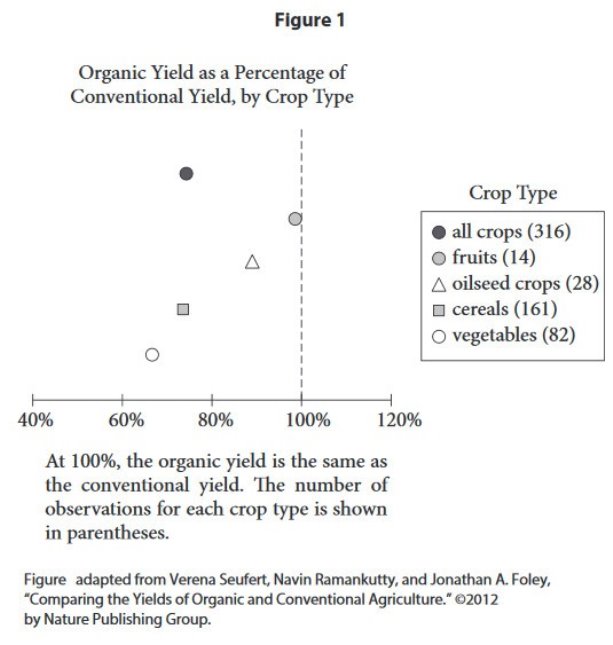
Yet a new meta-analysis in Nature does the math and comes to a hard conclusion: organic farming yields 25% fewer crops on average than conventional agriculture. More land is therefore needed to produce fewer crops – and that means organic farming may not be as good for the planet as we think.
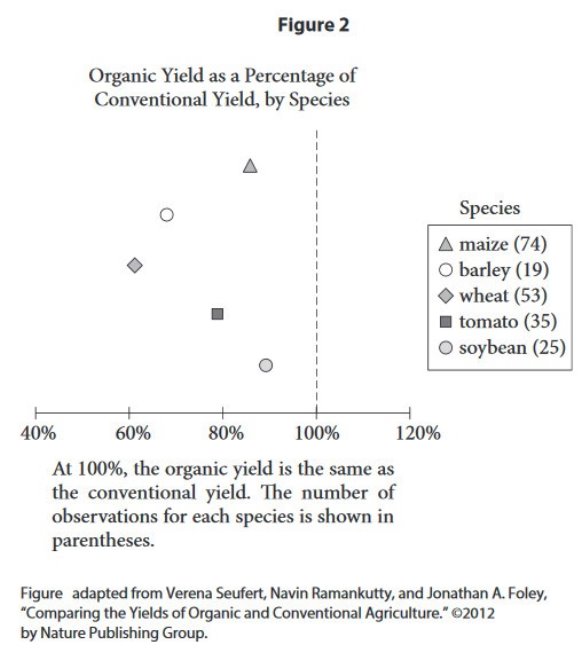
In the Nature analysis, scientists from McGill University in Montreal and the University of Minnesota performed an analysis of 66 studies comparing conventional and organic methods across 34 different crop species, from fruits to grains to legumes. They found that organic farming delivered a lower yield for every crop type, though the disparity varied widely. For rain watered legume crops like beans or perennial crops like fruit trees, organic trailed conventional agriculture by just 5%. Yet for major cereal crops like corn or wheat, as well as most vegetables – all of which provide the bulk of the world’s calories – conventional agriculture outperformed organics by more than 25%.
The main difference is nitrogen, the chemical key to plant growth. Conventional agriculture makes use of 171 million metric tons of synthetic fertilizer each year, and all that nitrogen enables much faster plant growth than the slower release of nitrogen from the compost or cover crops used in organic farming. When we talk about a Green Revolution, we really mean a nitrogen revolution – along with a lot of water.
But not all the nitrogen used in conventional fertilizer ends up in crops – much of it ends up running off the soil and into the oceans, creating vast polluted dead zones. We’re already putting more nitrogen into the soil than the planet can stand over the long term. And conventional agriculture also depends heavily on chemical pesticides, which can have unintended side effects.
What that means is that while conventional agriculture is more efficient – sometimes much more efficient – than organic farming, there are trade-offs with each. So an ideal global agriculture system, in the views of the study’s authors, may borrow the best from both systems, as Jonathan Foley of the University of Minnesota explained:
“The bottom line? Today’s organic farming practices are probably best deployed in fruit and vegetable farms, where growing nutrition (not just bulk calories) is the primary goal. But for delivering sheer calories, especially in our staple crops of wheat, rice, maize, soybeans and so on, conventional farms have the advantage right now.
Looking forward, I think we will need to deploy different kinds of practices (especially new, mixed approaches that take the best of organic and conventional farming systems) where they are best suited – geographically, economically, socially, etc.”
According to Foley, an “ideal global agriculture system” (sentence 2 of paragraph 8):
Select an option, then click Submit answer.
-
○
focuses primarily on yield percentages and global markets.
-
○
considers multiple factors in the selection of farming techniques.
-
○
weighs the economic interests of farmers against the needs of consumers.
-
○
puts the nutritional value of produce first and foremost.