Seven friends, Abe, Bob, Chad, Dolly, Elisa, Frank, and Gregory sit in a VIP enclosure of a stadium to watch a football match. The seats in the enclosure form a 3 x 3 matrix, i.e. 3 rows (front, middle and last) with 3 seats in each row. The following information is known:
 Chad sits immediately beside Dolly
Dolly sits in a row immediately behind the row in which Abe is sitting
There is no one sitting on one side of Chad
None of Elisa or Gregory sits immediately beside Abe Bob sits in the last row
Who could be the respective persons sitting in the middle of the first and last rows?
I. Bob and Gregory
II. Frank and Gregory
III. Abe and Elisa
Select an option, then click Submit answer.
Reference / correct answer:
We need the respective persons sitting in the middle of the first and last rows. Working with the statements, we have:
Statement I: Bob and Gregory: Since B is sitting in the last row, this statement is false. Note that the question asks for the respective persons sitting in the middle of the first and last rows; thus, from the statement, the first person (As per the statement, Bob) belongs to the middle of the first row and the second person (As per the statement, Gregory) belongs to the middle of the last row.
Statement II: Frank and Gregory: F can take the middle seat in the front row since F has no contradictions in sitting beside
A. Also, Gregory can also sit in the middle of the last row since he too has no contradictions in sitting beside
B. – This statement can be true
Statement III: Abe and Elisa: A can definitely be the person in the middle of the front row and E as a result, definitely must be in the last row (from (v)) and can also take the middle seat in that row. – This statement can be true
General
Let us name the people Abe, Bob, Chad, Dolly, Elisa, Frank, and Gregory as A, B, C, D, E, F, and G, respectively. We can see that there are 3 × 3 = 9 seats, but there are only 7 people. Thus, the only possible way of distributing the 7 people across the 3 rows is that 2 rows would have 2 members each and one row would have 3 members.
However, the exact number of people in a particular row is not yet known and further analysis of the statements needs to be done.
1st statement: C and D sit beside each other … (i)
3rd statement: The row in which C and D are sitting, has exactly 2 people sitting in it (since there is no one sitting on the other side of C) … (ii)
2nd statement: Since D sits in the row just behind A's row, the row where D (and C) sits must be either the middle or the last row
5th statement: Since B sits in the last row and the row where C and D sits has only 2 people, C and D must be in the middle row … (iii) Thus, it also follows that A must be in the front row … (iv)
4th statement: We know that neither E nor G sits beside
A. Thus, there are 2 possible scenarios:
If A is in the middle of the front row, none of E or G can sit in the front row; thus, they would sit in the last row … (v) If A is at either end of the front row, only in that scenario can one of E or G also sits in the front row … (vi) Thus, we have:
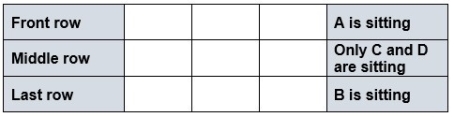
Also, in the middle row, since C has D on one side and a vacant seat on the other, C must be in the middle position. Thus, we finally have:
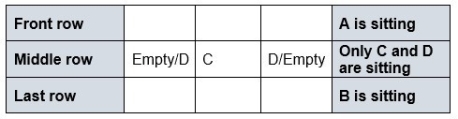
This is all that can be deduced from the main stem.
To answer the questions, we need to use the additional information contained in each question.
 The lecture on Chemistry is scheduled after the lecture on History


