HSPT-Test High School Placement Test

Loading demo links...

Showing 13–15 of 20 questions

Question 13 (Reading Comprehension)

"The Meaning of 'Liberal Arts Education'" by Matthew Minerd (2013)

Many people use the expression “liberal arts education” but do not know much at all about the original meaning of such an education. It is often thought that a “true liberal education” is one that gives the student knowledge that is not pursued for “utilitarian values” – that is, knowledge that is not merely “for the sake of getting a job.” Sometimes, the expression “liberal education” is used to describe an education that is not a mere repetition of old beliefs, but is open-minded and “liberal” in this way.

To understand the original meaning of the expression “liberal arts” it is necessary to consider each part of the expression as it was used in its ancient and medieval senses. The word “liberal” was used to describe these “arts” insofar as they were not the “servile arts,” that is, “arts” in the sense of “artisan work.” In this regard, “liberal arts” were not a matter of “getting a job.” The word “art” still had a meaning that was related to “artisanship.” However, these “arts” were “liberal” because they were the “arts of reasoning,” that is, “the arts of the mind.” They were meant to be tools that prepared someone for more in-depth studies. Thus, they were not envisioned as “knowledge for the sake of knowledge.” Instead, they were the initial tools that enabled the young student to reason properly. This more ancient sense of the “liberal arts” is often missed or, at least, partially overlooked in contemporary discussions about them.

According to the reasoning of the passage, which sentence directly explains the older meaning of “art” in the expression “liberal arts”?

Select an option, then click Submit answer.

  • In this regard, “liberal arts” were not a matter of “getting a job.”

  • Instead, they were the initial tools that enabled the young student to reason properly.

  • The word “liberal” was used to describe these “arts” insofar as they were not the “servile arts,” that is, “arts” in the sense of “artisan work.”

  • The word “art” still had a meaning that was related to “artisanship.”

  • This more ancient sense of the “liberal arts” is often missed or, at least, partially overlooked in contemporary discussions about them.

Question 14 (Mathematics and Quantitative Skills)

The above diagram shows a spinner. The radius of the smaller quarter-circles is half that of the larger quarter-circles.

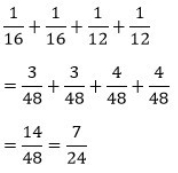
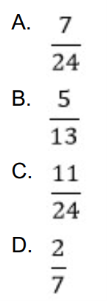
A player spins the above spinner. What is the probability that the spinner will stop while pointing inside a red region?

Select an option, then click Submit answer.

  • Option A

  • Option B

  • Option C

  • Option D

Question 15 (Reading Comprehension)

Adapted from "The Treatment of Rattlesnake Bite by Permanganate of Potassium, Based on Nine Successful Cases" by Amos W. Barber, M.D. in Scientific American Supplement No. 841, Vol.

XXXIII (February 13th 1892)

Poisoned wounds, inflicted by the fangs of the rattlesnake, are happily rarer each year, since, as the country is becoming more populated, the crotalus is rapidly being exterminated. Yet, considering the disregard that characterizes the cowboy in his treatment of this reptile, it is astonishing that this class of injury is not more common.

It is the invariable custom among the cattlemen to dismount and destroy these snakes whenever they are seen. This is readily accomplished, since a slight blow will break the back. This blow is, however, generally delivered by means of the quirt, a whip not over two and a half feet long, and hence a weapon which brings the one who wields it in unpleasant proximity to the fangs of the reptile. A still more dangerous practice, and one which I have frequently seen, is a method of playing with the rattlesnake for the humor of the cowboy at the expense of a "tenderfoot." It is well known that unless a snake is coiled or in other specific positions, it cannot strike. On this theory, a mounted cowboy first puts a rattler to flight, then seizes it by the tail, and, swinging it so rapidly around his head that it is impossible for it to strike, sets off in pursuit of whoever has exhibited the most terror at the sight of the reptile. When within fair distance, he hurls the snake at the unfortunate victim, in the full assurance that even should it hit him it cannot bury its fangs in his flesh, since it cannot coil until it reaches the ground. This is a jest of which I have frequently been the victim, nor have I yet learned to appreciate it with unalloyed mirth.

The first case of rattlesnake wound to which I was called occurred in 1885. A cowboy was bitten on the foot, the fang penetrating through the boot. I saw him about twenty-four hours after he was struck. There was enormous swelling, extending up to the knee. There was no special discoloration about the wound; in fact, the swelling disguised this to such an extent that it was impossible to determine exactly where the fangs had entered. The patient was suffering great pain. His mind was clear, but he was oppressed with a dreadful anxiety.

Why does the author believe the number of rattlesnake poisonings is decreasing each year?

Select an option, then click Submit answer.

  • People are being more careful around rattlesnakes

  • All of the other answers are given as reasons.

  • Changes in climate have reduced the rattlesnake population

  • The population of people is growing

  • Treatment of rattlesnake bites is improving