ACT-Test American College Testing: English, Math, Reading, Science, Writing

Loading demo links...

Showing 4–6 of 20 questions

Question 4 (Science)

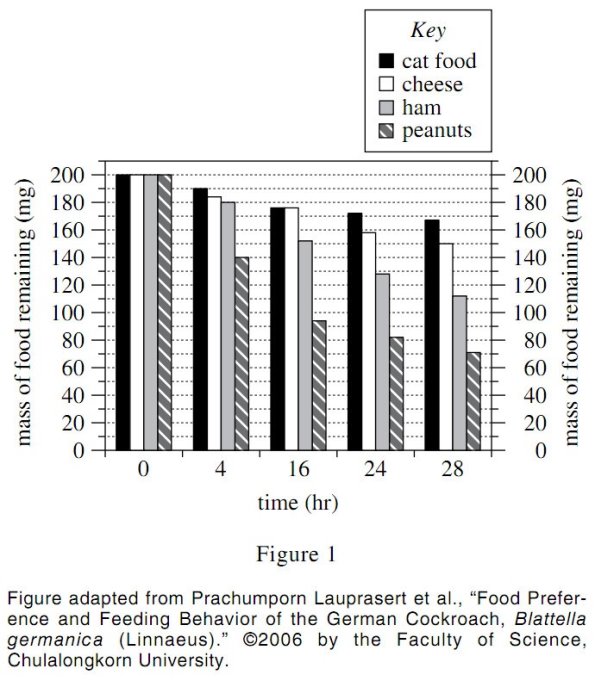
A study was conducted to examine whether female Blattella germanica (a species of cockroach) prefer to eat cat food, cheese, ham, or peanuts. First, 200 mg of each of the 4 foods was separately placed into a single box. Then, adult female

B. germanica were added to the box. Figure 1 shows how the mass, in mg, of each food in the box changed over time after the addition of the

B. germanica. Table 1 shows the percent by mass of carbohydrates, lipids, proteins, and water, respectively, present in each of the 4 foods tested in the study.

Based on Table 1, when 200 mg of each of the 4 foods was placed in the box, water accounted for more than 100 mg of the mass of which food(s)?

Select an option, then click Submit answer.

  • Peanuts only

  • germanica were added to the box. Figure 1 shows how the mass, in mg, of each food in the box changed over time after the addition of the
    germanica. Table 1 shows the percent by mass of carbohydrates, lipids, proteins, and water, respectively, present in each of the 4 foods tested in the study.


    Based on Table 1, when 200 mg of each of the 4 foods was placed in the box, water accounted for more than 100 mg of the mass of which food(s)?
    Cat food and ham only

  • Cheese and peanuts only

  • Cat food, cheese, and ham only

Question 5 (English)

DIRECTIONS: In the passage below, certain phrases are underlined and numbered . The question will present alternatives for the underlined part. In most cases, you are to choose the one that best expresses the idea, makes the statement appropriate for standard written English, or is worded most consistently with the style and tone of the passage as a whole. If you think the original version is the best, choose "NO CHANGE".

Annie Smith Peck

[§1] Since a hundred years, <1> the highest mountains in South America have lured climbers from all over the world. But until 1908, Peru’s Mt. Huascaran resisted the efforts of all those who attempted to reach its summit. One mountaineer, Annie Smith Peck, vowed to overcome the obstacles and be the first to the top of Mt. Huascaran. In order to succeed, she would have to organize expeditions – deal with reluctant companions –survive bad weather, and <2> climb steep cliffs of ice and rock.

[§2] Peck was born in the United States in 1850. Although she didn’t start mountain climbing until she was in her thirties, it <3> soon became clear that she had found her life’s work. A natural mountaineer, Peck was soon setting records on expeditions in North America and Europe. She traveled to Bolivia in 1903 and found Mount Huascaran, which had yet to be surmounted, a challenge she simply could not resist. <4>

[§3] (1) Peck mounted four expeditions and made five attempts before she finally conquered Mt. Huascaran. (2) Between those expeditions, Peck returned to the United States to raise money. (3) She received help from many scientific organizations, including the Museum of Natural History. (4) The Museum had also supported Admiral Peary on his trip to the North Pole. (5) Still, Peck struggled at least as much to raise money as she did climbing <5> her beloved mountains.

[§4] In 1908, Peck scraped together the funds for yet another expedition to Mt. Huascaran. This time, she hired two Swiss guides to assist <6> her with the climb. On their first trip up the mountain’s slopes, one of the guides became ill, and the entire team was forced to turn back even though they were very close to the top. Being so close to success was very frustrating for Peck, who could not even prove how close they had come because she had accidentally brought the wrong kind of film and was unable to photograph the climb.

[§5] The team rested for a few days, the guide recovered, and on August 28th, they set off again. The climb was extremely difficult. Steps had to be cut <7>one by one into the steep ice; snow bridges and crevasses had to be carefully crossed. The weather was so cold that everyone suffered from frostbite. When Peck and her two guides were just a short distance from the top, they stopped to determine the exact height of the mountain.

[§6] At that moment, one of the guides took advantage of Peck’s distraction and climbed the few remaining feet to the summit so that he was the first to reach the peak. What a jerk! <8>Although Peck was understandably angry, she <9> focused on the triumph of achieving her goal: standing at last on the top of Mt. Huascaran.

<6>:

Select an option, then click Submit answer.

  • NO CHANGE

  • assisting

  • would assist

  • who had assisted

Question 6 (Science)

Sedimentary rocks (which form from sediment) are thought to be deposited in cycles that occur in discrete packages called sequences. Each sequence constitutes a complete cycle. The cause for the cyclist has been linked to sea level change, uplift of continents, climate change, and changes in earth’s orbit. These packages are thought to have a duration ranging from 50,000 to 200 million years.

One theory states that the sequences that occur on a scale of every 200,000 to 10 million years are usually caused by changes in the global ice volume. As temperatures increase and glaciers melt, sea level rises and new marine sediment – which is typically coarser-grained than underlying sediments is deposited along shorelines. As global temperatures decrease and glaciers build up, sea level falls and shoreline environments are eroded.

In order to test this theory, two studies were undertaken which enable us better to understand the relations between glaciations (periods of maximum cooling and glacier build-up) and marine sedimentary sequences.

Study 1

A 400m long core of sedimentary rock from an ancient shoreline in the United States was analyzed. The core represents marine sediments deposited over the last 20 million years. The researchers observed patterns of erosion and change in sediment size and determined that unique sequences occurred every 50,000, 100,000, 5 million, and 12 million years.

Study 2

At several sites beneath the Atlantic Ocean, a 50m core was removed from 500,000-year-old ocean floor marine sediments. These sediments contained abundant microfossils that can be used in determining the nature of past climates. The researchers studied the abundance and taxonomy of these microfossils and deduced patterns of warming and cooling global temperatures. They found that periods of maximum cooling (peak glaciations) occurred 75,000, 175,000, 375,000, and 475,000 years ago.

Which of the following characteristics of a sequence of marine sediments or sedimentary rocks would make it unsuitable for a study such as this?

I. an age of only 30,000 to 40,000 years

II. depth of ocean water

III. location away from the polar ice caps

Select an option, then click Submit answer.

  • I only

  • II and II only

  • I, II, and III

  • I and III only

  • an age of only 30,000 to 40,000 years
    II. depth of ocean water
    III. location away from the polar ice caps