S90.09 SOA Design & Architecture Lab (S90-09A)

Loading demo links...

Showing 4–5 of 5 questions

Question 4

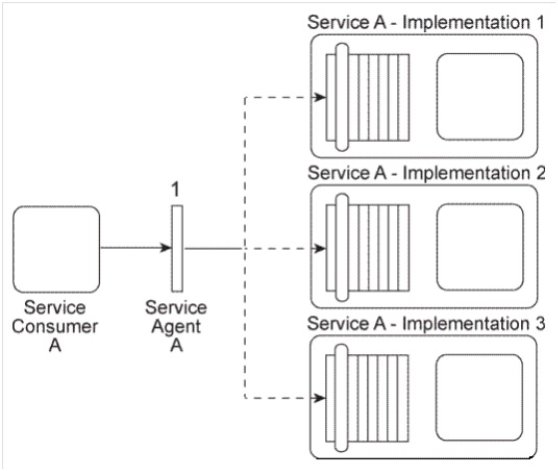
It has been confirmed that Policy A and Policy B are, in fact, the same policy and that the security credential check performed by Service Agent B also needs to be carried out on messages sent to Service B .
C:\Users\Kamran\Desktop\image.JPG

How can this service composition architecture be changed to reduce the redundancy of policy content and fulfill the new security requirement?

Select an option, then click Submit answer.

  • The Policy Centralization pattern can be applied so that Policy A and Policy B are combined into the same policy. The policy enforcement logic is removed from Service Agent C and Service Agent A is then used to enforce the policy for messages sent to Service A and Service B . Service Agent B can be used to perform the security credential check for Service A and Service B .

  • The Policy Centralization pattern can be applied so that Policy A and Policy B are combined into the same policy. The Service Agent pattern is then applied to introduce a new service agent (called Service Agent D) which carries out the validation and enforcement of Policy A and Policy Service Agent B can be moved so that it performs the security credential check for Service B, but not for Service A .

  • The Policy Centralization pattern can be applied so that Service Agent A is changed to enforce the policy for messages sent to Service A and Service B and to perform the security credential check for Service A and Service B .

  • None of the above.

Question 5

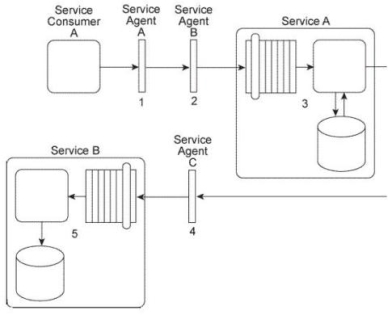
Service Consumer A sends a message to Service A. Before the message arrives with Service A, it is intercepted by Service Agent A (1). which checks the message for compliance to Policy A that is required by Service A. If the message fails compliance, Service Agent A will not allow it to proceed and will instead write the message contents to a log. If the message does comply to the policy, it continues to be transmitted toward Service A, but before it arrives it is intercepted by Service Agent B (2), which validates the security credentials in the message header. If the security credential validation fails, the message is rejected and a runtime exception is raised. If the security credentials are validated, the message is sent to Service A.

Upon receiving the message, Service A retrieves a data value from a database and populates the message header with this data value (3) prior to forwarding the message to Service B. Before the message arrives at Service B. it is intercepted by Service Agent C (4) which checks the message for compliance with two policies: Policy B and Policy C. Policy B is identical to Policy A that was checked by Service Agent A. To check for compliance to Policy C. Service Agent C uses the data value added by Service A. If the message complies with both of the policies, it is forwarded to Service B (5), which stores the message contents in its own database.

C:\Documents and Settings\user-nwz\Desktop\1.JPG

You are told that Policy B and Policy C have changed. Also, in order to carry out the compliance check of Policy C, Service Agent C will now require a new data value from the Service B database. How can this service composition architecture be changed to fulfill these new requirements?

Select an option, then click Submit answer.

  • The Policy Centralization pattern can be applied so that only one service agent is used to enforce Policy A and Policy B. Service A is redesigned to first query Service B for the value required by Service Agent C to check the compliance of the updated Policy C. If the compliance check is successful, the message is sent to Service B .

  • The Policy Centralization pattern can be applied so that only one service agent is used to enforce Policy A and Policy Service Consumer A is redesigned to first query Service B for the value required by Service Agent C. This way, Service Consumer A can include this value in the message header prior to sending the message to Service A .

  • The Policy Centralization pattern can be applied so that only one service agent is used to enforce Policy A and Policy B. The policy enforcement logic for Policy C is removed from Service Agent C and instead embedded within the logic of Service B . This way, Service B can itself retrieve the value required to check compliance with Policy If the message received is not in compliance, Service B will reject it.

  • None of the above.