S90.08B SOA Design & Architecture Lab with Services & Microservices

Loading demo links...

Showing 4–5 of 5 questions

Question 4

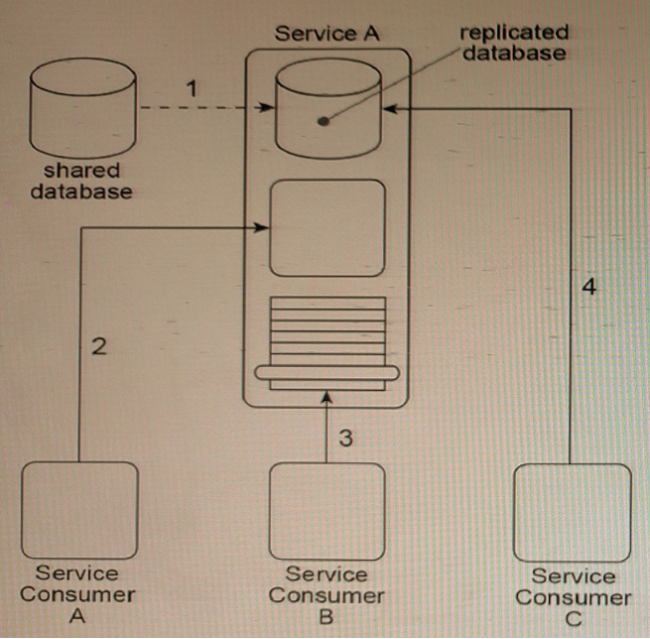
Service A is a utility service that provides generic data access logic to a database containing data that is periodically replicated from a shared database (1). Because the Standardized Service Contract principle was applied to the design of Service A, its service contract has been fully standardized.

The service architecture of Service A Is being accessed by three service consumers. Service Consumer A accesses a component that is part of the Service A Implementation by Invoking it directly (2). Service Consumer B invokes Service A by accessing Its service contract (3). Service Consumer C directly accesses the replicated database that Is part of the Service A Implementation (4).

You've been told that the reason Service Consumers A and C bypass the published Service A service contract is because, for security reasons, they are not allowed to access a subset of the capabilities in the API that comprises the Service A service contract. How can the Service A architecture be changed to enforce these security restrictions while avoiding negative forms of coupling?

Select an option, then click Submit answer.

  • The Contract Centralization pattern can be applied to force all service consumers to access the Service A architecture via its published service contract. This will prevent negative forms of coupling that could lead to problems when the database is replaced. The Service Abstraction principle can then be applied to hide underlying service architecture details so that future service consumers cannot be designed to access any part of the underlying service implementation.

  • The Contract Centralization pattern can be applied to force service consumers to access the Service A architecture via its published service contract only. The Service Loose Coupling principle can then be applied to ensure that the centralized service contract does not contain any content that is dependent on or derived from the underlying service implementation.

  • The Contract Centralization pattern can be applied to force service consumers to access the Service A architecture via its published service contract only. The Concurrent Contracts pattern can be applied to Service A in order to establish one or more alternative service contracts. This allows service consumers with different levels of authorization to access different types of service logic via Service A's published service contracts.

  • The Contract Centralization pattern can be applied to force service consumers to access the Service A architecture via its published service contract only. The Idempotent Capability pattern can be applied to Service A to establish alternative sets of service capabilities for service consumers with different levels of authorization.
Question 5

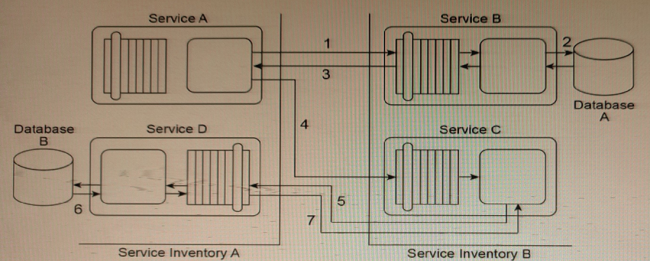
Service A sends a message to Service B (1). After Service B writes the message contents to Database A (2), it issues a response message back to Service A (3). Service A then sends a message to Service C (4). Upon receiving this message, Service C sends a message to Service D (5), which then writes the message contents to Database B (6) and issues a response message back to Service C (7).

Service A and Service D are located in Service Inventory A. Service B and Service C are located in Service Inventory B.

You are told that In this service composition architecture, all four services are exchanging invoice-related data in an XML format. However, the services in Service Inventory A are standardized to use a different XML schema for invoice data than the services in Service Inventory B. Also, Database A can only accept data in the Comma Separated Value (CSV) format and therefore cannot accept XML-formatted data. Database B only accepts XML-formatted data. However, it is a legacy database that uses a proprietary XML schema to represent invoice data that is different from the XML schema used by services in Service Inventory A or Service Inventory B.

What steps can be taken to enable the planned data exchange between these four services?

Select an option, then click Submit answer.

  • The Data Model Transformation pattern can be applied so that data model transformation logic is positioned between Service A and Service B, between Service C and Service D, and between the Service D logic and Database B. The Data Format Transformation pattern can be applied so that data format transformation logic is positioned between Service A and Service C, and between the Service B logic and Database A.

  • The Protocol Bridging pattern can be applied so that protocol conversion logic is positioned between the Service B logic and Database A. The Data Format Transformation pattern can be applied so that data format transformation logic is positioned between Service A and Service B, between Service A and Service C, between Service C and Service D, and between the Service D logic and Database B.

  • The Data Model Transformation pattern can be applied so that data model transformation logic is positioned between Service A and Service B, between Service A and Service C, between Service C and Service D, and between the Service D logic and Database B. The Data Format Transformation pattern can be applied so that data format transformation logic is positioned between the Service B logic and Database A.

  • The Protocol Bridging pattern can be applied so that protocol conversion logic is positioned between Service A and Service B, between Service A and Service C, and between Service C and Service The Data Format Transformation pattern can be applied so that data format transformation logic is positioned between the Service B logic and Database A and between the Service D logic and Database B.