C90.06 Cloud Architecture Lab

Loading demo links...

Showing 1–3 of 5 questions

Question 1

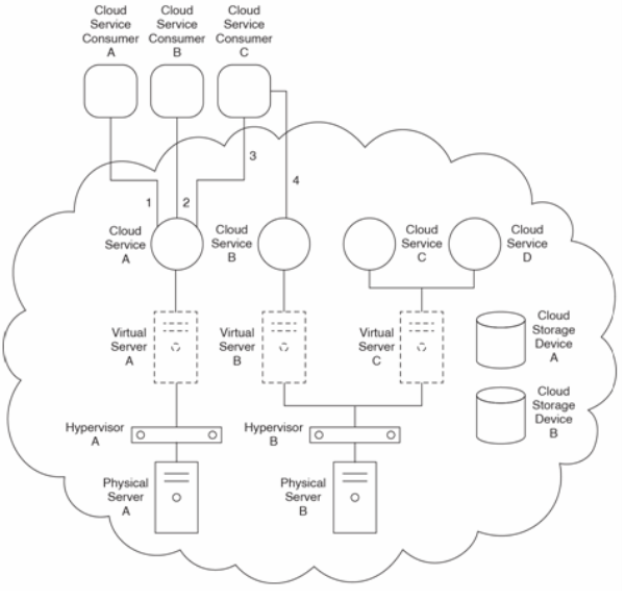
Cloud Sen/ice A is hosted by Virtual Server A, which is hosted by Hypervisor A on Physical Server A. Cloud Service B is hosted by Virtual Server B. Virtual Server C hosts Cloud Services C and D. Virtual Server B and Virtual Server C are hosted by Hypervisor B on Physical Server B.

Cloud Service Consumer A accesses Cloud Service A (1). Cloud Service Consumer B accesses Cloud Service A (2). Cloud Service Consumer C accesses Cloud Service A (3) and then accesses Cloud Service B (4).
C:\Documents and Settings\usernwz1\Desktop\1.PNG

Cloud Service Consumers A, B and C simultaneously access Cloud Service A. Cloud Service Consumer C receives a runtime exception and its request for access is rejected. It is determined that Cloud Service Consumer C attempted to upload a large amount of input data for Cloud Service A, which exceeded the bandwidth threshold of the virtual network. The cloud architecture needs to be improved to avoid this from happening again.

Cloud Service Consumer C's repeated access of Cloud Service B imposes workloads that are large and highly unpredictable. After some time, Cloud Service B begins to delay its responses and sometimes times out entirely. The cloud resource administrator discovers that Virtual Server B is unstable and close to failure primarily because its CPU and memory resources are being used to their maximum capacity.

Cloud Services C and D are being positioned as SaaS products for use by a range of cloud consumer organizations. After their initial release, they begin to quickly use up the available memory in Virtual Server C, primarily because of the large amounts of state and session data they need to place into memory for extended periods.

Which of the following statements lists the patterns that can be applied to solve these three requirements and problems?

Select an option, then click Submit answer.

  • Elastic Network Capacity, Load Balanced Virtual Server Instances, Service State Management

  • Elastic Resource Capacity, Service Load Balancing, Synchronized Operating State

  • Persistent Virtual Network Configuration. Load Balanced Virtual Switches, Service State Management

  • None of the above.

Question 2

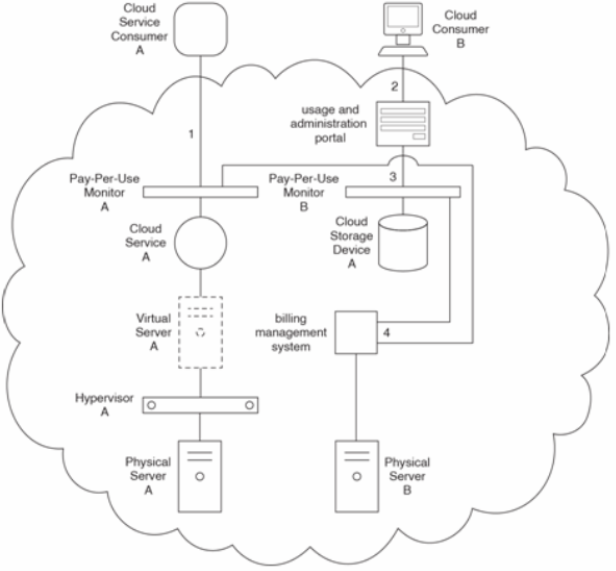
Cloud Service A is hosted by Virtual Server A, which is hosted by Hypervisor A that resides on Physical Server A. Cloud Storage Device A is used to store media library data that is continuously replicated with a redundant, secondary implementation of Cloud Storage A (not shown). Access to Cloud Service A is monitored by Pay-Per-Use Monitor A. Access to Cloud Storage Device A is monitored by Pay-Per-Use Monitor B. Pay-Per-Use Monitors A and B capture billing-related usage data that is forwarded to a billing management system that is hosted by Physical Server B.

Cloud Service Consumer A accesses Cloud Service A and the usage data is captured by Pay-Per-Use Monitor A (1). Cloud Consumer B accesses Cloud Storage Device A via a usage and administration portal that it uses to upload media data (2). This usage is captured by Pay-Per-Use Monitor B (3). Pay-Per-Use Monitors A and B store collected usage data in the billing management system (4), which is later used by the cloud provider to bill for the usage of Cloud Service A and Cloud Storage Device A.

C:\Documents and Settings\usernwz1\Desktop\1.PNG

Each service instance of Cloud Service A requires a virtual server with 2 virtual CPUs and 4 GBs of RAM at a package price of $2.00 for each initial invocation and an additional $0.50 for each consecutive 60 seconds of usage. Cloud Service Consumer A accesses Cloud Service A twice in one day. The two exchanges with Cloud Service A last 60 seconds and 120 seconds. For that one day, the organization that owns Cloud Service Consumer A is billed $6.50, which it determines is incorrect. After complaining to the cloud provider, it is discovered that the rapid provisioning system responsible for provisioning instances of Cloud Service A is not de-provisioning Cloud Service A when Cloud Service Consumer A indicates it has completed an exchange. Instead, Cloud Service A is de-provisioned after a 60 second timeout that occurs after Cloud Service Consumer A is completed with an exchange.

Storage space on Cloud Storage Device A can only be purchased in units of terabytes (TBs), with each TB costing $1 per day. Cloud Consumer B purchases 5 TBs of storage space on day 1 and stores 5 TBs of data on days 6 and 7. Cloud Consumer B was expecting to be billed $10.00, but is billed $35. After raising a complaint, Cloud Consumer B is informed by the cloud provider that cloud consumers are billed based on the allocation of storage space, regardless of how much storage space they actually use.

Which of the following statements describes a solution that can update the cloud architecture to avoid these billing-related problems and discrepancies?

Select an option, then click Submit answer.

  • The Pay-as-You-Go pattern can be applied together with the Usage Monitoring pattern to establish a monitoring and billing system capable of de-provisioning Cloud Service A instances when they are no longer required. The Dynamic Data Normalization pattern can be applied to eliminate any redundant data stored by Cloud Consumer A so that the amount of required storage space is minimized.

  • The Platform Provisioning pattern can be applied to create an intelligent automation script capable of immediately de-provisioning cloud service instances. The Redundant Storage pattern can be applied to introduce a secondary cloud storage device for which storage space can be billed based on actual usage.

  • The Self-Provisioning pattern can be applied to enable the organization that owns Cloud Service Consumer B to configure how and to what extent Cloud Service A instances need to be provisioned. The Resource Management pattern can be applied to establish a storage system that bills cloud consumers for actual storage space usage only.

  • None of the above.

Question 3

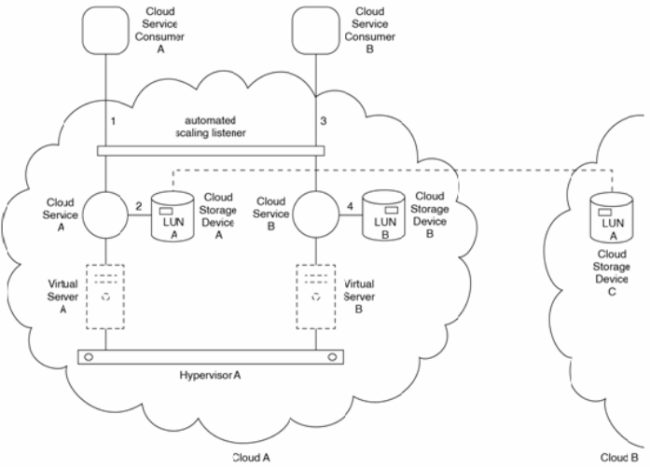
Cloud Service A is hosted by Virtual Server A. Cloud Storage Device A contains LUN A. Cloud Storage Device A is a multi-tiered cloud storage device with different types of disk groups that perform at different levels. LUN A is located in the disk group with the highest performance level. Cloud Service B is hosted by Virtual Server B. Virtual Servers A and B are hosted by HypervisorA, which is installed on a physical server (not shown) that resides in Cloud A. A redundant implementation of LUN A is replicated synchronously to Cloud Storage Device C. Cloud Storage Device C does not support multiple types of disk groups and resides in Cloud B, which is located in a different geographic region than Cloud A. Requests that cloud service consumers send to Cloud Services A and B are intercepted by an automated scaling listener responsible for initiating scaling activities.

C:\Documents and Settings\usernwz1\Desktop\1.PNG

Cloud Service Consumer A issues a request to Cloud Service A (1). To process the request, Cloud Service A accesses LUN Aon Cloud Storage Device A (2). Cloud Service Consumer B issues a request to Cloud Service B (3). To process the request, Cloud Service B accesses LUN B on Cloud Storage Device B (4).

When Cloud Service Consumer A accesses Cloud Service A, there is usually no noticeable performance fluctuation, even during peak usage periods. However, recently, Cloud Storage Device A became unexpectedly unavailable, requiring that Cloud Service A access LUN A on Cloud Storage Device C instead. During the following outage period for Cloud Storage Device A, Cloud Service Consumer A encounters inconsistent performance from Cloud Service A, including unusual delays that occur whenever the data requested by Cloud Consumer A isn't cached and Cloud Service A is required to retrieve the data from LUN A.

Which of the following statements describes a solution that can address this problem?

Select an option, then click Submit answer.

  • The Storage Maintenance Window pattern can be applied so that future outages of Cloud Storage Device A do not occur unexpectedly. The Resource Pooling and Resource Reservation patterns can be further applied to establish a resource pool on Cloud A that has resources reserved specifically for Cloud Service This will prevent other cloud service consumers, such as Cloud Service Consumer B, from competing for Cloud Service A's resources.

  • The Shared Resources pattern can be applied to prevent Cloud Service A from encountering performance issues when IT resources hosted by Hypervisor A are accessed by other cloud service consumers. The Cross-Storage Device Vertical Tiering pattern can be applied to enable Cloud Storage Device A to scale to a higher performance disk type when an outage occurs.

  • The Cloud Balancing pattern can be applied to enable Cloud Service A to switch over to Cloud Storage Device C if Cloud Storage Device A becomes unavailable. The Dynamic Data Normalization pattern can be further applied to streamline and reduce the quantity of the data being stored by LUN A within Cloud Storage Device A, so as to correspondingly reduce the performance impacts during high usage volumes.

  • None of the above.