C90.03 Cloud Technology Lab

Loading demo links...

Showing 4–5 of 5 questions

Question 4

The cloud service owner of Cloud Service A is evaluating Clouds X, Y and Z to determine which cloud environment can offer the greatest level of reliability. All three clouds are geographically dispersed across three separate time zones. As a result, each cloud experiences usage peaks at different times. Based on the metrics provided, the greater the usage of a cloud, the lower its reliability. When the cloud service owner complains to Cloud Provider A (the owner of all three clouds) that none of the clouds provide an adequate level of reliability, Cloud Provider A suggests a solution that increases resiliency.
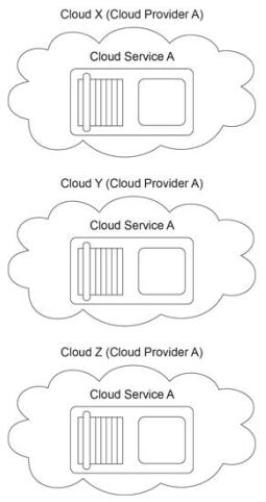
C:\Documents and Settings\user-nwz\Desktop\1.JPG

Which of the following statements accurately describes a solution that can be used to fulfill the resiliency requirements of Cloud Service A?

Select an option, then click Submit answer.

  • Redundant implementations of Cloud Service A are deployed in all three clouds. The failover system mechanism and a special type of automated scaling listener mechanism are implemented to establish a system whereby one redundant Cloud Service A implementation will automatically take over from another.

  • A cloud balancing solution is established, whereby an automated scaling listener mechanism is implemented on each cloud in such a way that every cloud can automatically scale out to another cloud. As a result, if reliability problems occur on any one cloud, the subsequent requests will be scaled out to another cloud in a manner that is transparent to cloud service consumers.

  • A failover system mechanism is implemented on Cloud X, which acts as the primary point of contact for cloud service consumers. Upon failure conditions occurring, the Cloud Service A implementation on Cloud X automatically hands over control of current and future message requests from cloud service consumers to Cloud Y. Cloud Y retains control of cloud service consumer communication until the next failure condition occurs, at which point it hands over control to Cloud Z. Finally, if a failure condition occurs in Cloud Z. control is handed back to Cloud X.

  • A cloud balancing solution is established, whereby a resource replication mechanism is implemented on each cloud. This allows Cloud Service A to be automatically replicated across cloud environments, thereby enabling each implementation of Cloud Service A to take the place of another, whenever failure conditions occur.
Question 5

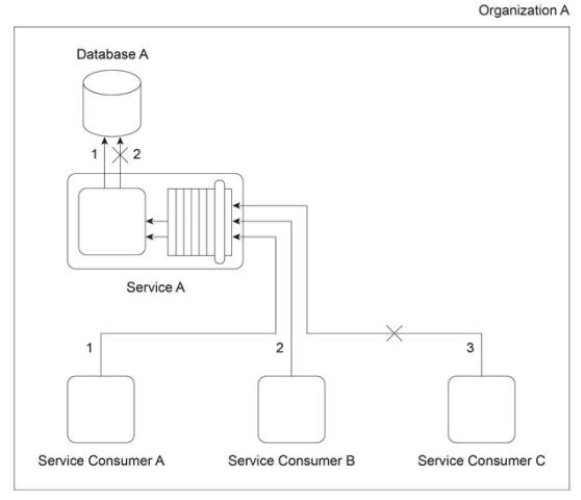
Organization A has been expanding and, as a result, is outgrowing the processing capacity of its on-premise Service A implementation. It is determined that this is due to usage thresholds of Service A and complex data processing limitations in Database A. The diagram depicts Organization A's current on-premise environment, where Service Consumers A. B and C attempt to access Service A at the same time. Service Consumer A successfully accesses Service A, which then successfully retrieves the requested data (1). Service Consumer B successfully accesses Service A, but due to the complex data structure, the request for the data times out and fails (2). Finally, Service Consumer C attempts to access Service A, but is rejected because Service A is unable to accept more concurrent requests.

C:\Documents and Settings\user-nwz\Desktop\1.JPG

Organization A is required to continue using its on-premise Service A implementation, with the exception of Database A, which does not need to remain on-premise. Database A is dedicated to Service A and is comprised of relational data. Which of the following statements provides a solution that uses cloud-based IT resources to solve the performance limitations of Service A and Database A?

Select an option, then click Submit answer.

  • A failover system can be implemented in a hybrid architecture comprised of Organization A's existing on-premise environment and a public cloud environment. The failover system would span both environments so that when Service A is unable to process request messages from Service Consumers A, B or C, the failover system can automatically route messages to a redundant implementation of Service A residing in the public cloud. Similarly, when Database A is unable to process a data access request from Service the failover system can automatically route this request to a redundant implementation of Database A, also residing in the public cloud.

  • The state management database and resource replication mechanisms can be implemented to establish redundant implementations of Service A and Database A in both on-premise and cloud environments. Using resource replication, a cloud-based duplicate of Service A (Cloud Service A) will be established in a public cloud and will remain in synch with Service A via regular replication cycles. Using the resource replication mechanism together with the state management database mechanism allows for Database A to be dynamically replicated in an independent state management database that has redundant implementations in both on-premise and cloud environments. The state management database can be further optimized to support non-relational data to improve data access performance.

  • A cloud bursting solution can be implemented, whereby a redundant copy of Service A is implemented within a public cloud. This cloud-based, redundant implementation of Service A is referred to as Cloud Service A. A copy of Database A is also implemented within the cloud and both the on-premise and cloud-based copies of Database A are redesigned to be non¬relational in order to improve data access performance. Service A continues to act as a first point of contact for Service Consumers A, B and An automated scaling listener is deployed so that when Service A's thresholds are met, requests are automatically routed to Cloud Service A.

  • None of the above