LSSMBB Lean Six Sigma Master Black Belt

Loading demo links...

Showing 4–6 of 15 questions

Question 4

If an experiment has 5 factors and no replicates for a 2-level Experimental Design with 16 experimental runs which statement(s) are correct? (Note: There are 3 correct answers).

Select all that apply, then click Submit answer.

  • The Main Effects for the 5 factors are not aliased or confounded but the 2-way interactions are confounded with the 3-way interactions

  • The Main Effects are confounded with only 4-way interactions

  • The Experimental Design is half-fractional

  • The experiment has 8 experimental runs with the first factor at the high level

  • The experiment has only 4 experimental runs with the 5th factor at the high level
Question 5

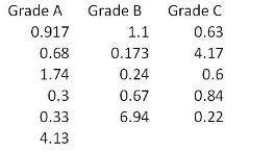
For the data shown here which statement(s) are true? (Note: There are 2 correct answers).

Select all that apply, then click Submit answer.

  • With 95% confidence, we cannot conclude if the samples are from three Normal Distributions.

  • With greater than 95% confidence, we conclude the samples are from Non-normal Distributions.

  • If we wanted to compare the Central Tendencies of these three samples we would use the one way ANOVA test.

  • If we wanted to compare the Central Tendencies of these three samples we could use Mood’s Median test.

Question 6

Choose those characteristics of a Simple Linear Regression (SLR) Analysis that are applicable. (Note: There are 3 correct answers).

Select all that apply, then click Submit answer.

  • The Correlation Coefficient is always greater than the Regression Coefficient in a SLR

  • General Regression Analysis deals only with Continuous Data

  • Non-linear Regressions can explain curvature when with more statistical confidence than Linear Regressions

  • SLR can help quantify the significance of variation in X that influences the variation in Y via a mathematical equation

  • A Correlation does not explain causation but a Regression Analysis with a statistically valid mathematical equation does explain causation