1z0-493 Oracle Communications Order and Service Management Server 7 Implementation Essentials

Loading demo links...

Showing 4–6 of 10 questions

Question 4

You have configured the following process flow in your OSM. Identify two possible outcomes of this process.
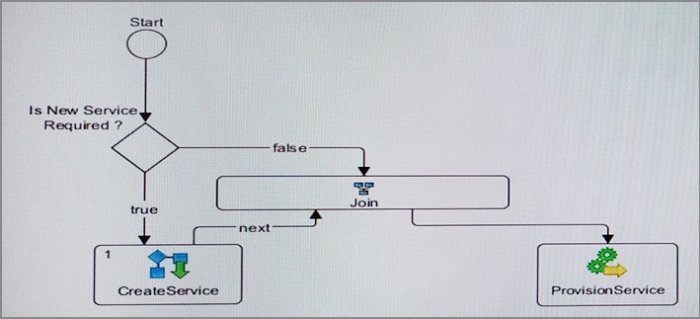
Select all that apply, then click Submit answer.

  • When the Join Type configuration of the Join element is set to ALL, the ProvisionService task will never be executed.

  • The Join Type configuration of the Join element must be set to ALL for the process to execute correctly.

  • The Join element can be eliminated from the process and the same logic can be implemented with the remaining elements.

  • The “Is New Service Required?” element can have as many exit flows as needed, if the use case logic requires it.

  • There would be an error if the “Next” transition is substituted by a transition without status.

Question 5

You detect some performance issues during the execution of a load test in an environment that will be used to fulfill a large number of orders in a given day. Which three resources should you check and re-configure in your Oracle WebLogic Server console in order to provide better performance to this environment?

Select all that apply, then click Submit answer.

  • database connections

  • threads

  • users and groups

  • JMS queues

  • deployments

Question 6

Which statement is true about the System Events feature in the OSM Administrator application?

Select an option, then click Submit answer.

  • It is a placeholder to display and manage notifications about Oracle WebLogic Server performance at regular intervals.

  • It is a placeholder to display and manage notifications about OSM Database performance at regular intervals.

  • It is a placeholder to display the list of orders in which exceptions are noted during processing of rules.

  • It is a placeholder to display and manage notifications about OSM Server performance at regular intervals.

  • It is a placeholder to display the list of cartridges that failed during deployment to the OSM Server.