1z0-082 Oracle Database Administration I

Loading demo links...

Showing 1–3 of 10 questions

Question 1

Examine the description of the BOOKS table:
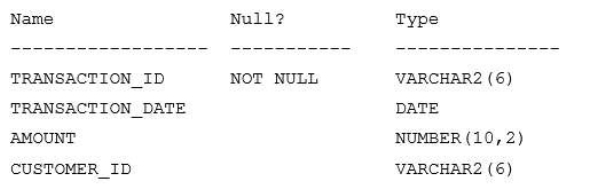
The table has 100 rows.

Examine this sequence of statements issued in a new session:

INSERT INTO books VALUES (‘ADV112’, ‘Adventures of Tom Sawyer’, NULL,

NULL);

SAVEPOINT a;

DELETE FROM books;

ROLLBACK TO SAVEPOINT a;

ROLLBACK;

Which two statements are true? (Choose two.)

Select all that apply, then click Submit answer.

  • The second ROLLBACK command does nothing

  • The second ROLLBACK command replays the delete

  • The first ROLLBACK command restores the 101 rows that were deleted, leaving the inserted row still to be committed

  • The second ROLLBACK command undoes the insert

  • The first ROLLBACK command restores the 101 rows that were deleted and commits the inserted row

Question 2

Which three statements are true about the Oracle join and ANSI join syntax? (Choose three.)

Select all that apply, then click Submit answer.

  • The Oracle join syntax supports creation of a Cartesian product of two tables

  • The Oracle join syntax performs better than the SQL:1999 compliant ANSI join syntax

  • The SQL:1999 compliant ANSI join syntax supports natural joins

  • The SQL:1999 compliant ANSI join syntax supports creation of a Cartesian product of two tables

  • The Oracle join syntax only supports right outer joins

  • The Oracle join syntax supports natural joins

  • The Oracle join syntax performs less well than the SQL:1999 compliant ANSI join syntax

Question 3

Which two statements are true about single row functions? (Choose two.)

Select all that apply, then click Submit answer.

  • MOD : returns the quotient of a division operation

  • FLOOR : returns the smallest integer greater than or equal to a specified number

  • TRUNC : can be used with NUMBER and DATE values

  • CONCAT : can be used to combine any number of values

  • CEIL : can be used for positive and negative numbers