1z0-070 Oracle Exadata X5 Administration

Loading demo links...

Showing 4–6 of 10 questions

Question 4

Which two statements are true about the use of Intelligent Platform Management Interface (IPMI) on an X5 or X6 Database Machine?

Select all that apply, then click Submit answer.

  • IPMI can be used for server configuration and management on each database server.

  • The Baseboard Management Controller (BMC), which supports IPMI, runs as a multithreaded process on the storage server O/S.

  • The Baseboard Management Controller (BMC), which supports IPMI, runs as a singlethreaded process on the storage server O/S.

  • IPMI can be used for server configuration and management on each storage server.
Question 5

Which three statements are true about bulk data loading capabilities in an X5 Database Machine environment?

Select all that apply, then click Submit answer.

  • DBFS must use the DBFS_DG diskgroup for any DBFS store.

  • DBFS may be used if Exadata-based shared storage is required to stage data before bulk loading into a database.

  • DBFS must be used to have a POSIX-compliant shared storage solution that is accessible from the database servers on a Database Machine.

  • DBFS must be used to bulk load data into a production database on the Database Machine.

  • ACFS may be used if Exadata-based shared storage is required to stage data before bulk loading into a database.

  • ACFS must be used to have a POSIX–compliant shared storage solution that is accessible from the database servers on a Database Machine.

  • ACFS may use the DBFS_DG diskgroup to contain the ADVM volume file.

Question 6

You are in the process of upgrading your X5 Database Machine half rack to a full rack.

The new storage servers are called DM01CEL08 through DM01CEL14.

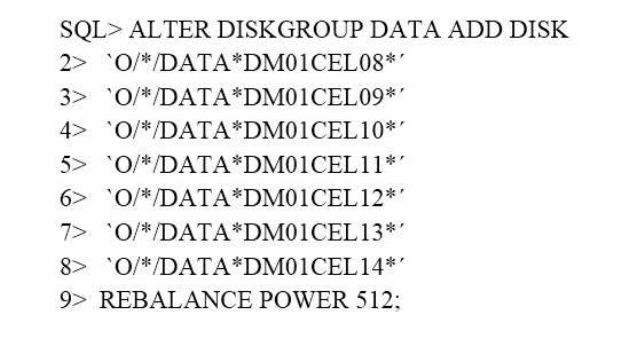
After creating 96 new griddisks, you issued this SQL statement:

How many failgroups if any, will be added to the DATA diskgroup by executing this SQL statement?

Select an option, then click Submit answer.

  • 0, because the new griddisks will be added to the existing failgroups

  • 12, consisting of seven griddisks each

  • 96, consisting of seven griddisk each

  • 7, consisting of 12 griddisks each

  • 1, consisting of all 96 griddisks